
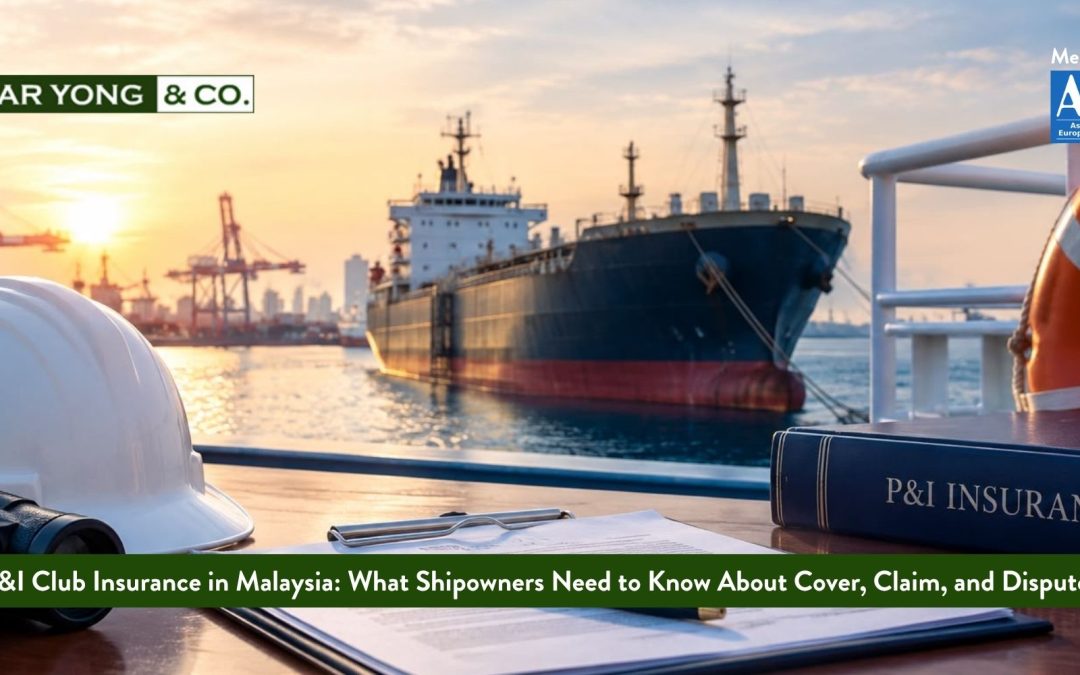
Protection and Indemnity (P&I) insurance is the cornerstone of a shipowner’s liability insurance programme. Unlike hull and machinery insurance — which covers physical damage to the vessel itself — P&I insurance covers the shipowner’s third-party liabilities arising from the operation of the vessel. A shipowner without adequate P&I cover is exposed to unlimited personal liability for cargo claims, collision damage, crew injuries, oil pollution, wreck removal, and a wide range of other maritime claims that can quickly reach figures far beyond the value of the vessel itself.
P&I insurance is provided by P&I Clubs — mutual insurance associations owned by their shipowner members. The International Group of P&I Clubs, whose members collectively insure approximately 90% of the world’s ocean-going tonnage, sets the framework within which most P&I coverage is structured. Malaysian shipowners typically obtain P&I cover from one of the International Group clubs — including Gard, Steamship Mutual, UK P&I Club, North P&I, West of England, and others — or from non-Group commercial P&I insurers for vessels that do not qualify for Group membership.
In Malaysia, P&I cover is compulsory for certain categories of vessel under the Merchant Shipping Ordinance 1952 — including oil tankers (required to carry CLC insurance), vessels subject to the Bunkers Convention, and passenger vessels. For most commercial vessels, P&I cover is not legally compulsory but is commercially essential: without it, a shipowner cannot obtain release from a ship arrest without providing alternative security of equivalent value.
Understanding the scope of P&I cover — what is included, what is excluded, and what conditions must be met for the Club to respond — is critical for every shipowner. Conditions of cover are strict, and late notification or failure to follow Club requirements can result in the Club declining to respond to a claim.
Key Areas of P&I Club Cover Relevant to Malaysian Operations
-
Cargo claims: P&I covers the shipowner’s liability for loss, damage, or short delivery of cargo under the bill of lading. The one-year Hague Rules time bar applies — the shipowner must notify the Club promptly on receiving any cargo claim.
-
Collision liability (3/4ths): P&I covers the 3/4 of collision liability not covered by hull insurance under the Running Down Clause. The remaining 1/4 is covered under hull insurance — but only if the hull policy includes RDC.
-
Crew injury and illness: Medical expenses, repatriation, death and disability compensation for crew members are covered under P&I — subject to MLC 2006 minimum standards and the terms of the SEA.
-
Oil pollution liability: P&I covers liability for oil pollution damage, including clean-up costs, third-party claims, and CLC certificate backing — up to the International Group’s pooling and excess reinsurance limits.
-
Wreck removal: P&I typically covers wreck removal costs ordered by a competent authority, subject to sub-limits that vary by Club.
Frequently Asked Questions: P&I Club Cover in Malaysia
Q: What is the difference between P&I cover and hull insurance?
A: Hull and machinery (H&M) insurance covers physical damage to the vessel itself — the cost of repairs after a collision, grounding, fire, or other marine peril. P&I (Protection and Indemnity) insurance covers the shipowner’s liability to third parties — cargo owners, other vessels, port authorities, seafarers, and pollution victims — arising from the operation of the vessel. The two policies are complementary: hull insurance pays to repair the ship; P&I insurance pays the claims of those damaged by the ship. In a collision scenario, hull insurance pays for damage to the insured vessel (and, under the Running Down Clause, 3/4 of the liability to the other vessel), while P&I covers the remaining 1/4 of liability to the other vessel plus any cargo liability, crew injury claims, and environmental damage arising from the same incident. Every commercially operated vessel needs both — hull insurance without P&I leaves a vast exposure, and P&I without hull insurance leaves the vessel itself uninsured.
Q: What conditions must I meet for my P&I Club to respond to a claim?
A: P&I Club rules impose a number of conditions that must be met for the Club to respond to a claim. The most important are: prompt notification — most Club rules require the owner to notify the Club of any incident, claim, or circumstance likely to give rise to a claim as soon as practicable. Late notification can give the Club grounds to reduce or refuse indemnity where the delay has prejudiced the Club’s ability to investigate and manage the claim. No admission of liability — the owner must not admit liability, make settlements, or incur recoverable expenses without the Club’s prior approval. Settlement without Club approval may not be reimbursed. Cooperation — the owner must cooperate fully with the Club’s appointed solicitors, surveyors, and correspondents, and provide all relevant information and documents on request. Compliance with Club rules — the vessel must have been maintained in a seaworthy condition, operated in compliance with applicable regulations, and crewed in accordance with the vessel’s Safe Manning Certificate. Non-compliance with these conditions is the most common reason for Club coverage disputes.
Q: My P&I Club is disputing my claim — what are my options?
A: Disputes between shipowners and their P&I Clubs are resolved under the Club’s own rules, which typically specify arbitration in London as the dispute resolution mechanism — reflecting the English law basis of most Club rules. A shipowner who believes the Club has wrongly declined to respond to a legitimate claim has the following options: first, make a formal written complaint to the Club’s Board or Managers, clearly setting out the grounds for disputing the decision; second, if internal escalation does not resolve the matter, commence arbitration proceedings under the Club’s rules — this is typically the contractually mandated dispute resolution mechanism; and third, engage a maritime lawyer experienced in P&I Club disputes to assess the strength of the claim and manage the arbitration or negotiation process. Disputes with P&I Clubs are specialised matters that require both maritime law expertise and detailed knowledge of Club rule interpretation — general insurance lawyers may not have the relevant experience.
Q: Can a cargo owner or third party sue my P&I Club directly?
A: Generally no — P&I Club cover is a contract of indemnity between the Club and the shipowner member, not a direct liability insurance policy in favour of third parties. A cargo owner or collision victim cannot typically sue the P&I Club directly under Malaysian law — their claim lies against the shipowner. The P&I Club then indemnifies the shipowner for the established liability. However, there are important exceptions. For oil pollution claims, the CLC Convention (implemented in Malaysia through Act 515) specifically requires tankers to carry compulsory CLC insurance and grants direct action rights to pollution victims against the insurer — meaning oil pollution claimants can sue the P&I Club directly. For seafarer wage and abandonment claims, the MLC 2006 financial security mechanism similarly provides a route for seafarers to access P&I Club cover directly where the shipowner has defaulted. Outside these specific conventions, direct action against the P&I Club is generally not available.
Q: My vessel is under arrest in Malaysia. Can my P&I Club provide a Letter of Undertaking to secure its release?
A: Yes — and the P&I Club Letter of Undertaking (LOU) is the most common and most efficient mechanism for securing the release of an arrested vessel in Malaysian admiralty proceedings. An LOU is a written undertaking from the P&I Club (or its local correspondent) to pay any judgment or settlement up to a specified amount, in lieu of the vessel remaining under arrest. The Malaysian Admiralty Court accepts P&I Club LOUs from International Group Clubs as adequate security for most types of maritime claim — allowing the vessel to be released from arrest and returned to trade while the underlying dispute is resolved. The amount of the LOU is negotiated between the parties, typically at the level of the claimant’s reasonable estimate of their claim including interest and costs. For arrests arising from claims not covered by P&I (such as hull damage claims), alternative security — a bank guarantee or cash deposit — will be needed instead. A maritime lawyer can negotiate the LOU terms and manage the release process efficiently.
About the Author: Mr. Yong Chee Kong

Yong Chee Kong is an experienced Advocate & Solicitor with over three decades of legal experience, with principal areas of practice in Corporate Law and Shipping & Maritime Law. Called to the Bar in 1995, he has advised shipping companies, developers, financial institutions, and corporate entities on complex legal matters, including shipping disputes, development projects, project financing, mergers, takeovers, and acquisitions.
As a seasoned litigation lawyer, Yong Chee Kong regularly appears before the High Court, Court of Appeal, and Federal Court of Malaysia. His broad experience also extends to Banking, Finance, and Construction Law, enabling him to advise clients across a range of complex commercial and corporate matters.
Beyond legal practice, he is a registered Patent, Trade Marks and Industrial Design agent, as well as a Commissioner for Oaths and Notary Public. He has also served as a member of the Bar Council Disciplinary Committee and chaired numerous disciplinary investigations involving members of the Malaysian Bar.
His academic and professional qualifications include an LL.B (Hons) from the University of London, a Certificate in Legal Practice from University Malaya, and successful completion of the Patent Agent Examination conducted by the Intellectual Property Corporation of Malaysia.
-
Expertise: Corporate Law, Shipping & Maritime Law, Banking & Finance, Construction Law, Commercial Litigation, Intellectual Property
-
Professional Experience: 30+ years
-
Called to the Bar: High Court of Malaya, 1995
-
Professional Roles: Patent, Trade Marks & Industrial Design Agent; Commissioner for Oaths; Notary Public
Offshore Vessel Disputes in Malaysia: What OSV Owners and Operators Need to Know
Malaysia's offshore oil and gas industry — anchored by PETRONAS and its production sharing contract (PSC) partners — is the largest single driver of demand for offshore support vessels (OSVs) in the country. Anchor handling tug supply vessels (AHTS), platform supply...
What Happens When a Shipyard Delays Delivery? Your Legal Rights in Malaysia
Delivery delays are the most common disputes in shipbuilding. When a yard fails to deliver a vessel by the contractual date — even accounting for permitted extensions — the buyer has clearly defined legal rights. The challenge is exercising them correctly, within the...
Shipbuilding Contracts in Malaysia: A Complete Legal Guide for Buyers and Shipyards
Malaysia has a significant and growing shipbuilding and ship repair industry. Major shipyards operate at Pulau Indah (Port Klang), Pasir Gudang (Johor), Penang, Labuan, and along the Sarawak coast — building offshore support vessels, tugs, barges, tankers, and...
US Tariffs and Malaysian Shipping in 2025: What Maritime Businesses Need to Know
The US tariff announcements of 2025 have created significant disruption to international trade flows — and Malaysian maritime businesses are directly in the crosshairs. Malaysia's export-driven economy, with major shipments of electronics, palm oil, rubber, LNG, and...
Court of Appeal Rules Vessel Arrest Invalid as Fuel Supply Did Not Qualify for Admiralty Jurisdiction
Meck Petroleum DMCC v International Bird Shipping Co. Inc. — Court of Appeal of Malaysia, Civil Appeal No. W-02(IM)(ADM)-1169-07/2024 A recent decision from the Court of Appeal of Malaysia offers a useful reminder for fuel suppliers, shipowners, and charterers alike:...
Wreck Removal in Malaysia: Who Pays When a Vessel Sinks?
When a vessel sinks, grounds, or is abandoned in Malaysian waters, the consequences extend far beyond the loss of the ship itself. A sunken wreck can obstruct navigation, damage port infrastructure, pollute the marine environment, and create a hazard for other vessels...