
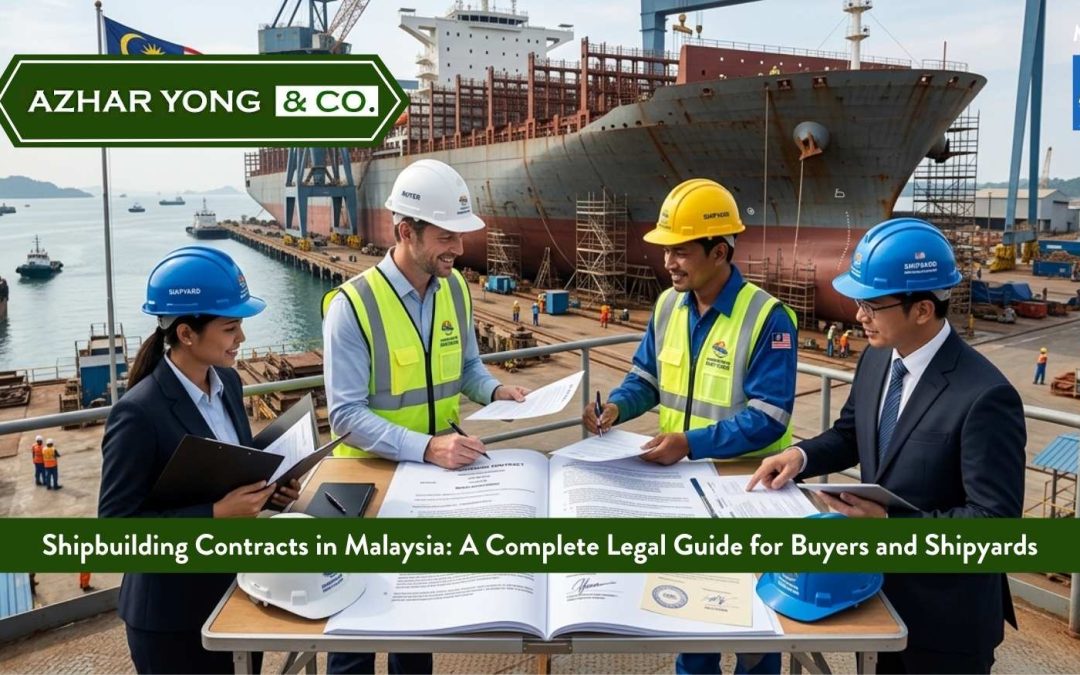
Malaysia has a significant and growing shipbuilding and ship repair industry. Major shipyards operate at Pulau Indah (Port Klang), Pasir Gudang (Johor), Penang, Labuan, and along the Sarawak coast — building offshore support vessels, tugs, barges, tankers, and specialist marine craft for both domestic and international buyers. Boustead Naval Shipyard, Malaysia Marine and Heavy Engineering (MMHE), and Sapura Marine are among the larger operators, alongside numerous mid-size and specialised yards.
Shipbuilding transactions are high in value and high in risk. A shipowner who pays instalments totalling millions of dollars over a two-year construction period is entirely dependent on the yard completing a vessel that meets the agreed specifications — and delivering it on time. A shipyard, in turn, is exposed to volatile steel and equipment prices, supply chain disruptions, and the risk of a buyer who defaults or makes unreasonable demands during construction. When disputes arise — over delayed delivery, defective construction, refusal to accept the vessel, or unpaid instalments — the legal and financial consequences can be severe for both sides.
This guide explains the legal framework governing shipbuilding contracts in Malaysia, the key contractual provisions that drive most disputes, the most common categories of dispute, and the legal remedies available to both buyers and yards when things go wrong.
The Legal Framework for Shipbuilding Contracts in Malaysia
Unlike charterparties — which are governed by well-established bodies of international maritime law — shipbuilding contracts are primarily governed by domestic contract law. In Malaysia, the foundational legislation is the Contracts Act 1950, which sets out the general principles of contract formation, performance, breach, and remedies. The Sale of Goods Act 1957 also applies to the supply of the vessel itself, imposing implied conditions as to quality and fitness for purpose.
There is no Malaysian-specific shipbuilding legislation. Standard international forms are used — the most common in the Asian market being the SAJ Form (developed by the Shipbuilders’ Association of Japan), which is widely adapted by Korean and Chinese yards, and the NEWBUILDCON (published by BIMCO in 2012), which is increasingly used for commercial newbuildings. Malaysian yards sometimes use bespoke contract forms, particularly for government or PETRONAS-related vessel construction.
Most commercial shipbuilding contracts specify English law as the governing law and London arbitration as the dispute resolution forum — reflecting the influence of English maritime law and the dominance of the LMAA for resolving shipping disputes. However, contracts involving Malaysian yards, Malaysian buyers, or Malaysian government contracts may specify Malaysian law and AIAC (formerly KLRCA) arbitration, or provide for disputes to be resolved in the Malaysian courts.
Where a shipbuilding contract is silent on governing law, a Malaysian court will determine the applicable law based on the closest and most real connection to the contract — which in most cases will be the law of the country where the yard is located, and the vessel is being built.
The Structure of a Shipbuilding Contract: Key Provisions
A well-drafted shipbuilding contract will address a comprehensive range of technical, commercial, and legal issues. The key provisions that most commonly drive disputes are:
1. Vessel Specification
The technical specifications — setting out the vessel’s dimensions, capacity, speed, fuel consumption, machinery, class, and equipment — are the central commercial document. Disputes frequently arise over whether the delivered vessel meets the specification, particularly for speed and fuel consumption warranties where the buyer claims the vessel underperforms. The specification is typically attached as an annex to the contract and must be read together with the main terms.
2. Instalment Payment Structure
Shipbuilding contracts typically require payment in a series of instalments tied to construction milestones — steel cutting, keel laying, launching, and delivery being the standard markers. The total contract price is split between these milestones, with the final (and usually largest) instalment payable at delivery. The buyer’s obligation to pay each instalment is typically a condition that must be fulfilled before the yard is obliged to proceed to the next stage. Non-payment of an instalment can entitle the yard to suspend construction and ultimately terminate the contract.
3. Refund Guarantee
Because the buyer pays instalments before receiving the vessel, virtually all shipbuilding contracts require the yard to procure a refund guarantee from an acceptable bank — an on-demand bank guarantee that secures the return of the buyer’s pre-delivery payments if the contract is cancelled due to the yard’s default or insolvency. The refund guarantee is one of the most heavily litigated documents in shipbuilding — disputes arise over whether the buyer’s cancellation was valid, whether the guarantee is truly on demand, and whether the guarantor bank can resist payment.
Under Malaysian law, a properly structured demand guarantee must be paid upon a complying demand, without the guarantor being entitled to raise defences from the underlying contract. However, a guarantee that is structured as a conditional guarantee (payable only if the buyer establishes the yard’s breach) may allow the guarantor to contest the demand. The distinction is critical and must be determined by careful analysis of the guarantee wording.
4. Delivery Date and Extensions
The contract fixes a delivery date — and sets out the circumstances in which the yard is entitled to an extension of that date. Standard extension provisions cover force majeure events (storms, floods, industrial action, equipment shortages), delays caused by the buyer’s own conduct (late approvals of drawings, unreasonable inspection requirements), and permissible changes to the specification that require additional construction time.
Delays that are not covered by an extension provision are the yard’s responsibility. The buyer’s primary remedy for non-permissible delay is liquidated damages at the rate specified in the contract — typically expressed as a daily rate capped at a percentage of the contract price. Once the delay exceeds the cap, the buyer is generally entitled to cancel the contract and claim a refund.
5. Acceptance and Rejection
Delivery is the critical moment of the transaction — it transfers title and risk from the yard to the buyer, and triggers the final instalment payment. The acceptance process typically involves sea trials, inspection of the vessel against the specification, and the signing of a Protocol of Delivery and Acceptance. A buyer who wrongly refuses to accept a vessel that complies with the specification — or who delays acceptance unreasonably — may be in breach of contract, exposing itself to termination and forfeiture of instalments already paid.
6. Post-Delivery Warranty
Most shipbuilding contracts include a warranty period — typically 12 months from delivery — during which the yard is obliged to rectify at its own cost any defects attributable to defective materials or workmanship. Post-delivery warranty disputes are common: yards dispute whether defects are within the warranty scope or caused by the buyer’s operation of the vessel; buyers dispute whether rectification has been properly completed.
The Most Common Shipbuilding Disputes in Malaysia
1. Delivery Delay and Cancellation
By far the most common category of shipbuilding dispute. Where a yard fails to deliver by the contractual date — even allowing for permitted extensions — the buyer’s entitlement to liquidated damages and ultimately to cancel the contract must be carefully managed. Yards frequently argue that delays were caused by buyer-related conduct (late approvals, specification changes) or force majeure, which complicates the buyer’s right to cancel. Time bar provisions in extension of time clauses — requiring notices to be given within days or weeks of the triggering event — are critically important and frequently missed.
2. Defective Vessel — Rejection at Delivery
A buyer who believes the vessel does not comply with the specification may refuse to accept delivery. This is a high-risk strategy: if the tribunal finds the rejection was unjustified, the buyer will have forfeited its instalments and may face a damages claim from the yard. A buyer who genuinely identifies non-compliance should take specialist legal and technical advice before refusing delivery, and should ensure that any refusal is properly documented and communicated within the contractual framework.
3. Refund Guarantee Calls
Where a contract is cancelled by the buyer for yard default, the buyer typically calls the refund guarantee. Yards and their guarantor banks may seek to resist payment — through injunctions in the courts of the guarantor bank’s jurisdiction — arguing that the cancellation was wrongful or that the demand was made fraudulently. Malaysian courts have shown a strong reluctance to grant injunctions preventing payment under on-demand guarantees, consistent with the principle that the commercial utility of such guarantees depends on their being payable without dispute of the underlying contract.
4. Price Escalation and Variation Disputes
Where market prices for steel, equipment, or labour increase significantly during a construction period, yards sometimes seek to renegotiate the contract price — or claim that specification changes requested by the buyer justify additional payment. Variation orders that are not properly documented and agreed in writing can give rise to significant disputes about what was actually contracted for and at what price.
5. Defects Discovered After Delivery — Warranty Claims
Post-delivery warranty claims require the buyer to give notice of any defect within the warranty period and in the correct form specified by the contract. Failure to give timely or proper notice can defeat an otherwise valid warranty claim. The yard’s obligation to rectify under warranty does not extend to defects caused by the buyer’s negligence or improper operation — a common source of dispute for vessels that develop problems after a period of use.
Resolving Shipbuilding Disputes in Malaysia
The dispute resolution mechanism specified in the contract determines the forum for any dispute. Most commercial shipbuilding contracts specify arbitration — often London arbitration under LMAA rules, or AIAC arbitration for contracts with Malaysian parties. Where no arbitration clause exists, disputes may be litigated in the Malaysian courts — typically the Admiralty Court in Kuala Lumpur for disputes with a maritime dimension, or the Commercial Division of the High Court for purely contractual claims.
One important point: the existence of an arbitration clause does not prevent either party from applying to a court for urgent interim relief — including an injunction to prevent the calling of a refund guarantee, or an order compelling the yard to continue construction pending arbitration. Malaysian courts have jurisdiction to grant such relief under the Arbitration Act 2005, even where the seat of arbitration is outside Malaysia.
For pre-delivery disputes where timing is critical — a buyer who needs a defect rectified before a contractual delivery date — some contracts provide for expedited arbitration with a hearing within a fixed number of weeks. This mechanism, where available, can be transformative: it allows the tribunal to rule on the defect while there is still time to require rectification, rather than leaving the buyer with only a damages claim after delivery.
How Azhar Yong & Co. Can Help
Azhar Yong & Co. advises both buyers and shipyards on the full spectrum of shipbuilding contract issues — from contract drafting and negotiation through to dispute resolution and enforcement. Our specific capabilities include:
-
Reviewing and advising on shipbuilding contract terms before signature — identifying onerous provisions, missing protections, and deficient dispute resolution clauses.
-
Advising buyers on delivery delay claims, the calculation of liquidated damages, and the procedure for exercising cancellation rights correctly.
-
Advising on the validity and enforceability of refund guarantees under Malaysian law, and managing refund guarantee calls.
-
Advising yards on extension of time claims, legitimate grounds for resisting cancellation, and the procedure for terminating contracts where buyers default.
-
Representing buyers and yards in AIAC and LMAA arbitrations arising from shipbuilding disputes.
-
Applying to the Malaysian courts for urgent interim relief in connection with shipbuilding disputes, including injunctions and vessel arrest.
Final Thoughts: Know Your Contract Before You Sign
A shipbuilding contract signed without careful legal review is a risk that no buyer or yard should take. The standard forms used in the industry — SAJ, NEWBUILDCON, and bespoke yard forms — are dense, technically complex documents that allocate significant financial risks between the parties. The instalment structure, the extension of time provisions, the refund guarantee terms, and the dispute resolution clause can all have enormous consequences if a dispute arises.
The time to understand a shipbuilding contract is before signature — not after a dispute has crystallised. And when a dispute does arise, the time to engage a specialist maritime lawyer is immediately — because in shipbuilding disputes, as in all areas of maritime law, notice periods and time bars are strictly enforced, and delay in taking legal advice can mean losing rights that could otherwise have been protected.
Ship Arrest in East Malaysia: Sabah, Sarawak, and Labuan — What You Need to Know!
Most people in the maritime industry know that Malaysia has a well-established ship arrest regime — centred on the Admiralty Court in Kuala Lumpur, operating 24 hours a day under Order 70 of the Rules of Court 2012. What is less well understood is that ship arrest in...
Maritime Cyber Security in Malaysia: IMO Requirements and Legal Liability for Shipowners
A ransomware attack locks your vessel's bridge navigation systems at sea. A phishing email compromises your cargo booking platform. A GPS spoofing attack sends your vessel off course in the Strait of Malacca. Maritime cyber attacks are no longer hypothetical — they...
Malaysia’s Merchant Shipping Ordinance 2026: Key Changes Every Shipowner Must Know
The Merchant Shipping Ordinance 1952 (MSO 1952) has been the bedrock of Malaysian maritime law for over 70 years. It governs vessel registration, seafarer employment, casualty investigation, limitation of liability, port operations, and a vast range of other maritime...
Container Loss at Sea: Legal Rights When Your Cargo Goes Overboard in Malaysian Waters
Container loss overboard — where containers are lost from a vessel's deck during heavy weather or vessel instability — is a significant and growing problem in international shipping. High-profile incidents, including the loss of hundreds of containers from major...
Ship Recycling in Malaysia: Legal Framework and What Shipowners Need to Know
Ship recycling — the dismantling and scrapping of end-of-life vessels — is a significant industry in the Asia-Pacific region. In Malaysia, ship breaking and recycling activities are conducted at yards in Pulau Indah (Port Klang), Pasir Gudang (Johor), and along the...

Maritime Liens in Malaysia: Priority Claims Against Vessels and How to Enforce Them
A maritime lien is a privileged security interest that arises automatically by operation of law against a vessel when certain defined claims are incurred. Unlike a registered ship mortgage — which requires formal registration to be effective — a maritime lien arises...