
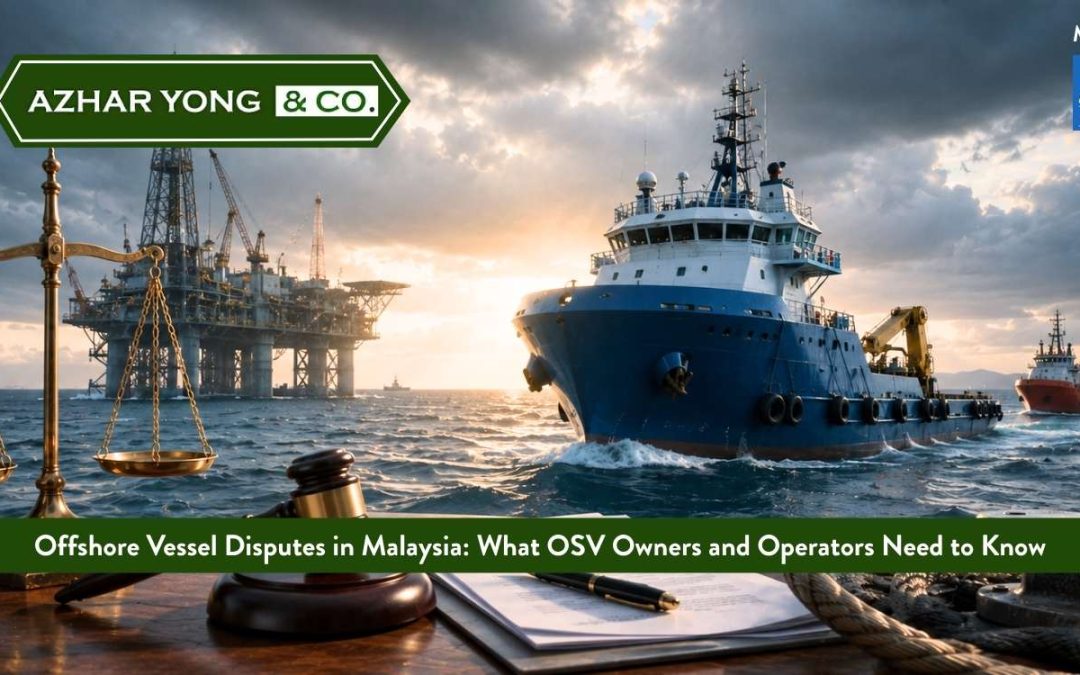
Malaysia’s offshore oil and gas industry — anchored by PETRONAS and its production sharing contract (PSC) partners — is the largest single driver of demand for offshore support vessels (OSVs) in the country. Anchor handling tug supply vessels (AHTS), platform supply vessels (PSV), accommodation vessels, crane barges, and pipe-lay vessels are all essential to upstream operations in the South China Sea, and their deployment is governed by a complex web of contracts, regulations, and legal obligations.
Most OSV contracts in Malaysia are structured as time charters or bareboat charters, with rates, performance specifications, and maintenance obligations negotiated against a backdrop of PETRONAS standard contracting terms. Unlike conventional commercial shipping, offshore vessel contracts often include additional regulatory requirements — Cabotage Policy compliance, the requirement for Malaysian-flagged vessels on certain routes, PETRONAS-specific safety management system certifications, and adherence to offshore safety legislation under the Petroleum (Safety Measures) Act 1984.
Disputes in the offshore sector arise from many of the same triggers as conventional charterparty disputes — unpaid hire, off-hire claims, and premature termination — but with additional complexity. Contract termination for convenience clauses (common in PETRONAS and oil major contracts) give the charterer a unilateral right to terminate with notice, but do not necessarily extinguish the owner’s right to damages for loss of the bargain. Disputes over whether maintenance deficiencies justify off-hire or termination are particularly frequent, given the demanding operational environment.
Malaysia’s Cabotage Policy — requiring that domestic maritime transport be conducted by Malaysian-registered, Malaysian-crewed, and majority Malaysian-owned vessels — adds a further layer of legal complexity for foreign OSV owners seeking to operate in Malaysian waters. Cabotage exemptions are available for specialised vessels where no qualifying Malaysian tonnage exists, but the exemption regime is regularly updated and must be monitored closely.
Common Legal Issues in Malaysian Offshore Vessel Contracts
-
Termination for convenience: Most PETRONAS and oil major contracts permit termination on notice. But ‘termination for convenience’ does not eliminate the owner’s right to compensation for losses that flow from the early termination — a distinction frequently overlooked by charterers.
-
Off-hire disputes: Maintenance defects and vessel downtime are frequent triggers for off-hire deductions. Whether a specific event qualifies as off-hire depends entirely on the charter wording — not the severity of the defect or downtime.
-
Cabotage compliance: Operating a non-qualifying vessel in Malaysian domestic waters without a valid exemption is a criminal offence under the Merchant Shipping Ordinance 1952. Cabotage status must be confirmed before vessel deployment.
-
PETRONAS standard terms: PETRONAS contracts contain onerous indemnity and liability provisions — including knock-for-knock regimes and broad intellectual property and confidentiality obligations — that require careful review before signature.
-
Abandonment and crew welfare: Where an OSV operator becomes insolvent or abandons a vessel, the MLC 2006 obligations to the crew — wages, repatriation, medical care — fall on the registered owner and P&I Club.
Frequently Asked Questions: Offshore Vessel Disputes in Malaysia
Q: Can PETRONAS terminate an OSV charter at will, and must it pay compensation?
A: Most PETRONAS and oil major charter contracts contain a termination for convenience clause — giving the charterer the right to terminate the contract at any time on a defined notice period, typically 30 to 90 days. This right is contractual and is generally enforceable — the charterer is not required to demonstrate cause or fault to exercise it. However, termination for convenience does not eliminate the owner’s right to claim compensation for losses caused by the early termination, to the extent those losses are recoverable under the contract. Compensation clauses in PETRONAS contracts vary: some provide a defined termination fee; others limit recovery to hire up to the notice period. Where no compensation clause exists, the owner may have a claim for damages at common law for loss of the bargain. Each case depends on the specific contract terms — a maritime lawyer should review the charter before any termination notice is accepted without qualification.
Q: What is Malaysia’s Cabotage Policy and how does it affect foreign OSV owners?
A: Malaysia’s Cabotage Policy, administered under the Merchant Shipping Ordinance 1952 and enforced by the Marine Department, requires that maritime transport services between Malaysian ports and in Malaysian waters be performed by Malaysian-registered, Malaysian-owned, and Malaysian-crewed vessels. For the offshore sector, this means that vessels operating under a domestic offshore contract — including supply runs to platforms, anchor handling, and accommodation support — must generally comply with Cabotage requirements. Foreign OSV owners wishing to deploy non-qualifying tonnage in Malaysian waters must obtain a Cabotage exemption (a ‘permit’) from the Minister of Transport. Exemptions are granted where there is no suitable Malaysian tonnage available for the specific role — but the exemption regime is subject to regular policy changes, and exemptions are not guaranteed. Operating without a valid permit or exemption is a criminal offence.
Q: My offshore contract includes a knock-for-knock indemnity. What does this mean?
A: A knock-for-knock indemnity is a standard risk allocation mechanism in offshore contracts under which each party agrees to bear responsibility for damage to its own property and injury to its own personnel — regardless of which party’s fault caused the loss. The owner indemnifies the charterer for losses to the vessel and injury to the owner’s crew; the charterer indemnifies the owner for losses to the charterer’s property and injury to the charterer’s personnel. This mutual indemnity eliminates the need to determine fault for each incident and simplifies claims management in a complex, multi-party offshore environment. However, knock-for-knock indemnities have significant implications — they transfer risk in ways that may not be intuitive, and they interact with insurance arrangements in complex ways. Before accepting knock-for-knock terms, both owners and charterers should ensure their insurance programmes are aligned with the contractual indemnity obligations.
Q: What happens if the OSV operator goes insolvent and the vessel is abandoned offshore?
A: The abandonment of an offshore vessel — with crew on board and unpaid — is a serious maritime emergency that triggers multiple simultaneous legal obligations. Under the MLC 2006, the registered owner and their P&I Club are required to repatriate the crew and pay outstanding wages, regardless of the operational entity’s insolvency. The Malaysian Marine Department and the relevant port authority will be notified and may take action to ensure crew welfare. The vessel’s P&I Club typically has a designated correspondent in Malaysian ports who can assist with crew repatriation and emergency measures. For the insolvency itself, the secured lenders (holding ship mortgages) and the P&I Club will need to coordinate on the management or sale of the vessel. A maritime lawyer experienced in both maritime law and insolvency can provide critical guidance in this situation.
Q: Can I arrest a vessel belonging to an offshore contractor to recover unpaid hire?
A: Yes — provided the claim falls within Malaysian admiralty jurisdiction. A claim for hire or freight under a charterparty is a recognised admiralty claim under Malaysian law, and gives rise to a right to proceed in rem against the vessel. Where the vessel — or a sister ship beneficially owned by the same entity — is in Malaysian waters, a Warrant of Arrest can be obtained from the Admiralty Court in Kuala Lumpur. The arrest creates immediate commercial pressure and secures the claim pending resolution. In the offshore context, timing is particularly important: offshore vessels often move between Malaysian and international waters on short cycles. A maritime lawyer should be instructed immediately if the vessel is known to be calling at a Malaysian port.
Ship Arrest in East Malaysia: Sabah, Sarawak, and Labuan — What You Need to Know!
Most people in the maritime industry know that Malaysia has a well-established ship arrest regime — centred on the Admiralty Court in Kuala Lumpur, operating 24 hours a day under Order 70 of the Rules of Court 2012. What is less well understood is that ship arrest in...
Maritime Cyber Security in Malaysia: IMO Requirements and Legal Liability for Shipowners
A ransomware attack locks your vessel's bridge navigation systems at sea. A phishing email compromises your cargo booking platform. A GPS spoofing attack sends your vessel off course in the Strait of Malacca. Maritime cyber attacks are no longer hypothetical — they...
Malaysia’s Merchant Shipping Ordinance 2026: Key Changes Every Shipowner Must Know
The Merchant Shipping Ordinance 1952 (MSO 1952) has been the bedrock of Malaysian maritime law for over 70 years. It governs vessel registration, seafarer employment, casualty investigation, limitation of liability, port operations, and a vast range of other maritime...
Container Loss at Sea: Legal Rights When Your Cargo Goes Overboard in Malaysian Waters
Container loss overboard — where containers are lost from a vessel's deck during heavy weather or vessel instability — is a significant and growing problem in international shipping. High-profile incidents, including the loss of hundreds of containers from major...
Ship Recycling in Malaysia: Legal Framework and What Shipowners Need to Know
Ship recycling — the dismantling and scrapping of end-of-life vessels — is a significant industry in the Asia-Pacific region. In Malaysia, ship breaking and recycling activities are conducted at yards in Pulau Indah (Port Klang), Pasir Gudang (Johor), and along the...
Maritime Liens in Malaysia: Priority Claims Against Vessels and How to Enforce Them
A maritime lien is a privileged security interest that arises automatically by operation of law against a vessel when certain defined claims are incurred. Unlike a registered ship mortgage — which requires formal registration to be effective — a maritime lien arises...