
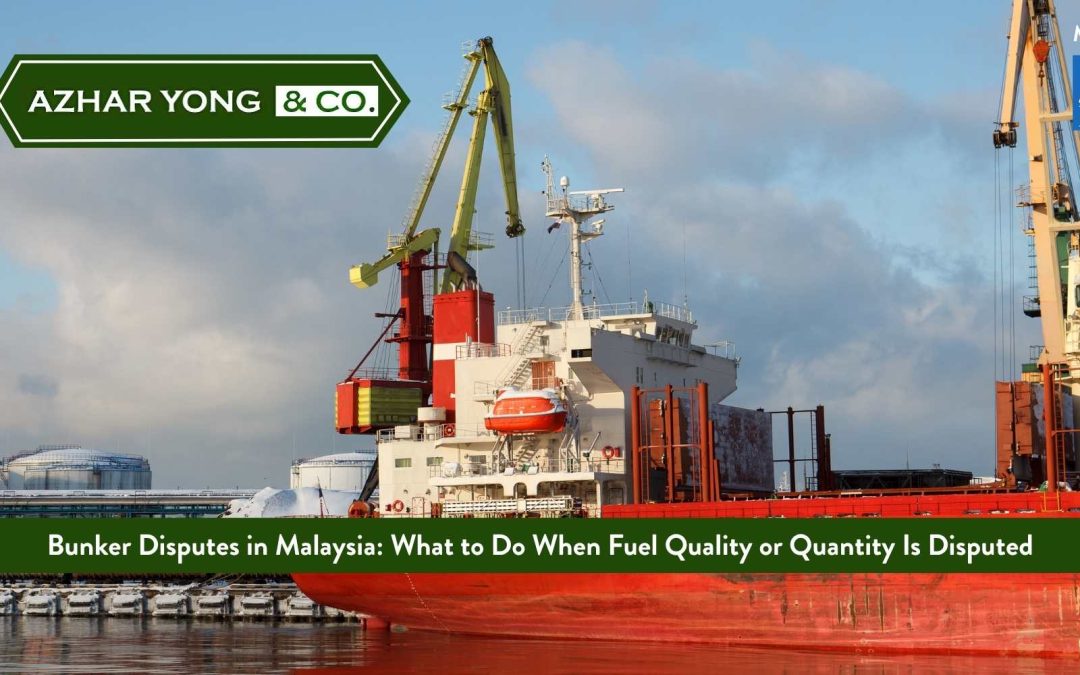
Malaysia is a significant bunkering market, with licensed suppliers operating across 19 ports, including Port Klang, Port of Tanjung Pelepas, Pasir Gudang, Penang, and Labuan. Vessels transiting the Strait of Malacca regularly bunker in Malaysian waters, and where significant volumes of fuel change hands at speed, disputes over quality and quantity are inevitable.
Bunker disputes fall into two main categories. Quality disputes arise when fuel delivered does not meet the contractual specification — typically ISO 8217 — causing engine damage, fuel system contamination, derating of the vessel’s performance, or regulatory non-compliance due to off-spec sulphur content. Quantity disputes — also called short delivery claims — arise when the volume of fuel actually received is less than what was ordered, invoiced, and paid for, with discrepancies often obscured by measurement method differences between the barge and the receiving vessel.
In Malaysia, a bunker supply contract is a commercial contract governed by the Contracts Act 1950, and the Sale of Goods Act 1957 imposes implied terms that goods supplied must be of satisfactory quality and fit for their intended purpose. Where off-spec bunkers cause engine or machinery damage, the shipowner has a claim against the supplier for the cost of repairs, off-hire losses, and any consequential damages that flow directly from the breach. Where a quantity shortfall is established, the shipowner can recover the value of the fuel not delivered.
The single most important factor in any bunker dispute is contemporaneous evidence. A claim built on clear, complete documentation gathered at the time of delivery is recoverable. A claim assembled weeks later from incomplete records is not. The window for protecting your position is short — and it opens the moment the barge arrives.
What to Do During and After Bunkering to Protect Your Claim
-
Measure accurately: Sound the vessel’s tanks before and after delivery. Record the barge’s opening and closing figures independently. Any discrepancy between the Bunker Delivery Note (BDN) and your own figures must be noted immediately.
-
Retain all samples: Ensure the MARPOL retained sample and any additional drip or composite samples are properly sealed, labelled with the seal number, and secured on board. These samples are your primary evidence in a quality dispute.
-
Issue a note of protest: If you dispute the quantity or have any concerns about delivery conditions, issue a written note of protest to the bunker supplier before the barge departs. Do not wait — an undisputed BDN signed without reservation significantly weakens your claim.
-
Send samples for independent analysis: If you suspect off-spec fuel, arrange for the retained samples to be tested by an accredited independent laboratory — such as a FOBAS or DNV-certified lab — as soon as possible. Results are the cornerstone of a quality claim.
-
Engage a maritime lawyer promptly: Bunker supply contracts frequently contain short contractual time bars — sometimes as little as 14 to 30 days for quality claims. Missing a time bar extinguishes your claim entirely. A maritime lawyer will identify applicable deadlines and take protective action immediately.
Frequently Asked Questions
Q: The bunkers delivered have damaged my engine. Who is responsible?
A: If the engine damage is caused by off-spec fuel — fuel that does not comply with the agreed specification under the bunker supply contract — the supplier is liable for breach of the Sale of Goods Act 1957’s implied terms as to quality and fitness for purpose. To establish this, you must show that: the fuel as supplied was off-specification; the off-spec fuel caused the damage (causation); and the damage and losses claimed flow directly from that cause. Independent laboratory analysis of the retained fuel samples is essential to proving the first element. An expert marine engineer’s report is typically required for the causation evidence. Keep all evidence of the damage — engine room records, photographs, repair invoices, and off-hire calculations — from the moment the problem is identified.
Q: We received less fuel than the BDN states. How do we prove a short delivery?
A: Quantity disputes are notoriously difficult to prove after the fact, which is why documentation during the delivery is everything. The strongest evidence of a short delivery is a contemporaneous record of the vessel’s own tank soundings before and after delivery, together with a note of protest issued at the time of delivery recording the discrepancy between the barge figures and the vessel’s own measurements. If the BDN was signed without protest and no contemporaneous records exist, establishing a short delivery claim becomes very difficult. For significant quantity disputes, a bunker quantity survey conducted by an independent surveyor appointed specifically for that purpose is the most reliable evidence. If you frequently bunker in Malaysian ports, appointing a surveyor for larger stems is strongly recommended.
Q: The bunker supplier says the contract terms bar my claim. Is that enforceable?
A: Contractual time bars and notice requirements in bunker supply contracts are generally enforceable under Malaysian law as commercial terms freely agreed between sophisticated parties. However, there are limits. An unreasonably onerous term — particularly one that was not brought to the buyer’s attention before the contract was concluded — may be subject to challenge under the principles of incorporation and, in appropriate cases, under the Contracts Act 1950. Additionally, where the supplier’s own conduct — such as providing false documentation or concealing a quality defect — has contributed to the buyer’s failure to give timely notice, there may be grounds to argue that the time bar should not be strictly applied. These arguments require specialist legal analysis. The starting point, always, is to take legal advice before the time bar expires.
Q: Can I arrest the bunker barge or the supplying vessel to secure my claim?
A: Potentially yes — and in the right circumstances, vessel arrest is a powerful tool in a bunker dispute. A claim by a shipowner against a bunker supplier for the supply of off-spec or short-delivered fuel may, depending on the circumstances, give rise to an admiralty claim that can be enforced in rem against a vessel. Whether the specific claim qualifies for in rem proceedings depends on how it is characterised under Malaysian admiralty jurisdiction — in particular, whether it falls within the categories of claim recognised under the Courts of Judicature Act 1964. A maritime lawyer can assess whether arrest is available for your specific bunker dispute and advise on the fastest route to securing your claim before the barge leaves port.
Q: The bunker supplier is a foreign company. Can I still sue them in Malaysia?
A: Yes — provided there is a sufficient connection to Malaysia. Where the bunkers were supplied in a Malaysian port, Malaysian courts generally have jurisdiction to hear the dispute, regardless of where the supplier is incorporated. If the bunker supply contract specifies a foreign governing law or a foreign arbitration seat, those terms will usually be respected — but they do not prevent you from applying to the Malaysian Admiralty Court for interim relief, including vessel arrest, to secure your claim while the substantive dispute proceeds elsewhere. In practice, many bunker disputes involving Malaysian ports are resolved through negotiation or arbitration rather than court proceedings, making early legal engagement — to identify applicable terms, deadlines, and enforcement options — essential.
Facing a bunker quality or quantity dispute in Malaysia? Azhar Yong & Co. advises shipowners, operators, and suppliers on bunker disputes across Malaysian ports — from preserving evidence and issuing notices to pursuing or defending claims in court or arbitration.
Ship Recycling in Malaysia: Legal Framework and What Shipowners Need to Know
Ship recycling — the dismantling and scrapping of end-of-life vessels — is a significant industry in the Asia-Pacific region. In Malaysia, ship breaking and recycling activities are conducted at yards in Pulau Indah (Port Klang), Pasir Gudang (Johor), and along the...
Maritime Liens in Malaysia: Priority Claims Against Vessels and How to Enforce Them
A maritime lien is a privileged security interest that arises automatically by operation of law against a vessel when certain defined claims are incurred. Unlike a registered ship mortgage — which requires formal registration to be effective — a maritime lien arises...
Manning Agency Liability in Malaysia: What Shipowners and Seafarers Need to Know
Malaysia is one of Southeast Asia's most active seafarer supply markets, with thousands of licensed manning agencies operating under the oversight of the Marine Department of Malaysia (Jabatan Laut) and the Department of Labour. Manning agencies — also known as crew...
Reefer Cargo Disputes in Malaysia: Who Pays When Temperature-Sensitive Goods Are Damaged?
Malaysia is a major exporter of temperature-sensitive goods — including palm oil products, pharmaceutical ingredients, fresh tropical produce, rubber products, and frozen seafood — and a significant importer of cold chain goods including dairy, meat, vaccines, and...
Dangerous Goods at Sea in Malaysia: Legal Obligations and Liability Under the IMDG Code
Malaysia is a major hub for the regional chemical and petrochemical trade, with significant volumes of Class 3 flammable liquids, Class 2 compressed gases, Class 6 toxic substances, and Class 9 miscellaneous dangerous goods moving through Port Klang and other ports...
Towage Contracts in Malaysia: Who Is Liable When a Tug Causes Damage?
Towage is the service of using one vessel (the tug) to move, guide, or assist another vessel (the tow). In Malaysian ports, towage services are provided by licensed tug operators — including Bumi Armada, Maju Maritime, and port authority-operated tugs — and are a...