
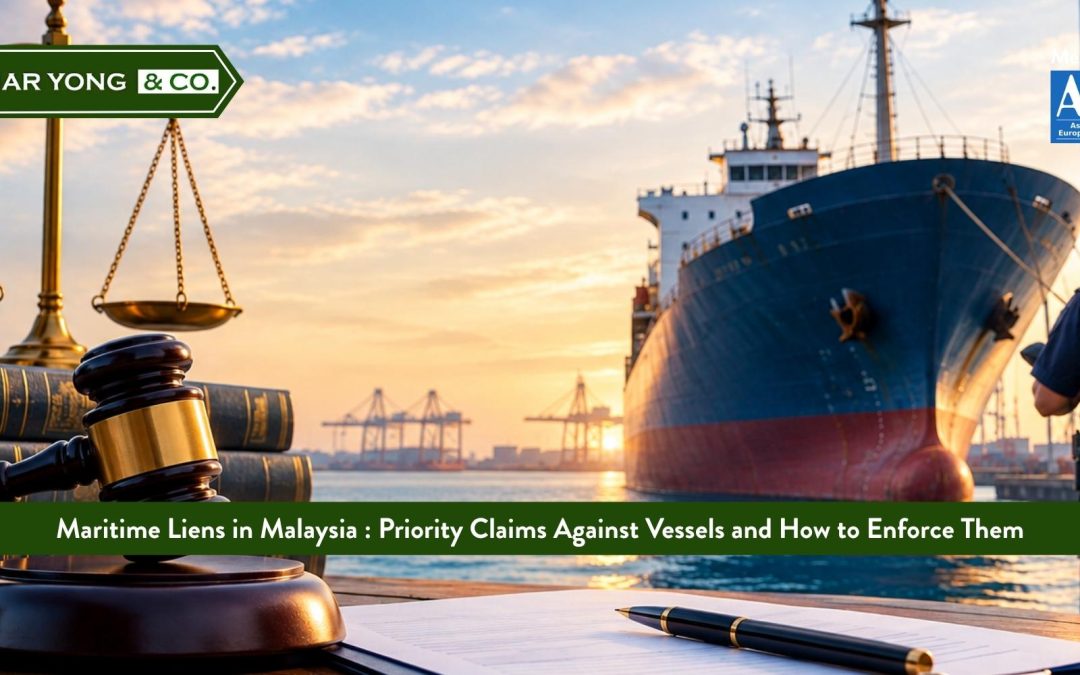
A maritime lien is a privileged security interest that arises automatically by operation of law against a vessel when certain defined claims are incurred. Unlike a registered ship mortgage — which requires formal registration to be effective — a maritime lien arises without any formality, documentation, or registration at the moment the qualifying event occurs. It attaches invisibly to the vessel and travels with it through every subsequent change of ownership, flag, or registration, until it is either satisfied or extinguished by a judicial sale.
In Malaysia, maritime liens are recognised under the admiralty jurisdiction of the High Court as established by the Courts of Judicature Act 1964, which incorporates the admiralty jurisdiction of the Senior Courts Act 1981 (UK). Malaysian courts apply the lex fori — the law of the Malaysian forum — when determining which categories of claim attract a maritime lien. The established categories recognised in Malaysia are: (1) salvage claims; (2) damage done by a ship (including collision damage); (3) seafarers’ wages claims; (4) Master’s wages and disbursements made on behalf of the shipowner; and (5) bottomry (now largely obsolete). Claims outside these categories — including cargo damage, unpaid port dues, and ship repair bills — do not give rise to a maritime lien in Malaysia, though they may give rise to a statutory right in rem enabling vessel arrest.
The critical practical consequence of a maritime lien is its priority. When an arrested vessel is sold by judicial sale in the Malaysian Admiralty Court and the proceeds are distributed among competing creditors, maritime lien holders rank ahead of registered mortgagees and virtually all other secured and unsecured creditors. This means that a seafarer owed three months’ wages — holding a maritime lien — will be paid before a bank holding a registered ship mortgage over the same vessel. This priority structure reflects the law’s recognition that certain classes of creditor are essential to the vessel’s operation and must be protected accordingly.
Enforcing a maritime lien requires applying to the Malaysian Admiralty Court to arrest the vessel against which the lien is held. The arrest creates immediate commercial pressure, securing the lien claimant’s position while the underlying claim is resolved. If the claim is established and the debt remains unpaid, the court will order a judicial sale, and the maritime lien holder will be paid from the proceeds in priority order.
Key Differences: Maritime Liens vs Statutory Rights in Rem
-
Maritime lien — arises automatically, without registration or formality, at the moment the qualifying claim occurs. Follows the vessel through change of ownership. Has priority over mortgages.
-
Statutory right in rem — created by statute (Courts of Judicature Act 1964), requires the claim to fall within a defined category. Can be enforced by arresting the vessel, but only if the owner or demise charterer ‘at the time of the arrest’ is the same person who was owner or charterer when the claim arose. Does not follow the vessel through ownership change in the same way as a maritime lien. Ranks below maritime liens and mortgages.
-
The practical implication: if a vessel has been sold since the claim arose, a maritime lien claimant can still arrest and enforce against the vessel in new ownership. A statutory right-in-rem claimant may not be able to if ownership has changed.
Frequently Asked Questions: Maritime Liens in Malaysia
Q: Which claims give rise to a maritime lien in Malaysia?
A: Malaysian courts apply the lex fori — Malaysian law — when determining which claims attract a maritime lien. The recognised categories are: salvage claims (including salvage of cargo and freight); damage done by a ship (typically collision or allision); seafarers’ wages (including the Master’s wages and personal disbursements made on the vessel’s behalf); and historically, bottomry bonds (now effectively obsolete). These categories are closed — Malaysian courts have been reluctant to expand them judicially, on the basis that maritime liens are a distinctive and unusual form of security that should not be expanded beyond their established scope without legislation. Claims that do not attract a maritime lien — including cargo damage claims, unpaid bunker bills, port dues, ship repair bills, and charterparty hire claims — may still give rise to a statutory right in rem, which allows arrest of the vessel but without the same priority and without the ability to follow the vessel through a change of ownership.
Q: Can a maritime lien survive the sale of a vessel to a new owner?
A: Yes — and this is one of the most important and commercially significant features of a maritime lien. Unlike a statutory right in rem, a maritime lien attaches to the vessel itself at the moment the claim arises, and travels with the vessel regardless of any subsequent change of ownership, flag, or registration. A creditor holding a maritime lien — for example, a seafarer owed wages — can arrest the vessel and enforce the lien against a subsequent purchaser who acquired the vessel in good faith and without notice of the lien. The only way a maritime lien is extinguished (other than by payment) is through a judicial sale ordered by a competent admiralty court, which releases the vessel from all prior maritime liens. This makes maritime lien exposure a critical due diligence consideration for any vessel purchaser — particularly where wages, salvage, or collision claims may have arisen before the purchase.
Q: How do I enforce a maritime lien in Malaysia if the vessel is in Malaysian waters?
A: Enforcing a maritime lien requires commencing an action in rem in the Malaysian Admiralty Court — a claim brought against the vessel itself rather than against the owner personally. The process involves: filing a Writ in Rem and an Affidavit Leading to Arrest in the Admiralty Court Registry; obtaining a Warrant of Arrest, which is typically issued within one to two days of filing; serving the Warrant on the vessel through the Admiralty Sheriff, who physically boards the vessel and notifies the Marine Department and port authority; and — if the debt is not settled or secured — applying for an Order for Sale, under which the vessel is auctioned by the court and the proceeds distributed in priority order. The maritime lien holder is entitled to be paid from the sale proceeds ahead of mortgagees and other creditors. A maritime lawyer must be instructed to conduct the arrest proceedings — the procedural requirements under Order 70 of the Rules of Court 2012 are strict and technical.
Q: Does a seafarer’s wage lien rank above the bank’s ship mortgage?
A: Yes — unambiguously. Seafarers’ wage claims give rise to a maritime lien that ranks ahead of a registered ship mortgage in the distribution of proceeds from a judicial sale. This priority reflects the law’s recognition that seafarers are particularly vulnerable creditors — they cannot withdraw their labour mid-voyage, cannot easily obtain alternative security for their wages, and are entirely dependent on the vessel for their livelihood while at sea. The priority of seafarers’ wage liens over mortgages is established under both Malaysian admiralty law and international convention, and has been consistently upheld in the Malaysian Admiralty Court. In practice, where a vessel is arrested and sold following an owner’s insolvency, seafarers’ wage liens are typically among the first claims paid from the sale proceeds — even before the mortgagee bank recovers its loan. This is one of the most concrete protections available to seafarers under Malaysian maritime law.
Q: My salvage claim was not paid. Can I arrest the salved vessel in Malaysia even if it has been sold?
A: Yes — a salvage maritime lien follows the vessel through a change of ownership. If the salved vessel was subsequently sold — even to a bona fide purchaser who had no knowledge of the outstanding salvage award — the salvor can still arrest the vessel in Malaysia and enforce the lien against it, provided the vessel has not already been sold through a judicial sale that would have extinguished the lien. Among the maritime lien categories, salvage liens enjoy a further important feature: the most recent salvage lien takes priority over earlier ones. This is because each successive rescue preserves the value available to all earlier lien holders — and the most recent salvor’s contribution is therefore treated as the most immediately valuable. In practice, once a salvor’s award is determined (whether by Lloyd’s arbitration or court assessment), the salvor should move quickly to arrest the vessel if payment is not forthcoming — before the vessel leaves Malaysian jurisdiction or is disposed of through a non-judicial sale.
About the Author: Mr. Yong Chee Kong

Yong Chee Kong is an experienced Advocate & Solicitor with over three decades of legal experience, with principal areas of practice in Corporate Law and Shipping & Maritime Law. Called to the Bar in 1995, he has advised shipping companies, developers, financial institutions, and corporate entities on complex legal matters, including shipping disputes, development projects, project financing, mergers, takeovers, and acquisitions.
As a seasoned litigation lawyer, Yong Chee Kong regularly appears before the High Court, Court of Appeal, and Federal Court of Malaysia. His broad experience also extends to Banking, Finance, and Construction Law, enabling him to advise clients across a range of complex commercial and corporate matters.
Beyond legal practice, he is a registered Patent, Trade Marks and Industrial Design agent, as well as a Commissioner for Oaths and Notary Public. He has also served as a member of the Bar Council Disciplinary Committee and chaired numerous disciplinary investigations involving members of the Malaysian Bar.
His academic and professional qualifications include an LL.B (Hons) from the University of London, a Certificate in Legal Practice from University Malaya, and successful completion of the Patent Agent Examination conducted by the Intellectual Property Corporation of Malaysia.
-
Expertise: Corporate Law, Shipping & Maritime Law, Banking & Finance, Construction Law, Commercial Litigation, Intellectual Property
-
Professional Experience: 30+ years
-
Called to the Bar: High Court of Malaya, 1995
-
Professional Roles: Patent, Trade Marks & Industrial Design Agent; Commissioner for Oaths; Notary Public
Manning Agency Liability in Malaysia: What Shipowners and Seafarers Need to Know
Malaysia is one of Southeast Asia's most active seafarer supply markets, with thousands of licensed manning agencies operating under the oversight of the Marine Department of Malaysia (Jabatan Laut) and the Department of Labour. Manning agencies — also known as crew...

Reefer Cargo Disputes in Malaysia: Who Pays When Temperature-Sensitive Goods Are Damaged?
Malaysia is a major exporter of temperature-sensitive goods — including palm oil products, pharmaceutical ingredients, fresh tropical produce, rubber products, and frozen seafood — and a significant importer of cold chain goods including dairy, meat, vaccines, and...
Dangerous Goods at Sea in Malaysia: Legal Obligations and Liability Under the IMDG Code
Malaysia is a major hub for the regional chemical and petrochemical trade, with significant volumes of Class 3 flammable liquids, Class 2 compressed gases, Class 6 toxic substances, and Class 9 miscellaneous dangerous goods moving through Port Klang and other ports...
Towage Contracts in Malaysia: Who Is Liable When a Tug Causes Damage?
Towage is the service of using one vessel (the tug) to move, guide, or assist another vessel (the tow). In Malaysian ports, towage services are provided by licensed tug operators — including Bumi Armada, Maju Maritime, and port authority-operated tugs — and are a...
Port Operations and Liability in Malaysia: A Complete Guide for Shipowners, Cargo Owners, and Port Users
Malaysia operates some of the most strategically important ports in the world. Port Klang — Malaysia's largest and one of Asia's top 15 container ports — handles over 14 million TEUs annually. Port of Tanjung Pelepas (PTP) in Johor is a major transhipment hub serving...
Marine Casualties and Official Investigations in Malaysia: What Shipowners and Masters Need to Know
A marine casualty — whether a grounding, fire, flooding, collision, or structural failure — triggers a cascade of simultaneous legal, regulatory, and commercial obligations. In Malaysia, the primary investigative authority for marine casualties is the Marine...