
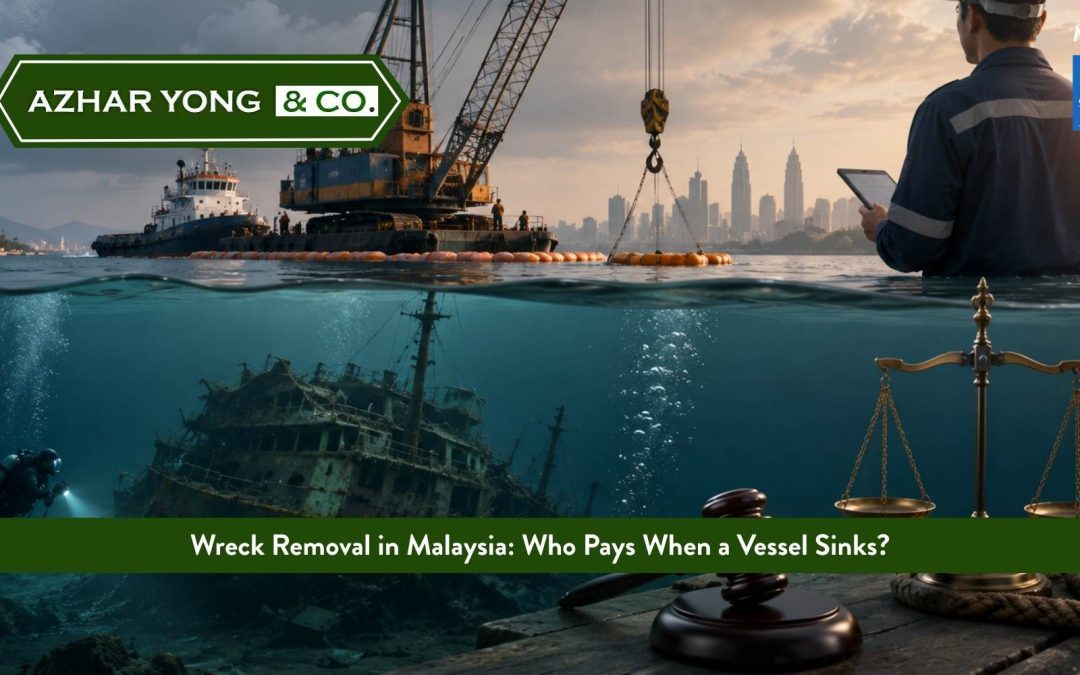
When a vessel sinks, grounds, or is abandoned in Malaysian waters, the consequences extend far beyond the loss of the ship itself. A sunken wreck can obstruct navigation, damage port infrastructure, pollute the marine environment, and create a hazard for other vessels transiting one of the world’s busiest shipping lanes. Malaysian law imposes clear obligations on the shipowner to remove the wreck, and the financial consequences of non-compliance are severe.
In Malaysia, wreck removal is governed by the Merchant Shipping Ordinance 1952 (MSO 1952), which empowers the Director General of Marine to order the raising, removal, or destruction of a vessel that has sunk, stranded, or been abandoned in Malaysian waters where it constitutes a danger or obstruction to navigation. The Marine Department may carry out the removal itself and recover the costs from the shipowner if the owner fails to act.
Malaysia has also acceded to the Nairobi International Convention on the Removal of Wrecks 2007 (Nairobi Convention), which extends these obligations to vessels located in the Exclusive Economic Zone (EEZ) — up to 200 nautical miles from the Malaysian baseline. Under the Nairobi Convention, the registered owner is strictly liable for the costs of locating, marking, and removing a hazardous wreck in the Convention area. Importantly, wreck removal costs are a limited claim under the LLMC 1996 — meaning the shipowner may be able to cap its liability for wreck removal costs within the same limitation fund as other claims arising from the incident.
P&I Club insurance typically covers wreck removal liability — but the policy must be in force at the time of the incident, and prompt notification to the Club is essential. A shipowner who fails to notify or whose P&I Club declines cover may face direct personal liability for wreck removal costs running into millions.
Key Wreck Removal Issues for Malaysian Shipowners
-
Strict liability: Under the Nairobi Convention, the registered owner is strictly liable for locating, marking, and removing a hazardous wreck in Malaysian waters — regardless of fault.
-
EEZ coverage: The Nairobi Convention extends wreck removal obligations to Malaysia’s EEZ — a significant expansion of the geographic scope of liability.
-
Compulsory insurance: Vessels of 300 GT and above are required to maintain insurance covering wreck removal liability under the Nairobi Convention. Vessels without valid insurance may be denied entry to Malaysian ports.
-
Limitable claim: Wreck removal costs can be included in a limitation fund under the LLMC 1996 — but only if the fund is constituted promptly and correctly.
-
Marine Department powers: The Marine Department can order removal, carry out the work itself, and recover costs from the shipowner — plus interest and legal fees.
Frequently Asked Questions:
Q: Is a shipowner always responsible for removing a wreck in Malaysian waters?
A: Under the Nairobi Convention, which Malaysia has acceded to, the registered owner of a vessel that sinks or is stranded in Malaysian waters — including the EEZ — is strictly liable for the costs of locating, marking, and removing the wreck where it constitutes a hazard to navigation, shipping, or the marine environment. Strict liability means the shipowner is responsible regardless of fault — even where the sinking was caused by an act of God, a third party, or circumstances entirely outside the owner’s control. The only exceptions are narrow: damage resulting from an act of war or hostilities, an exceptional natural phenomenon, or the negligence of a coastal state authority. In practice, this means virtually every sinking in Malaysian waters will give rise to wreck removal liability for the registered owner.
Q: Can I include wreck removal costs in a limitation fund?
A: Yes — wreck removal costs are a limited claim under Article 2(1)(d) of the LLMC 1976, as applied in Peninsular Malaysia and Labuan. This means that where a shipowner constitutes a limitation fund following a sinking or grounding incident, wreck removal costs claimed by the Marine Department or any other authority share in the same fund as cargo claims, collision claims, and other limitable losses — subject to the applicable tonnage-based cap. This can significantly limit the shipowner’s net exposure. However, wreck removal costs are not covered by oil pollution limitation under the CLC 1992 framework — only by the LLMC. A maritime lawyer must carefully analyse which claims fall within which limitation regime, where a single incident gives rise to both pollution and wreck removal liability.
Q: Does my P&I insurance cover wreck removal costs?
A: Standard P&I Club cover typically includes liability for wreck removal costs — subject to the terms, conditions, and deductibles of the P&I entry. However, P&I cover for wreck removal is not unlimited: most Club rules impose sub-limits on wreck removal liability, and where wreck removal costs are particularly high — as they can be for laden tankers or large bulk carriers — the P&I limit may be insufficient to cover the full exposure. Shipowners should review their P&I entry carefully, confirm that wreck removal is covered, and check the applicable sub-limits. Where there is a gap between P&I cover and the wreck removal cost, the shipowner faces direct liability for the shortfall. Prompt notification to the P&I Club following any sinking or stranding is a condition of cover — late notification can prejudice the Club’s ability to manage the situation and may affect coverage.
Q: What powers does the Marine Department have to compel wreck removal?
A: The Marine Department of Malaysia has broad statutory powers under the MSO 1952 to deal with wrecks that constitute a hazard or obstruction. Where a vessel sinks or grounds in Malaysian waters, the Director General of Marine can: order the owner to mark the wreck immediately to warn other vessels; order the owner to remove the wreck within a specified period; carry out the marking or removal itself if the owner fails to comply; and recover all reasonable costs of marking and removal from the owner, with interest. The Marine Department can also apply to the Admiralty Court to arrest any vessel in which the owner has an interest to secure the recovery of wreck removal costs. Where the wreck poses an imminent environmental risk, the Department can act without prior notice to the owner — and recover costs afterwards.
Q: What if the previous owner sold the vessel and it sank under the new owner — who is responsible?
A: Under the Nairobi Convention, wreck removal liability rests with the registered owner of the vessel at the time of the incident — not the previous owner. If a vessel is sold and then sinks under the new registered owner’s operation, the new owner bears the wreck removal liability, not the seller. However, this principle is sometimes complicated in practice: if the vessel was sold in breach of the conditions of a ship mortgage, the mortgagee bank may have claims against the seller; if the sale was a sham transaction designed to avoid liability, courts may look through the formal ownership structure. For buyers of vessels, this underlines the importance of due diligence before purchase — including checking the vessel’s condition, its insurance arrangements, and any outstanding wreck or environmental liabilities that might have been disclosed as risk factors.
Maritime Cyber Security in Malaysia: IMO Requirements and Legal Liability for Shipowners
A ransomware attack locks your vessel's bridge navigation systems at sea. A phishing email compromises your cargo booking platform. A GPS spoofing attack sends your vessel off course in the Strait of Malacca. Maritime cyber attacks are no longer hypothetical — they...
Malaysia’s Merchant Shipping Ordinance 2026: Key Changes Every Shipowner Must Know
The Merchant Shipping Ordinance 1952 (MSO 1952) has been the bedrock of Malaysian maritime law for over 70 years. It governs vessel registration, seafarer employment, casualty investigation, limitation of liability, port operations, and a vast range of other maritime...
Container Loss at Sea: Legal Rights When Your Cargo Goes Overboard in Malaysian Waters
Container loss overboard — where containers are lost from a vessel's deck during heavy weather or vessel instability — is a significant and growing problem in international shipping. High-profile incidents, including the loss of hundreds of containers from major...
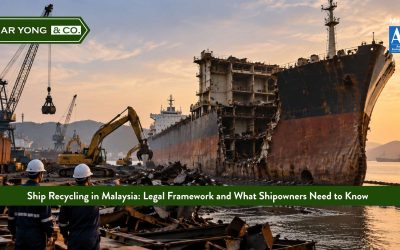
Ship Recycling in Malaysia: Legal Framework and What Shipowners Need to Know
Ship recycling — the dismantling and scrapping of end-of-life vessels — is a significant industry in the Asia-Pacific region. In Malaysia, ship breaking and recycling activities are conducted at yards in Pulau Indah (Port Klang), Pasir Gudang (Johor), and along the...
Maritime Liens in Malaysia: Priority Claims Against Vessels and How to Enforce Them
A maritime lien is a privileged security interest that arises automatically by operation of law against a vessel when certain defined claims are incurred. Unlike a registered ship mortgage — which requires formal registration to be effective — a maritime lien arises...
Manning Agency Liability in Malaysia: What Shipowners and Seafarers Need to Know
Malaysia is one of Southeast Asia's most active seafarer supply markets, with thousands of licensed manning agencies operating under the oversight of the Marine Department of Malaysia (Jabatan Laut) and the Department of Labour. Manning agencies — also known as crew...