
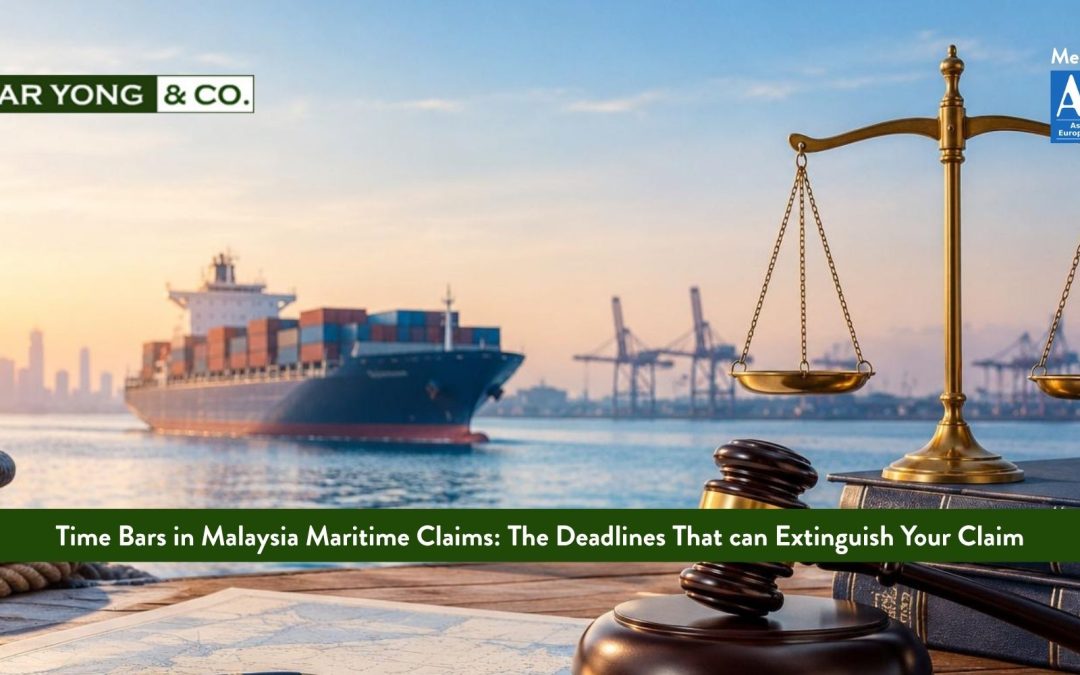
Time bars — also known as limitation periods or prescription periods — are the legal deadlines within which a maritime claim must be commenced. Once a time bar expires, the claim is extinguished entirely, regardless of how strong the merits might be. In Malaysian maritime law, time bars arise from three distinct sources: international conventions incorporated into domestic law; domestic statutes; and contractual provisions in bills of lading, charterparties, and standard trading conditions.
The multiplicity of time bars applicable to different categories of maritime claim is one of the most dangerous features of maritime law for uninitiated claimants. A cargo owner with a strong case for breach of the carrier’s obligations under the Hague Rules has exactly one year from delivery to commence proceedings — or the claim is gone. A person injured in a ship collision must commence proceedings within two years under the Maritime Conventions Act 1911. A seafarer pursuing a wage claim must act within the six-year general limitation period, but must also be alert to shorter contractual time bars in the SEA. A party pursuing a demurrage claim may face a 90-day contractual time bar in the charterparty.
The practical challenge is that maritime disputes often involve extensive pre-litigation correspondence — negotiations, without-prejudice discussions, and internal investigations — that can consume the time available without the parties realising that a hard deadline is approaching. By the time formal legal proceedings are contemplated, the time bar may have already expired or be days away from doing so. This is one of the most compelling reasons to engage a maritime lawyer at the earliest stage of a dispute, before any deadline passes.
Malaysian courts have consistently declined to extend expired maritime time bars absent exceptional circumstances. The principle of legal certainty in commercial transactions — which the strict application of time bars serves — is treated as paramount. Courts will not rescue a claimant who missed a time bar through inadvertence or delay.
Key Maritime Time Bars in Malaysian Law
-
Cargo claims (Hague Rules): 1 year from delivery (or the date delivery should have been made). Under the Carriage of Goods by Sea Act 1950. Strictly enforced — no extension without mutual agreement in writing before expiry.
-
Collision damage claims: 2 years from the date of the collision. Under the Maritime Conventions Act 1911. Court may extend where arrest was not reasonably possible within 2 years.
-
Salvage claims: 2 years from the date the salvage operations are terminated. Under the Merchant Shipping Ordinance 1952.
-
General contract claims (Contracts Act 1950): 6 years from the date the cause of action accrued. Applies to charterparty claims, ship repair claims, and other contractual maritime claims where no specific shorter period applies.
-
Contractual time bars: Charterparty demurrage claims (commonly 90 days from completion of discharge); freight forwarder claims under MFFA conditions (commonly 9 months from delivery); ship arrest — jurisdiction must be established before the applicable statutory period expires.
Frequently Asked Questions: Time Bars in Malaysian Maritime Law
Q: Can the one-year Hague Rules time bar for cargo claims be extended?
A: Yes — but only by mutual written agreement between the cargo claimant and the carrier, concluded before the one-year period expires. The Carriage of Goods by Sea Act 1950 permits the parties to agree in writing to extend the limitation period — typically through a ‘standstill agreement’ or ‘time bar waiver’ letter signed by both parties before the deadline. Such extensions are commonly agreed in practice where negotiations are ongoing and both parties wish to continue without the pressure of an imminent claim filing. Critically, the agreement must be concluded before the period expires — a letter written after expiry has no effect. If a carrier refuses to agree to an extension, the cargo owner must file proceedings before the year expires, even if negotiations are still ongoing. A maritime lawyer can draft the extension agreement and ensure it is properly executed in time.
Q: I missed the one-year cargo claim time bar. Is there any way to still recover?
A: In most cases, no — once the one-year Hague Rules limitation period expires without valid proceedings being commenced or a written extension being agreed, the cargo claim against the carrier is extinguished and cannot be revived. Malaysian courts have consistently applied this bar strictly. However, there are limited circumstances where recovery may still be possible: if the time bar in the bill of lading is found to be unenforceable for a specific reason (for example, if the bill of lading terms were not properly incorporated, or if the claim falls outside the Hague Rules entirely); if a separate claim exists against a party other than the carrier — such as the freight forwarder or a terminal operator — who may not benefit from the one-year time bar; or if the carrier’s own fraudulent conduct caused the claimant to miss the time bar. These are narrow exceptions. The only reliable protection is to file proceedings in time.
Q: My charterparty has a 90-day time bar for demurrage claims. What happens if I miss it?
A: A contractual time bar for demurrage claims — requiring the claim to be submitted with supporting documents within 90 days of completion of discharge — is a condition precedent to the right to claim, not merely a procedural deadline. If the charterparty specifies that demurrage claims must be submitted within 90 days with all supporting documents (statements of fact, NOR, laytime calculations), failure to comply within that period extinguishes the claim — regardless of how well-supported it might otherwise be. The 90-day time bar is particularly dangerous because it is short, starts running from completion of discharge (not from the date of a dispute), and requires full documentation to be compiled quickly. As soon as a voyage is completed with a potential demurrage situation, the claim preparation process should begin immediately. A maritime lawyer can prepare and submit the demurrage claim within the contractual time frame.
Q: Does the 6-year limitation period under the Contracts Act apply to all maritime claims?
A: The 6-year limitation period under the Limitation Act 1953 (not the Contracts Act itself, though the underlying claim is usually contractual) applies as a default to contract claims in Malaysia that are not subject to a shorter specific statutory or contractual time bar. In maritime law, this means that charterparty claims for hire, freight, damages for breach of contract, and ship repair claims all potentially benefit from the 6-year period — subject to any shorter contractual time bar in the relevant document. However, the 6-year period is a maximum, not a safe minimum: many maritime contracts contain shorter time bars that override it. Always check the contract for any time bar clause before assuming the 6-year period applies. For tort claims — including collision damage claims — the applicable period under the Maritime Conventions Act 1911 is two years, not six.
Q: What is a ‘standstill agreement’ and when should I use one?
A: A standstill agreement (also called a time bar extension agreement or tolling agreement) is a written agreement between the parties to a maritime dispute that suspends or extends the running of a time bar for a defined period. It allows negotiations to continue without the pressure of an imminent filing deadline. Standstill agreements are most commonly used in cargo claims (to extend the one-year Hague Rules period), collision claims (to extend the two-year period), and charterparty disputes where the parties are in active settlement discussions. To be effective, a standstill agreement must be: in writing; signed by an authorised representative of each party; entered into before the applicable time bar expires; specific about which time bar is being extended and for how long; and, ideally, reviewed by a maritime lawyer to ensure it is legally effective. A standstill agreement buys time — but it does not resolve the dispute. If negotiations fail, formal proceedings must still be commenced before the extended period expires.
About the Author: Mr. Yong Chee Kong

Yong Chee Kong is an experienced Advocate & Solicitor with over three decades of legal experience, with principal areas of practice in Corporate Law and Shipping & Maritime Law. Called to the Bar in 1995, he has advised shipping companies, developers, financial institutions, and corporate entities on complex legal matters, including shipping disputes, development projects, project financing, mergers, takeovers, and acquisitions.
As a seasoned litigation lawyer, Yong Chee Kong regularly appears before the High Court, Court of Appeal, and Federal Court of Malaysia. His broad experience also extends to Banking, Finance, and Construction Law, enabling him to advise clients across a range of complex commercial and corporate matters.
Beyond legal practice, he is a registered Patent, Trade Marks and Industrial Design agent, as well as a Commissioner for Oaths and Notary Public. He has also served as a member of the Bar Council Disciplinary Committee and chaired numerous disciplinary investigations involving members of the Malaysian Bar.
His academic and professional qualifications include an LL.B (Hons) from the University of London, a Certificate in Legal Practice from University Malaya, and successful completion of the Patent Agent Examination conducted by the Intellectual Property Corporation of Malaysia.
-
Expertise: Corporate Law, Shipping & Maritime Law, Banking & Finance, Construction Law, Commercial Litigation, Intellectual Property
-
Professional Experience: 30+ years
-
Called to the Bar: High Court of Malaya, 1995
-
Professional Roles: Patent, Trade Marks & Industrial Design Agent; Commissioner for Oaths; Notary Public
Ship Arrest in East Malaysia: Sabah, Sarawak, and Labuan — What You Need to Know!
Most people in the maritime industry know that Malaysia has a well-established ship arrest regime — centred on the Admiralty Court in Kuala Lumpur, operating 24 hours a day under Order 70 of the Rules of Court 2012. What is less well understood is that ship arrest in...
Maritime Cyber Security in Malaysia: IMO Requirements and Legal Liability for Shipowners
A ransomware attack locks your vessel's bridge navigation systems at sea. A phishing email compromises your cargo booking platform. A GPS spoofing attack sends your vessel off course in the Strait of Malacca. Maritime cyber attacks are no longer hypothetical — they...
Malaysia’s Merchant Shipping Ordinance 2026: Key Changes Every Shipowner Must Know
The Merchant Shipping Ordinance 1952 (MSO 1952) has been the bedrock of Malaysian maritime law for over 70 years. It governs vessel registration, seafarer employment, casualty investigation, limitation of liability, port operations, and a vast range of other maritime...
Container Loss at Sea: Legal Rights When Your Cargo Goes Overboard in Malaysian Waters
Container loss overboard — where containers are lost from a vessel's deck during heavy weather or vessel instability — is a significant and growing problem in international shipping. High-profile incidents, including the loss of hundreds of containers from major...
Ship Recycling in Malaysia: Legal Framework and What Shipowners Need to Know
Ship recycling — the dismantling and scrapping of end-of-life vessels — is a significant industry in the Asia-Pacific region. In Malaysia, ship breaking and recycling activities are conducted at yards in Pulau Indah (Port Klang), Pasir Gudang (Johor), and along the...
Maritime Liens in Malaysia: Priority Claims Against Vessels and How to Enforce Them
A maritime lien is a privileged security interest that arises automatically by operation of law against a vessel when certain defined claims are incurred. Unlike a registered ship mortgage — which requires formal registration to be effective — a maritime lien arises...