
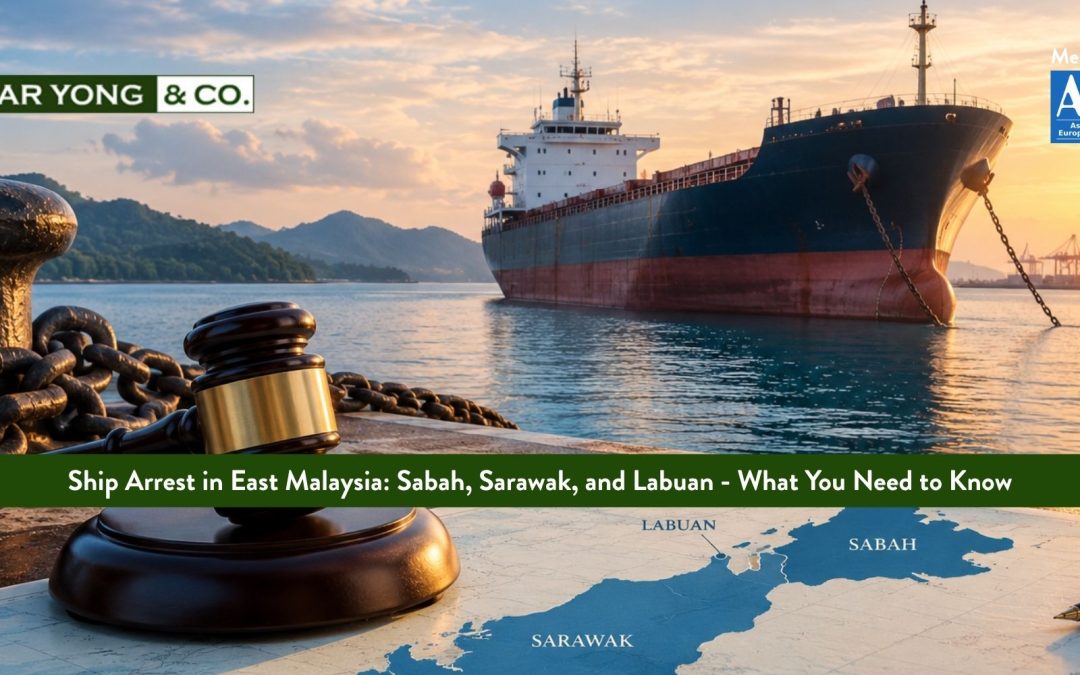
Most people in the maritime industry know that Malaysia has a well-established ship arrest regime — centred on the Admiralty Court in Kuala Lumpur, operating 24 hours a day under Order 70 of the Rules of Court 2012. What is less well understood is that ship arrest in East Malaysia — the states of Sabah and Sarawak, and the Federal Territory of Labuan — operates through a distinct set of courts, with some important differences in procedural requirements, applicable limitation conventions, and the geographic extent of available remedies.
Vessels calling at the port of Kota Kinabalu (Sabah), Kuching, Sibu, Bintulu, or Miri (Sarawak), or at Labuan Port, are subject to the admiralty jurisdiction of the High Courts of Sabah and Sarawak — not the Admiralty Court in Kuala Lumpur. These courts operate under the same fundamental admiralty jurisdiction framework as the Kuala Lumpur court — derived from the Courts of Judicature Act 1964 — but local procedural rules and court practice may differ in ways that affect the speed and mechanics of an arrest.
A critically important difference between East and West Malaysia is the applicable limitation of liability convention. As discussed in our June pillar blog on limitation of liability, the LLMC 1996 applies in Peninsular Malaysia and Labuan, while the older 1957 Convention applies in Sabah and Sarawak. This distinction means that in a Sabah or Sarawak arrest, the standard for breaking limitation is lower for claimants — a factor that can significantly affect the strategic calculation for both the arresting party and the shipowner seeking to limit.
Recent legal developments have confirmed that the Kuala Lumpur Admiralty Court can, in certain circumstances, issue a Warrant of Arrest for a vessel located in East Malaysian waters — providing an alternative avenue where the Kuala Lumpur court is more convenient or efficient. However, the service and execution of the warrant in East Malaysia still requires coordination with local authorities, and local maritime lawyers familiar with the specific ports and courts in Sabah and Sarawak are invaluable.
Key Differences: Ship Arrest in East Malaysia vs Peninsular Malaysia
-
Court: High Court of Sabah and Sarawak (sitting in Kota Kinabalu or Kuching) — not the Admiralty Court in Kuala Lumpur.
-
Limitation convention: 1957 Convention applies in Sabah and Sarawak (lower limits and lower threshold for breaking limitation than the LLMC 1996 in Peninsular Malaysia).
-
Court deposit: Similar deposit requirements to Peninsular Malaysia, but verify the current amount with local court practice.
-
Labuan: The Federal Territory of Labuan falls within the Peninsular Malaysia/Labuan LLMC 1996 regime — different from Sabah and Sarawak.
-
Practical considerations: The oil and gas industry is dominant in Sarawak and Labuan — OSV arrests and offshore contract disputes are common, requiring specialist knowledge of PETRONAS and offshore sector contracting practice.
Frequently Asked Questions: Ship Arrest in East Malaysia
Q: Can I use the Kuala Lumpur Admiralty Court to arrest a vessel in Sabah or Sarawak?
A: Yes — in certain circumstances. Recent Malaysian case law has confirmed that the Kuala Lumpur Admiralty Court has jurisdiction to issue a Warrant of Arrest for a vessel in East Malaysian waters, provided the claim falls within its admiralty jurisdiction. The KL court’s warrant would then need to be served and executed by the appropriate authorities in Sabah or Sarawak — which requires coordination between the KL court, the local High Court, and the port and maritime authorities at the relevant East Malaysian port. In practice, the most efficient approach depends on the specific facts: where the KL court is already seized of the matter (because proceedings were commenced there), issuing the KL arrest warrant for an East Malaysian vessel may be quicker than commencing fresh proceedings in the local East Malaysian court. A maritime lawyer with experience in both Peninsular and East Malaysian admiralty practice can advise on the most effective route.
Q: What limitation convention applies if I am arrested in Sarawak — and why does it matter?
A: The 1957 Convention on Limitation of Liability for Owners of Sea-Going Ships applies in Sabah and Sarawak. This is materially different from the LLMC 1996, which applies in Peninsular Malaysia and Labuan, in two key respects. First, the financial limits under the 1957 Convention are lower than those under the LLMC 1996 — meaning the limitation fund available to the shipowner is smaller. Second, and more importantly for claimants, the standard for breaking limitation under the 1957 Convention requires proof of ‘actual fault or privity’ of the shipowner — a lower and more accessible threshold than the LLMC 1996’s requirement of personal intent or recklessness. Malaysian courts have successfully broken limitation in Sabah and Sarawak cases, whereas the LLMC 1996 limitation has never been successfully broken in Peninsular Malaysia. The applicable convention therefore significantly affects the strategic positioning of both parties in an East Malaysian maritime dispute.
Q: I have a claim against an OSV operator based in Miri, Sarawak. How do I arrest their vessel?
A: A claim against a vessel or operator based in Miri would typically be pursued in the High Court of Sabah and Sarawak, sitting in Kuching or Kota Kinabalu. The process mirrors the Peninsular Malaysian procedure: file a Writ in Rem and Affidavit Leading to Arrest with the relevant court registry; obtain a Warrant of Arrest; arrange for the court’s bailiff or designated officer to serve the warrant on the vessel at Miri Port. The timing of the arrest is critical in Sarawak’s offshore sector — OSVs rotate between offshore locations and port frequently, and a vessel that departs for an offshore platform cannot be arrested until it returns to port limits. A maritime lawyer with Sarawak practice experience can advise on the vessel’s likely port call schedule and ensure the arrest is executed at the optimal moment.
Q: Are maritime liens recognised in the same way in East Malaysia as in Peninsular Malaysia?
A: Yes — the categories of maritime lien recognised in East Malaysia are the same as in Peninsular Malaysia: salvage, damage done by a ship, seafarers’ wages, Master’s wages and disbursements, and bottomry. The lex fori principle applies in both jurisdictions — Malaysian admiralty law determines which claims attract maritime liens. The priority of maritime lien holders over registered mortgagees and other creditors is also the same. The key differences in East Malaysia relate to the limitation of liability regime (1957 Convention vs LLMC 1996) and the court procedure, not to the substantive law of maritime liens. A seafarer owed wages from a vessel in Kota Kinabalu has exactly the same maritime lien — and the same priority — as a seafarer owed wages from a vessel in Port Klang.
Q: Is Labuan treated the same as East Malaysia for admiralty purposes?
A: No — Labuan is a Federal Territory with a distinct legal position. For limitation of liability purposes, Labuan falls under the LLMC 1996 regime (the same as Peninsular Malaysia), not the 1957 Convention regime of Sabah and Sarawak. The Labuan Financial Services Authority (LFSA) also administers the Malaysian International Ship Register (MISR), which is based in Labuan and offers full foreign ownership, attractive tax incentives, and the ability to fly the Malaysian flag. Vessels registered under the MISR are subject to the LLMC 1996 for limitation purposes. Ship arrests in Labuan would be conducted in the relevant Federal Territory court with jurisdiction over Labuan — and a maritime lawyer with Labuan experience is essential for arrest applications in this jurisdiction.
About the Author: Mr. Yong Chee Kong

Yong Chee Kong is an experienced Advocate & Solicitor with over three decades of legal experience, with principal areas of practice in Corporate Law and Shipping & Maritime Law. Called to the Bar in 1995, he has advised shipping companies, developers, financial institutions, and corporate entities on complex legal matters, including shipping disputes, development projects, project financing, mergers, takeovers, and acquisitions.
As a seasoned litigation lawyer, Yong Chee Kong regularly appears before the High Court, Court of Appeal, and Federal Court of Malaysia. His broad experience also extends to Banking, Finance, and Construction Law, enabling him to advise clients across a range of complex commercial and corporate matters.
Beyond legal practice, he is a registered Patent, Trade Marks and Industrial Design agent, as well as a Commissioner for Oaths and Notary Public. He has also served as a member of the Bar Council Disciplinary Committee and chaired numerous disciplinary investigations involving members of the Malaysian Bar.
His academic and professional qualifications include an LL.B (Hons) from the University of London, a Certificate in Legal Practice from University Malaya, and successful completion of the Patent Agent Examination conducted by the Intellectual Property Corporation of Malaysia.
-
Expertise: Corporate Law, Shipping & Maritime Law, Banking & Finance, Construction Law, Commercial Litigation, Intellectual Property
-
Professional Experience: 30+ years
-
Called to the Bar: High Court of Malaya, 1995
-
Professional Roles: Patent, Trade Marks & Industrial Design Agent; Commissioner for Oaths; Notary Public
US Tariffs and Malaysian Shipping in 2025: What Maritime Businesses Need to Know
The US tariff announcements of 2025 have created significant disruption to international trade flows — and Malaysian maritime businesses are directly in the crosshairs. Malaysia's export-driven economy, with major shipments of electronics, palm oil, rubber, LNG, and...
Court of Appeal Rules Vessel Arrest Invalid as Fuel Supply Did Not Qualify for Admiralty Jurisdiction
Meck Petroleum DMCC v International Bird Shipping Co. Inc. — Court of Appeal of Malaysia, Civil Appeal No. W-02(IM)(ADM)-1169-07/2024 A recent decision from the Court of Appeal of Malaysia offers a useful reminder for fuel suppliers, shipowners, and charterers alike:...
Wreck Removal in Malaysia: Who Pays When a Vessel Sinks?
When a vessel sinks, grounds, or is abandoned in Malaysian waters, the consequences extend far beyond the loss of the ship itself. A sunken wreck can obstruct navigation, damage port infrastructure, pollute the marine environment, and create a hazard for other vessels...

Maritime Carbon Regulation in Malaysia: What Shipowners Need to Know Before 2026
Malaysia's maritime sector is entering a period of significant regulatory change. The Malaysian government has announced that a carbon tax will be introduced beginning in 2026, targeting energy-intensive sectors — including shipping and port operations....
Port State Control in Malaysia: What Happens When Your Vessel Is Detained?
Port State Control (PSC) is the system by which a coastal state — in Malaysia's case, the Marine Department of Malaysia (Jabatan Laut Malaysia) — inspects foreign-flagged vessels visiting its ports to verify compliance with international maritime conventions. Malaysia...
A Strategic Guide to Maritime Risk: Understanding General Average in Malaysia
General Average is one of the oldest principles in maritime law — and one of the least understood by modern importers and exporters. It applies when, during a voyage, the shipowner or Master makes a deliberate sacrifice or incurs an extraordinary expenditure to save...