
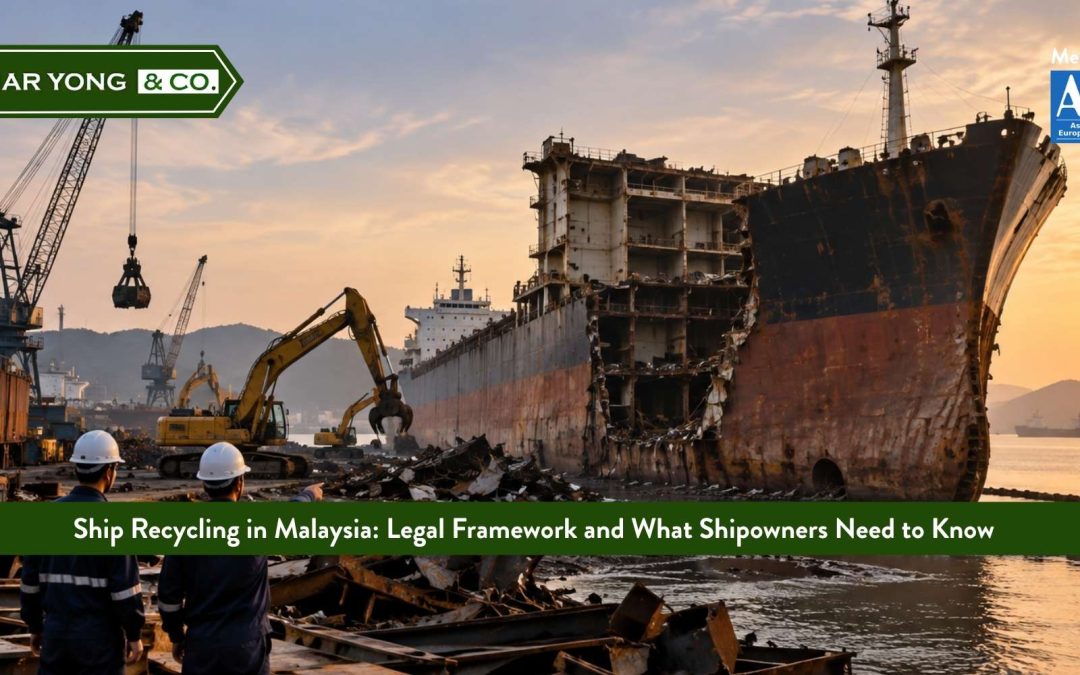
Ship recycling — the dismantling and scrapping of end-of-life vessels — is a significant industry in the Asia-Pacific region. In Malaysia, ship breaking and recycling activities are conducted at yards in Pulau Indah (Port Klang), Pasir Gudang (Johor), and along the Sarawak coast. The industry provides valuable steel and material recovery but creates significant environmental and occupational health hazards due to the toxic materials found in older vessels — including asbestos insulation, lead paint, PCB-containing electrical equipment, and heavy fuel oil residues.
The international legal framework for ship recycling is the Hong Kong International Convention for the Safe and Environmentally Sound Recycling of Ships 2009 (Hong Kong Convention). Malaysia has signed but not yet ratified the Hong Kong Convention — which has not yet entered into force globally, requiring 40 states representing 40% of world merchant shipping tonnage to ratify. However, the EU Ship Recycling Regulation (EU SRR), which entered into force in December 2023, applies to all vessels flagged in EU member states and to vessels calling at EU ports — giving it de facto global reach for EU-trading vessels. The EU SRR requires vessels to carry an Inventory of Hazardous Materials (IHM) and to be recycled only at facilities on the EU List of Approved Ship Recycling Facilities. Most Malaysian yards are not on this list — creating challenges for EU-flagged vessels seeking to be recycled in Malaysia.
Under Malaysian domestic law, ship recycling activities are regulated under the Environmental Quality Act 1974 (EQA), the Occupational Safety and Health Act 1994 (OSHA), and the Scheduled Wastes Regulations 2005, which classify most ship recycling waste as scheduled (hazardous) waste requiring special handling and disposal procedures. Shipowners sending vessels to Malaysian yards for recycling must ensure that the receiving yard holds all required environmental and safety licences.
The ship recycling contract — typically negotiated by a ship recycling broker — must specify clearly how hazardous materials will be managed, what licences the yard holds, which party bears liability for regulatory non-compliance, and how the proceeds of the scrap metal sale are to be paid. A maritime lawyer should review the recycling contract before execution to identify onerous terms and liability exposures.
Key Legal Obligations for Shipowners in Malaysian Ship Recycling
-
Inventory of Hazardous Materials (IHM): EU SRR vessels must have a certified IHM before entering a recycling yard. Non-compliance can result in EU port state control detention on the vessel’s next call at an EU port.
-
Yard licensing: Verify that the Malaysian recycling yard holds valid EQA and OSHA licences before executing the recycling contract. Recycling at an unlicensed yard exposes the shipowner to joint environmental liability.
-
Pre-recycling survey: An independent pre-recycling survey should identify all hazardous materials on board and confirm the yard’s capability to handle them safely.
-
Recycling Plan approval: Under the Hong Kong Convention framework (which Malaysia is expected to ratify), each vessel must have an approved Ship Recycling Plan before recycling commences.
-
Residual cargo and fuel: All residual cargo and fuel must be removed and properly disposed of before the vessel enters the recycling yard. Failure to do so creates environmental liability for the shipowner under the EQA.
Frequently Asked Questions: Ship Recycling in Malaysia
Q: Can I send my EU-flagged vessel to a Malaysian yard for recycling?
A: This is complex. The EU Ship Recycling Regulation requires EU-flagged vessels to be recycled only at facilities on the EU List of Approved Ship Recycling Facilities. As of the current list, Malaysian yards are not included — the list is dominated by facilities in Turkey, the UK, the Netherlands, and a small number of other EU and non-EU countries. An EU-flagged vessel recycled at a non-listed Malaysian yard would be in breach of the EU SRR, exposing the shipowner to enforcement action by the flag state administration, potential fines, and complications in certificate renewal. However, flag state changes are permissible: a shipowner can re-flag a vessel to a non-EU flag before recycling, removing the EU SRR’s application. Whether a flag change for recycling purposes is legally permissible — and commercially effective — depends on the specific circumstances, the flag state’s requirements, and the timing of the change relative to the recycling. A maritime lawyer can advise on the permissibility and mechanics of a pre-recycling flag change.
Q: What environmental liability can I face for recycling at an unlicensed Malaysian yard?
A: Recycling at an unlicensed Malaysian yard creates significant environmental liability exposure for the shipowner. Under the Environmental Quality Act 1974, a person who disposes of scheduled waste (which includes most ship recycling materials) without the required licence or in a manner that causes environmental pollution commits a criminal offence — and the offence can be attributed to the person who arranged for the disposal (the shipowner), not just the yard. Penalties include substantial fines and imprisonment for the responsible individuals. Civil liability for environmental contamination caused by hazardous material leakage during unlicensed recycling can also be significant — including liability for clean-up costs, remediation of contaminated land or water, and claims from affected local communities. Before executing any recycling contract with a Malaysian yard, verify the yard’s EQA scheduled waste disposal licence, OSHA compliance status, and environmental track record independently.
Q: How is the scrap price calculated and how do I protect my payment rights?
A: The scrap price in a ship recycling transaction is typically expressed as a price per light displacement ton (LDT) — the weight of the vessel’s steel hull and structure, excluding fuel, water, cargo, and crew. LDT prices are highly volatile, tracking the price of steel scrap in the relevant market (typically the South Asian market). The total recycling proceeds are calculated by multiplying the vessel’s LDT (certified by a classification society or independent surveyor) by the agreed LDT price. Payment security is a critical issue in ship recycling contracts — the yard has the physical possession of the vessel once it arrives, creating leverage that can be used to renegotiate terms. Best practice is to negotiate a payment schedule tied to recycling milestones (arrival, commencement of cutting, completion) with each payment secured by a bank guarantee or an irrevocable letter of credit. A maritime lawyer should review the recycling contract specifically for payment security provisions before the vessel departs for the yard.
Q: Who is liable if a worker is injured or killed during recycling at a Malaysian yard?
A: Under Malaysian law, primary liability for worker safety during ship recycling rests with the yard as the employer and the occupier of the workplace, under the Occupational Safety and Health Act 1994 and the Employees’ Social Security Act 1969. The yard owes a duty of care to its workers to provide a safe working environment, proper safety equipment, and adequate hazardous materials training. A yard that fails to do so is liable for injuries in negligence and potentially criminally under OSHA. The shipowner’s potential liability to recycling workers is more limited — but not non-existent. Where the shipowner provided a defective IHM that concealed hazardous materials (leading workers to handle them without proper protection), or where the recycling contract imposed obligations on the shipowner for hazardous material management, the shipowner may have secondary liability for worker injuries that result from those deficiencies.
Q: What happens if the ship arrives at the Malaysian yard and then the recycling market collapses?
A: Price collapse between contract signing and vessel arrival is a real commercial risk in ship recycling, given steel price volatility. Whether the yard can reduce its price offer after the vessel has arrived depends on the recycling contract. A firm contract with a fixed price and no price revision clause is binding — the yard cannot unilaterally reduce the price, and the shipowner can enforce the contract price or claim damages for the shortfall. In practice, however, a yard that cannot pay the agreed price may seek to negotiate — and the shipowner in possession of a vessel already at a remote recycling location has limited practical options. This underscores the importance of: insisting on a fixed-price contract with no reopener; requiring payment of a portion of the price on arrival (before cutting begins); and including a buyback or cancellation clause if the price falls below a specified threshold before cutting commences. A maritime lawyer can negotiate these protective provisions into the recycling contract at the outset.
About the Author: Mr. Yong Chee Kong

Yong Chee Kong is an experienced Advocate & Solicitor with over three decades of legal experience, with principal areas of practice in Corporate Law and Shipping & Maritime Law. Called to the Bar in 1995, he has advised shipping companies, developers, financial institutions, and corporate entities on complex legal matters, including shipping disputes, development projects, project financing, mergers, takeovers, and acquisitions.
As a seasoned litigation lawyer, Yong Chee Kong regularly appears before the High Court, Court of Appeal, and Federal Court of Malaysia. His broad experience also extends to Banking, Finance, and Construction Law, enabling him to advise clients across a range of complex commercial and corporate matters.
Beyond legal practice, he is a registered Patent, Trade Marks and Industrial Design agent, as well as a Commissioner for Oaths and Notary Public. He has also served as a member of the Bar Council Disciplinary Committee and chaired numerous disciplinary investigations involving members of the Malaysian Bar.
His academic and professional qualifications include an LL.B (Hons) from the University of London, a Certificate in Legal Practice from University Malaya, and successful completion of the Patent Agent Examination conducted by the Intellectual Property Corporation of Malaysia.
-
Expertise: Corporate Law, Shipping & Maritime Law, Banking & Finance, Construction Law, Commercial Litigation, Intellectual Property
-
Professional Experience: 30+ years
-
Called to the Bar: High Court of Malaya, 1995
-
Professional Roles: Patent, Trade Marks & Industrial Design Agent; Commissioner for Oaths; Notary Public
Marine Casualties and Official Investigations in Malaysia: What Shipowners and Masters Need to Know
A marine casualty — whether a grounding, fire, flooding, collision, or structural failure — triggers a cascade of simultaneous legal, regulatory, and commercial obligations. In Malaysia, the primary investigative authority for marine casualties is the Marine...
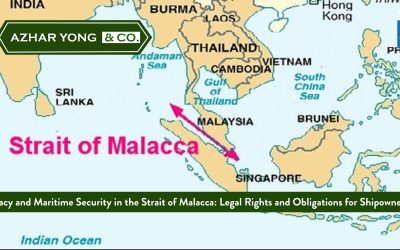
Piracy and Maritime Security in the Strait of Malacca: Legal Rights and Obligations for Shipowners
The Strait of Malacca — shared between Malaysia, Indonesia, and Singapore — was historically one of the world's most dangerous waterways for piracy and armed robbery at sea. Coordinated multinational patrols under the Malacca Straits Patrol (MSP) framework,...
Freight Forwarder Liability in Malaysia: When Things Go Wrong
Freight forwarders occupy a central but legally ambiguous position in modern supply chains. Depending on how the contract is structured, a freight forwarder may be acting purely as an agent — arranging transport on behalf of the cargo owner without assuming any...

Maritime Fraud in Malaysia: How to Protect Your Business and What to Do If You Are a Victim?
Maritime fraud encompasses a wide range of dishonest conduct — document forgery, cargo diversion, misrepresentation of vessel identity, fraudulent letters of indemnity, phantom shipments, and more. In Malaysia, maritime fraud is a criminal offence under the Penal Code...
Ship Repair Disputes in Malaysia: What Shipowners and Yards Need to Know
Malaysia's ship repair industry is substantial, with yards in Port Klang, Penang, Johor Bahru, Labuan, and Kuching handling routine dry-docking, emergency repairs, and major conversions for both domestic and international vessels. The ship repair relationship is...
Letters of Indemnity in Shipping: Risks and Legal Consequences in Malaysia
A Letter of Indemnity (LOI) in shipping is a document issued by the cargo receiver (or shipper) to the carrier, undertaking to indemnify the carrier against all losses, costs, and liabilities that may arise from releasing or delivering cargo in circumstances that...