
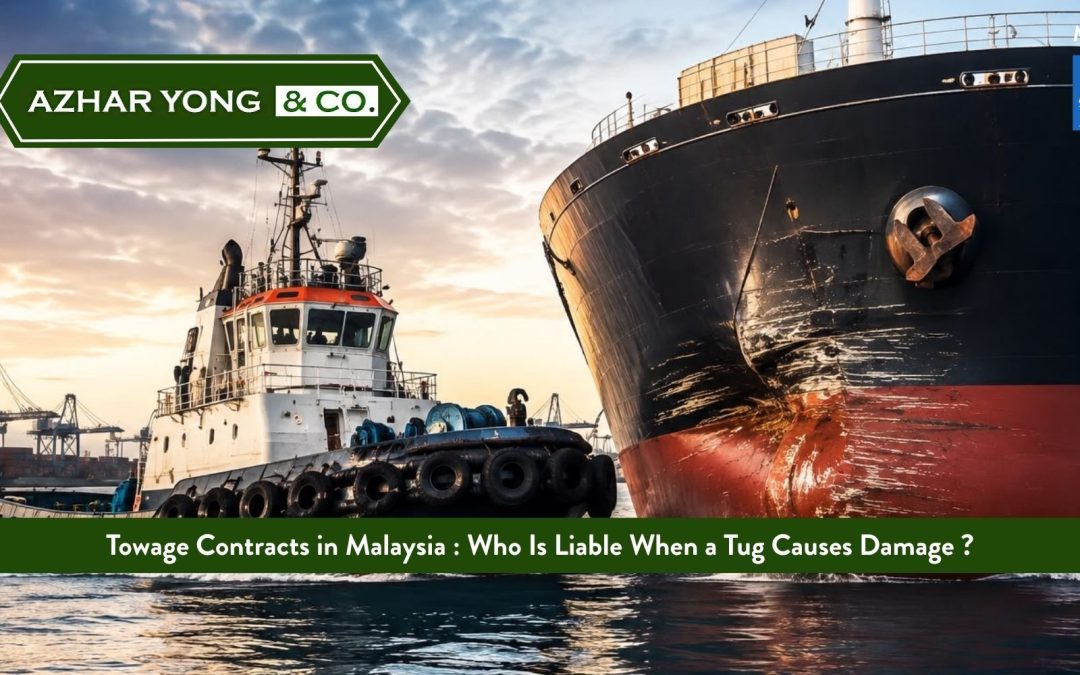
Towage is the service of using one vessel (the tug) to move, guide, or assist another vessel (the tow). In Malaysian ports, towage services are provided by licensed tug operators — including Bumi Armada, Maju Maritime, and port authority-operated tugs — and are a compulsory requirement for vessels above a specified size in most port approaches. The towage contract governs the legal relationship between the tug owner and the tow owner, and determines how liability is allocated when damage occurs.
The most widely used towage contract forms in Malaysia are the BIMCO TOWCON (for ocean towage on a lump sum basis), BIMCO TOWHIRE (for ocean towage on a daily rate), and the standard port towage terms of the relevant port authority. These standard forms typically contain a paramount liability clause — also known as a ‘negligent tow’ clause — which provides that the tug and its crew are deemed to be the servants of the tow owner during the towage operation, and that the tug owner is therefore not liable for damage caused by the tug’s own negligence.
This clause — which shifts liability to the tow owner for the negligence of the tug — is one of the most counterintuitive provisions in maritime law. A tug captain makes a navigational error and strikes another vessel: under the standard towage terms, it is the tow owner, not the tug owner, who bears liability for the damage to the third party. The tow owner may also be denied a claim against the tug owner for damage to their own vessel.
However, this liability allocation is not absolute. Malaysian courts and arbitrators will scrutinise whether the negligent tow clause was properly incorporated into the contract and whether it was reasonable in the circumstances. Where the tug owner’s conduct amounts to gross negligence or wilful misconduct — or where the tug was unseaworthy at the commencement of the towage — the clause may not provide a complete defence.
Key Liability Issues in Malaysian Port Towage
-
The ‘negligent tow’ clause: Standard port towage terms typically shift liability for tug crew negligence to the tow owner. Know your terms before the tug lines are made fast.
-
Unseaworthiness of the tug: A tug owner cannot rely on a negligent tow clause where the tug was unseaworthy at the commencement of the towage. This is an important exception that must be investigated after any incident.
-
Third-party damage: A third party damaged by the tug’s negligence can sue either the tug owner or the tow owner in tort — the towage contract between tug and tow is not binding on third parties.
-
P&I Club notification: Both tug and tow P&I Clubs must be notified immediately after any incident. Late notification can prejudice coverage.
-
Limitation of liability: Both the tug owner and the tow owner may be entitled to limit their liability under the LLMC 1996 — but the applicable tonnage-based limit is calculated separately for each vessel.
Frequently Asked Questions: Towage in Malaysia
Q: Is the ‘negligent tow’ clause always enforceable in Malaysia?
A: Not automatically. For the negligent tow clause in a port towage contract to be binding, it must have been properly incorporated into the contract — meaning the tow owner must have agreed to the towage on those terms, either expressly or through a prior course of dealing. Where a tow owner was not given the opportunity to review the towage terms before the operation commenced, or where the terms were not brought to their attention, the clause may not be binding. Even where the clause is incorporated, Malaysian courts — following established English admiralty principles — will scrutinise its scope carefully. A clause that purports to exclude liability for the tug owner’s gross negligence, wilful misconduct, or the unseaworthiness of the tug at the outset of the towage may be held unenforceable as contrary to public policy or as an unreasonable exclusion under general contract principles.
Q: Who is liable to a third party damaged by a tug during port towage?
A: This is one of the most important questions in towage law — and the answer is more flexible than the towage contract between tug and tow might suggest. The towage contract allocates liability between the tug owner and the tow owner inter se — but it is not binding on third parties. A vessel, cargo owner, or port authority damaged by the tug’s negligent navigation during a towage operation can sue either the tug owner (in negligence, for the tug crew’s actions) or the tow owner (if the tow is deemed to have been in charge of the operation) or both. The courts will apportion liability between the tug and tow based on the actual facts of the incident — regardless of what the private towage contract says. This means that a third-party victim has the broadest possible choice of defendants, while the tug and tow owners resolve their own liability allocation between themselves under the towage contract.
Q: Can a tug owner limit its liability under the LLMC 1996?
A: Yes — a tug is a vessel, and the owner of a tug that causes damage during a towage operation can invoke the LLMC 1996 limitation regime in Peninsular Malaysia and Labuan. The limitation fund is calculated by reference to the tug’s gross tonnage — which is typically much smaller than the vessels it is assisting. This means that in practice, the available limitation fund for a port tug may be very modest — potentially insufficient to cover the full value of damage to a large container vessel or the cargo it was carrying. The tow owner’s limitation fund, by contrast, is calculated by reference to the tow’s (larger) tonnage — which is why the negligent tow clause can produce a higher net recovery for a damaged third party than a direct claim against the tug. A maritime lawyer can map out the most effective strategy for recovery in a specific towage incident.
Q: My vessel was damaged by a tug during compulsory port towage — what are my rights?
A: Where the use of a port tug is compulsory — required by the port authority’s rules for vessels of a certain size — the tow owner has no choice but to engage the tug. Despite this, the standard negligent tow clause in most port towage terms still operates to allocate liability for tug negligence to the tow owner. This may seem harsh, but it is the established position in Malaysian and English maritime law. Your immediate remedies are: claim against your own hull insurer for the damage to your vessel; instruct your P&I Club to investigate whether the tug was unseaworthy or whether the clause was properly incorporated; and seek legal advice on whether there are grounds to challenge the clause’s application in the specific circumstances. Where the tug owner’s conduct amounts to gross negligence, wilful misconduct, or fraud, the negligent tow clause will not protect them.
Q: What should I do in the immediate aftermath of a towage accident in Malaysia?
A: The immediate post-incident steps are: ensure crew safety and account for all personnel; notify the port authority and MMEA as required; notify your P&I Club and hull insurer without delay — this is a condition of cover; instruct a marine surveyor to attend both the tug and the tow to document the damage, the tug’s condition, and the circumstances of the incident; preserve all evidence including bridge recordings, engine room logs, VDR data, and communications; obtain copies of the towage contract and the port authority’s standard towage terms; do not make any admission of liability or sign any document without taking legal advice; and engage a maritime lawyer immediately. In port towage accidents, the evidence from the first hours is critical — and it can disappear quickly.
About the Author: Mr. Yong Chee Kong

Yong Chee Kong is an experienced Advocate & Solicitor with over three decades of legal experience, with principal areas of practice in Corporate Law and Shipping & Maritime Law. Called to the Bar in 1995, he has advised shipping companies, developers, financial institutions, and corporate entities on complex legal matters, including shipping disputes, development projects, project financing, mergers, takeovers, and acquisitions.
As a seasoned litigation lawyer, Yong Chee Kong regularly appears before the High Court, Court of Appeal, and Federal Court of Malaysia. His broad experience also extends to Banking, Finance, and Construction Law, enabling him to advise clients across a range of complex commercial and corporate matters.
Beyond legal practice, he is a registered Patent, Trade Marks and Industrial Design agent, as well as a Commissioner for Oaths and Notary Public. He has also served as a member of the Bar Council Disciplinary Committee and chaired numerous disciplinary investigations involving members of the Malaysian Bar.
His academic and professional qualifications include an LL.B (Hons) from the University of London, a Certificate in Legal Practice from University Malaya, and successful completion of the Patent Agent Examination conducted by the Intellectual Property Corporation of Malaysia.
-
Expertise: Corporate Law, Shipping & Maritime Law, Banking & Finance, Construction Law, Commercial Litigation, Intellectual Property
-
Professional Experience: 30+ years
-
Called to the Bar: High Court of Malaya, 1995
-
Professional Roles: Patent, Trade Marks & Industrial Design Agent; Commissioner for Oaths; Notary Public
Maritime Fraud in Malaysia: How to Protect Your Business and What to Do If You Are a Victim?
Maritime fraud encompasses a wide range of dishonest conduct — document forgery, cargo diversion, misrepresentation of vessel identity, fraudulent letters of indemnity, phantom shipments, and more. In Malaysia, maritime fraud is a criminal offence under the Penal Code...
Ship Repair Disputes in Malaysia: What Shipowners and Yards Need to Know
Malaysia's ship repair industry is substantial, with yards in Port Klang, Penang, Johor Bahru, Labuan, and Kuching handling routine dry-docking, emergency repairs, and major conversions for both domestic and international vessels. The ship repair relationship is...
Letters of Indemnity in Shipping: Risks and Legal Consequences in Malaysia
A Letter of Indemnity (LOI) in shipping is a document issued by the cargo receiver (or shipper) to the carrier, undertaking to indemnify the carrier against all losses, costs, and liabilities that may arise from releasing or delivering cargo in circumstances that...
Offshore Vessel Disputes in Malaysia: What OSV Owners and Operators Need to Know
Malaysia's offshore oil and gas industry — anchored by PETRONAS and its production sharing contract (PSC) partners — is the largest single driver of demand for offshore support vessels (OSVs) in the country. Anchor handling tug supply vessels (AHTS), platform supply...
What Happens When a Shipyard Delays Delivery? Your Legal Rights in Malaysia
Delivery delays are the most common disputes in shipbuilding. When a yard fails to deliver a vessel by the contractual date — even accounting for permitted extensions — the buyer has clearly defined legal rights. The challenge is exercising them correctly, within the...
Shipbuilding Contracts in Malaysia: A Complete Legal Guide for Buyers and Shipyards
Malaysia has a significant and growing shipbuilding and ship repair industry. Major shipyards operate at Pulau Indah (Port Klang), Pasir Gudang (Johor), Penang, Labuan, and along the Sarawak coast — building offshore support vessels, tugs, barges, tankers, and...