
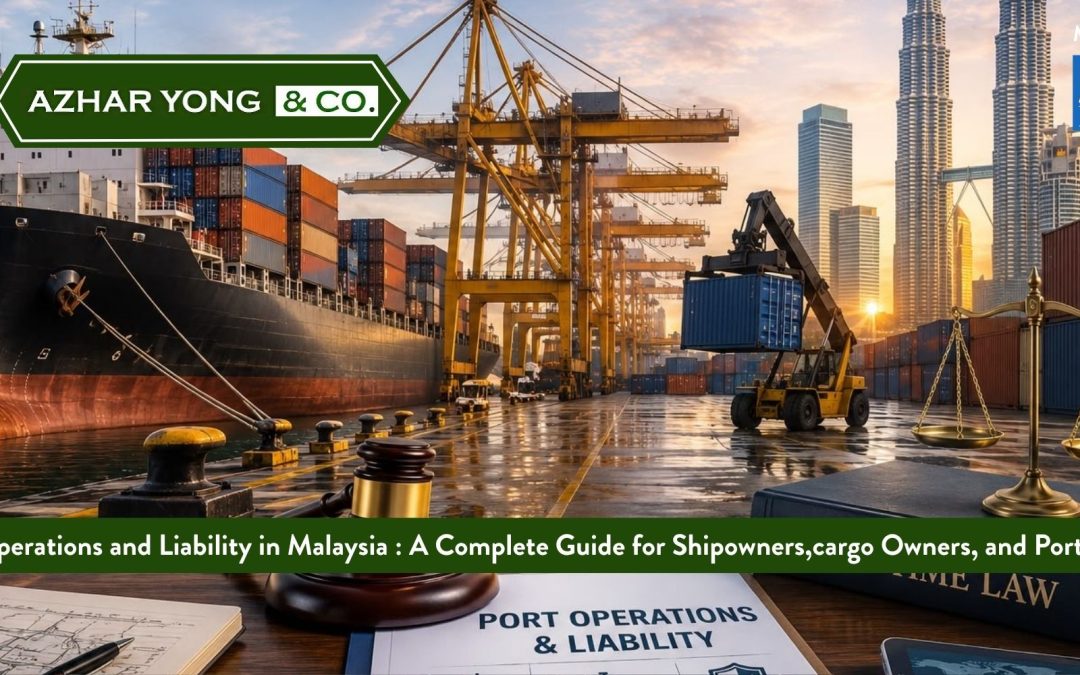
Malaysia operates some of the most strategically important ports in the world. Port Klang — Malaysia’s largest and one of Asia’s top 15 container ports — handles over 14 million TEUs annually. Port of Tanjung Pelepas (PTP) in Johor is a major transhipment hub serving the Asia-Europe and Asia-Americas trade lanes. Penang Port serves northern Malaysia and remains critical for the electronics manufacturing sector. Bintulu Port in Sarawak is the principal export gateway for Malaysia’s LNG trade. Together, these ports — and dozens of smaller regional ports — form the physical infrastructure through which Malaysia’s export-driven economy operates.
With this level of activity comes significant legal complexity. Ports are environments where multiple legal relationships intersect simultaneously: the port authority’s statutory functions; the terminal operator’s contractual obligations to shipping lines; the pilotage authority’s duties to vessels navigating the port approach; tug operators providing towage assistance; stevedores handling cargo; and warehouse operators storing goods. When an incident occurs in port — a vessel collision while manoeuvring, a container dropped by a quayside crane, a fire in a terminal warehouse, a dock worker fatally injured — the question of who bears legal liability is rarely simple.
This guide provides a comprehensive overview of the legal framework governing port operations and liability in Malaysia, covering the roles and responsibilities of each key party, the most common categories of port-related disputes, the applicable legislation, and the legal remedies available to shipowners, cargo owners, and other port users.
Malaysia’s Port Legal Framework: Who Governs and Who Is Liable?
Port operations in Malaysia are regulated by a combination of federal legislation, port authority by-laws, and international conventions. The primary legislation includes:
-
The Ports Act 1963 — the foundational statute establishing the legal framework for port operations, port authorities, and port dues.
-
The Merchant Shipping Ordinance 1952 (MSO 1952) — governing vessel movements, pilotage, and casualty investigation in port waters.
-
The Port Authorities Act 1963 — establishing the legal status and powers of individual port authorities including Klang Port Authority (KPA), Penang Port Commission (PPC), and Johor Port Authority.
-
The Privatisation Act 1992 and individual concession agreements — governing the relationship between port authorities and privatised terminal operators such as Northport, Westports, MMC-Gamuda, and Pelabuhan Tanjung Pelepas Sdn Bhd.
-
The Environmental Quality Act 1974 — imposing environmental liability for pollution incidents in port waters.
-
The Occupational Safety and Health Act 1994 (OSHA) — governing the safety obligations of employers and occupiers at port facilities.
The critical legal distinction in Malaysian port law is between the port authority — a statutory body with regulatory and safety functions — and the terminal operator — a private company contracted to handle vessels and cargo within the port area. This distinction determines who bears liability for different categories of incident.
The Key Parties and Their Legal Obligations
1. Port Authorities
Malaysian port authorities — Klang Port Authority, Penang Port Commission, Johor Port Authority, and others — are statutory bodies established under the Port Authorities Act 1963. Their primary functions are regulatory: controlling vessel movements, licensing port operations, maintaining port infrastructure, and enforcing port by-laws. Port authorities owe a duty of care to vessels using the port in respect of the safety of port infrastructure — including quay walls, navigation aids, dredged depths, and port signals. Where a vessel is damaged due to a defect in port infrastructure that the authority knew or should have known about, the authority may be liable in negligence.
However, port authorities in Malaysia enjoy certain statutory protections, and establishing liability against a port authority requires overcoming defences of statutory immunity and act of state. The courts have held that port authorities are not insurers of vessel safety — they are not automatically liable for every incident occurring within port limits.
2. Terminal Operators
Terminal operators — Westports, Northport, PTP, Bintulu Port Holdings, and others — are private companies operating under concession agreements with the relevant port authority. They are responsible for berth allocation, vessel berthing and unberthing operations, stevedoring (loading and unloading cargo), container handling, and cargo storage within the terminal. Terminal operators owe contractual duties to shipping lines and cargo owners for the safe handling and storage of cargo, and owe tortious duties of care for the safety of vessels, cargo, and personnel within the terminal.
Most terminal operator liability disputes arise from cargo handling damage — containers dropped by gantry cranes, goods damaged in transit through the terminal, refrigerated cargo spoiled due to power failure, or cargo lost in a terminal fire. Terminal operator standard terms and conditions typically contain liability limitation clauses — but as with freight forwarder terms, these must be properly incorporated and may not protect against gross negligence or fraud.
3. Pilotage Authorities and Pilots
Pilotage — the service provided by licensed pilots who board vessels to guide them through port approaches and within port limits — is compulsory for most vessels above a specified size in Malaysian ports under the MSO 1952. A licensed pilot boards the vessel and takes charge of its navigation within the compulsory pilotage zone.
The legal liability framework for pilotage is one of the most complex in maritime law. In Malaysia, as in most common law jurisdictions, a pilot navigating a vessel under compulsory pilotage is treated as the servant of the vessel, not of the pilotage authority. This means that where a compulsory pilot’s negligent navigation causes a collision or grounding, the shipowner — not the pilotage authority — bears primary liability for the resulting damage, even though the pilot is an independent public officer and not the shipowner’s employee. The shipowner has no right of recourse against the compulsory pilot or the pilotage authority for losses caused by the pilot’s negligence.
4. Stevedores
Stevedores are the companies and workers who physically load and unload cargo from vessels. Their liability to cargo owners arises in both contract (where they are party to a direct agreement with the cargo owner or the carrier) and in tort (where their negligent handling causes damage to cargo or injury to persons). The Himalaya clause in bills of lading extends the carrier’s contractual immunities and limitations to stevedores acting as sub-contractors — but only where the clause is properly incorporated, and the stevedore falls within its scope.
5. Tug Operators
Tugs assist vessels in manoeuvring within port limits — pushing, pulling, and guiding larger vessels to and from berths. The legal relationship between tug and tow, and liability for damage caused during port towage, is governed by the towage contract (typically the BIMCO TOWCON or TOWHIRE forms, or the port authority’s standard towage terms) and by the law of negligence. This topic is covered in detail in our dedicated blog on towage liability — link in SEO notes below.
The Most Common Port Liability Disputes in Malaysia
1. Vessel Collision or Damage at Berth
Vessels can be damaged at berth by other vessels, by floating objects, by quayside cranes, or by substandard berth infrastructure. Where the damage is caused by another vessel’s manoeuvring error, the claim is a collision claim. Where it is caused by defective port infrastructure — a broken fender, an inadequate quay wall, insufficient dredging — the claim lies against the port authority or terminal operator. The cause must be established through survey and expert evidence before liability can be determined.
2. Cargo Damage in the Terminal
Cargo can be damaged at multiple points during its passage through a port terminal: during discharge from the vessel, during horizontal transport within the terminal, during stacking and storage in the container yard, and during loading onto road or rail transport for onward delivery. Identifying where damage occurred — on board the vessel, during stevedoring, or in terminal storage — determines which party is liable and which limitation regime applies.
3. Port Congestion and Delay Claims
Port congestion — a persistent challenge at Port Klang and other major Malaysian ports — gives rise to commercial losses that parties attempt to apportion through their contracts. Demurrage claims against cargo interests for vessel delay in port; off-hire claims against shipowners for time lost due to berth unavailability; and claims against terminal operators for delay in container gate-out are all common. Whether any particular loss is legally recoverable depends on the relevant contract and whether the delay was caused by the claimant, the defendant, or a third party.
4. Port Worker Injuries
Injuries to port workers — dock labourers, crane operators, tally clerks — give rise to employer liability claims under the Employees’ Social Security Act 1969 (SOCSO), the Workmen’s Compensation Act 1952, and in negligence. Where a port worker is injured due to the fault of a vessel’s crew (for example, by an unsafe vessel condition or crew negligence), a claim can be brought against the shipowner. The shipowner’s liability to third parties injured in port is within the admiralty jurisdiction, and may be subject to limitation under the LLMC 1996.
5. Dangerous Cargo Incidents
The mishandling, misdeclaration, or improper stowage of dangerous goods in port can cause fires, explosions, and toxic releases with catastrophic consequences — as tragically illustrated by the Beirut port explosion in 2020. In Malaysia, dangerous goods handling in ports is governed by the IMDG Code, the Port Klang Authority By-Laws, and OSHA 1994. Liability for a dangerous goods incident in a Malaysian port can extend simultaneously to the shipper, the freight forwarder, the terminal operator, the vessel, and potentially the port authority.
Limitation of Liability in the Port Context
Many port-related claims are subject to the maritime limitation of liability regime under the LLMC 1996 (for Peninsular Malaysia and Labuan) and the 1957 Convention (for Sabah and Sarawak). Where a shipowner’s vessel causes damage in port — whether to another vessel, to port infrastructure, or to cargo — the shipowner can seek to limit its liability to the tonnage-based fund under the applicable convention.
Port authorities and terminal operators are not automatically entitled to limit their liability under the LLMC — their entitlement to limitation depends on whether they fall within the definition of persons entitled to limit under the convention. Terminal operators who own or operate vessels (such as a terminal tug or a harbour crane barge) may be able to invoke limitation in respect of their vessel-related operations.
Time Limits: Port-related claims are subject to various limitation periods depending on their nature. Cargo claims under the Hague Rules have a one-year limitation period. Collision damage claims have a two-year period under the Maritime Conventions Act 1911. Claims against terminal operators in contract follow the general six-year limitation period under the Limitation Act 1953. Always check the applicable limitation period and take legal advice before it expires.
Claiming Against Port Klang Authority and Malaysian Terminal Operators
Port Klang is Malaysia’s largest port and the most frequent forum for port liability disputes. Claims against the Klang Port Authority (KPA) or against the privatised terminal operators (Westports Malaysia, Northport, and others) require careful analysis of: the statutory framework governing the KPA’s duties; the concession agreement between the KPA and the terminal operator; the terminal operator’s standard terms and conditions; and the specific facts giving rise to the claim.
Where cargo has been damaged at a terminal, the claimant should act quickly to: survey the damage before the cargo is moved from the terminal; preserve all terminal handling records and CCTV footage; issue a formal written claim to the terminal operator within any applicable contractual time bar; and engage a maritime lawyer to assess the available legal routes.
Claims against terminal operators in Malaysia are heard in the civil courts (typically the Admiralty Court in Kuala Lumpur where there is a maritime dimension) and through arbitration where the terminal’s standard terms specify arbitration as the dispute resolution mechanism.
How Azhar Yong & Co. Can Help
Azhar Yong & Co. advises shipowners, cargo owners, terminal operators, and port users on the full range of port liability issues in Malaysia — from initial incident response and evidence preservation through to litigation, arbitration, and settlement. Our specific capabilities include:
-
Advising vessel owners on port infrastructure defect claims against Malaysian port authorities.
-
Pursuing and defending cargo damage claims against Malaysian terminal operators, including Westports, Northport, PTP, and Bintulu Port Holdings.
-
Advising on pilotage liability and the legal consequences of vessel incidents occurring during compulsory pilotage.
-
Managing dangerous goods incidents in Malaysian ports — including regulatory response, criminal defence, and civil liability claims.
-
Advising on port worker injury claims involving vessel crew liability.
-
Constituting limitation funds and managing multi-party port casualty proceedings in the Admiralty Court.
Conclusion: Know Your Rights Before Entering Port
Port operations are among the most legally complex environments in the maritime world — multiple parties, overlapping legal frameworks, short time limits, and high-value claims all converge at once. Whether you are a shipowner bringing a vessel into Port Klang for the first time, a cargo owner whose container has been damaged in a terminal, or a port operator managing the aftermath of a serious incident, understanding the legal landscape before you need it is far better than discovering it after the fact.
Azhar Yong & Co. is available to advise on all aspects of port liability in Malaysia — from urgent response to a port incident to long-term claims strategy. Contact us for a confidential consultation.
About the Author: Mr. Yong Chee Kong

Yong Chee Kong is an experienced Advocate & Solicitor with over three decades of legal experience, with principal areas of practice in Corporate Law and Shipping & Maritime Law. Called to the Bar in 1995, he has advised shipping companies, developers, financial institutions, and corporate entities on complex legal matters, including shipping disputes, development projects, project financing, mergers, takeovers, and acquisitions.
As a seasoned litigation lawyer, Yong Chee Kong regularly appears before the High Court, Court of Appeal, and Federal Court of Malaysia. His broad experience also extends to Banking, Finance, and Construction Law, enabling him to advise clients across a range of complex commercial and corporate matters.
Beyond legal practice, he is a registered Patent, Trade Marks and Industrial Design agent, as well as a Commissioner for Oaths and Notary Public. He has also served as a member of the Bar Council Disciplinary Committee and chaired numerous disciplinary investigations involving members of the Malaysian Bar.
His academic and professional qualifications include an LL.B (Hons) from the University of London, a Certificate in Legal Practice from University Malaya, and successful completion of the Patent Agent Examination conducted by the Intellectual Property Corporation of Malaysia.
-
Expertise: Corporate Law, Shipping & Maritime Law, Banking & Finance, Construction Law, Commercial Litigation, Intellectual Property
-
Professional Experience: 30+ years
-
Called to the Bar: High Court of Malaya, 1995
-
Professional Roles: Patent, Trade Marks & Industrial Design Agent; Commissioner for Oaths; Notary Public

Cargo Claim Legal Process in Malaysia: A Detailed Guide for Cargo Owners
The cargo claim legal process in Malaysia governs how disputes involving lost, damaged, or delayed cargo are resolved under Malaysian maritime law. For cargo owners, traders, freight forwarders, and insurers, cargo claims can result in significant financial loss and...

Shipping Dispute Lawyer in Kuala Lumpur: Resolving Maritime Conflicts Effectively
A shipping dispute lawyer in Kuala Lumpur plays a vital role in resolving disputes arising from maritime trade, vessel operations, and shipping contracts. As Kuala Lumpur remains closely linked to Malaysia’s major ports, shipping lanes, and logistics networks,...

Marine Insurance Dispute Lawyer in Malaysia: Managing Coverage and Claim Disputes
A marine insurance dispute lawyer in Malaysia plays a crucial role in protecting the rights of policyholders when insurers dispute coverage or deny claims following maritime incidents. Marine insurance claims often involve substantial financial exposure, whether...

Ship Arrest in Malaysia: Legal Procedures, Risks, and Strategic Considerations
Ship arrest in Malaysia is one of the most powerful remedies available to maritime claimants seeking to secure unpaid debts or enforce maritime rights. This legal mechanism allows a claimant to detain a vessel as security for a recognised maritime claim, often...

Admiralty Jurisdiction of Malaysian Courts: Enforcement of Maritime Rights
The admiralty jurisdiction of Malaysian courts plays a central role in the enforcement of maritime rights and obligations within Malaysia. It allows maritime claimants to pursue legal action directly against vessels and shipping interests, making it an essential...

Protecting Assets at Sea: The Evolution of Marine Insurance Claims Malaysia
Marine insurance claims Malaysia have become a core element of corporate risk management as the global shipping and logistics industry faces new operational risks, regulatory pressures, and mounting asset values. Globally, premiums for marine insurance surpassed USD...