
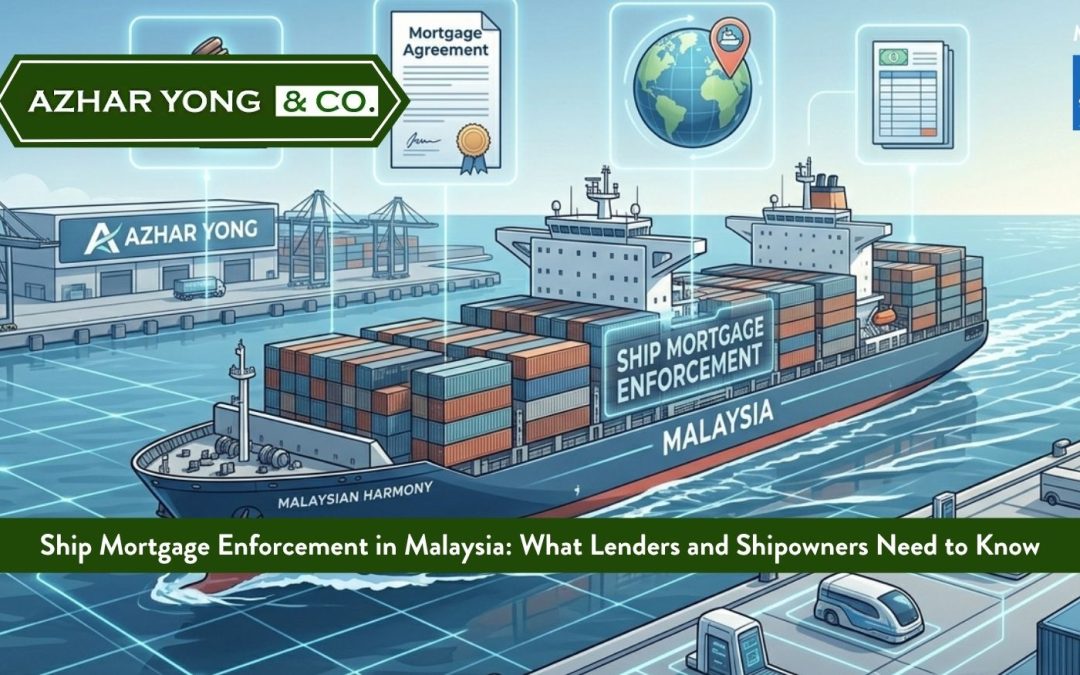
A ship mortgage is a security interest granted by a shipowner over a vessel in favour of a lender as collateral for a loan or financing facility. It functions similarly to a property mortgage — the shipowner retains possession and continues operating the vessel. Still, the lender holds a registered charge over the ship that can be enforced if the borrower defaults.
In Malaysia, ship mortgages are governed by the Merchant Shipping Ordinance 1952 (MSO 1952) and must be registered to be effective as a legal mortgage. Registration is maintained by the Malaysian Ship Register (MSR), with offices in Port Klang, Penang, Kuching, and Kota Kinabalu, and by the Malaysian International Ship Register (MISR) in Labuan for international vessels. A registered mortgage provides public notice of the lender’s security interest and establishes its priority over subsequent creditors.
When a borrower defaults — whether by failing to repay the loan, breaching a covenant, or allowing insurance to lapse — the mortgagee lender has several enforcement options. The most powerful option is to apply to the Malaysian Admiralty Court to arrest the vessel and obtain a judicial sale. The court will supervise the sale process and distribute the proceeds to creditors in order of priority. Under Malaysian admiralty law, a registered ship mortgage ranks as a high-priority claim — behind certain maritime liens such as seafarer wages and salvage, but ahead of most unsecured creditors.
Speed is critical in mortgage enforcement. Once a default occurs, a vessel that leaves Malaysian waters may be difficult or impossible to arrest in this jurisdiction. A maritime lawyer with Admiralty Court experience can move quickly — filing the arrest application within days — to prevent the vessel from sailing before security is obtained.
How Ship Mortgage Enforcement Works in Malaysia
-
Step 1 — Default and demand: The lender serves formal notice of default and demands repayment. The mortgage instrument will specify the conditions triggering enforcement rights.
-
Step 2 — Vessel arrest: The lender’s maritime lawyer applies to the Admiralty Court for a Warrant of Arrest. Once issued, the Admiralty Sheriff serves the warrant on the vessel, preventing it from leaving port.
-
Step 3 — Judicial sale: If the debt is not discharged, the court orders the judicial sale of the vessel. The sale proceeds are applied first to court costs and maritime liens ranking above the mortgage, then to the mortgagee’s debt.
-
Step 4 — Distribution of proceeds: Any surplus after satisfying the mortgage debt is distributed to other creditors in order of priority. Any shortfall remains recoverable as a personal debt against the shipowner.
Frequently Asked Questions
Q: Does a ship mortgage need to be registered in Malaysia to be enforceable?
A: Registration is critical. Under the MSO 1952, a ship mortgage over a Malaysian-registered vessel must be registered with the relevant ship registry — the MSR or MISR — to constitute a legal mortgage with priority over subsequent creditors. An unregistered mortgage may still be enforceable as an equitable charge between the parties, but it will not have the same priority status and can be defeated by a subsequent registered mortgagee who takes without notice. Importantly, Malaysian admiralty law also recognises mortgages and charges created under foreign law — meaning a mortgage registered with a foreign flag state registry can still be the basis for an in rem claim in the Malaysian Admiralty Court, even if not registered in Malaysia.
Q: What happens to an existing charter party when a ship mortgage is enforced?
A: This is one of the most complex issues in ship mortgage enforcement. Where a vessel is operating under a charterparty at the time the mortgagee enforces, the mortgagee takes possession subject to the charterer’s rights — unless the charterparty was granted by the shipowner without the mortgagee’s consent in breach of the mortgage terms. In practice, most commercial ship mortgages contain an ‘assignment of earnings’ clause under which the charterer is directed to pay hire to the mortgagee directly upon default. A mortgagee considering enforcement should take legal advice on the existing charter arrangements before proceeding, as wrongly disrupting a charterparty can expose the lender to counterclaims.
Q: What is the priority of a ship mortgage against maritime liens in Malaysia?
A: In Malaysia, certain maritime liens rank ahead of a registered ship mortgage in the distribution of sale proceeds. These include: seafarers’ wage claims; salvage claims; claims for damage done by the vessel; and port and harbour dues. This means that even a first-registered mortgagee may not recover the full debt if the vessel is subject to significant maritime lien claims. This priority structure is one of the key risks that ship finance lenders must account for when assessing security. A maritime lawyer can advise lenders on strategies to manage maritime lien risk, including requiring the borrower to maintain P&I Club cover and monitoring the vessel’s trading activities.
Q: Can a foreign bank enforce a ship mortgage in the Malaysian Admiralty Court?
A: Yes. The Malaysian Admiralty Court regularly hears ship mortgage enforcement actions brought by foreign banks and financial institutions. A claim in respect of a mortgage of or charge on a ship — whether registered in Malaysia or under foreign law — falls squarely within the admiralty jurisdiction of the Malaysian High Court under Section 20(2)(c) of the UK Senior Courts Act 1981, as applied in Malaysia through the Courts of Judicature Act 1964. Foreign lenders typically engage a Malaysian maritime law firm to conduct the arrest and enforcement proceedings locally, while coordinating with their home jurisdiction counsel on the broader debt recovery strategy.
Q: What happens if the judicial sale proceeds are not enough to cover the full mortgage debt?
A: If the vessel sells for less than the outstanding mortgage debt — a real risk in a depressed shipping market — the shortfall does not disappear. The mortgagee retains a personal claim against the shipowner (the mortgagor) for the balance, which can be pursued through ordinary civil proceedings. However, recovering a deficiency judgment against a shipowner who is insolvent or based in a foreign jurisdiction can be difficult and expensive. This is precisely why lenders structure ship finance transactions with additional security — personal guarantees from the beneficial owner, corporate guarantees from related companies, and assignment of insurance proceeds — to maximise recovery beyond the vessel itself.
Enforcing a ship mortgage or advising on vessel financing in Malaysia? Azhar Yong & Co. advises lenders, financiers, and shipowners on ship mortgage registration, enforcement, and admiralty proceedings across Malaysia and the Asia-Pacific region.

Reefer Cargo Disputes in Malaysia: Who Pays When Temperature-Sensitive Goods Are Damaged?
Malaysia is a major exporter of temperature-sensitive goods — including palm oil products, pharmaceutical ingredients, fresh tropical produce, rubber products, and frozen seafood — and a significant importer of cold chain goods including dairy, meat, vaccines, and...
Dangerous Goods at Sea in Malaysia: Legal Obligations and Liability Under the IMDG Code
Malaysia is a major hub for the regional chemical and petrochemical trade, with significant volumes of Class 3 flammable liquids, Class 2 compressed gases, Class 6 toxic substances, and Class 9 miscellaneous dangerous goods moving through Port Klang and other ports...
Towage Contracts in Malaysia: Who Is Liable When a Tug Causes Damage?
Towage is the service of using one vessel (the tug) to move, guide, or assist another vessel (the tow). In Malaysian ports, towage services are provided by licensed tug operators — including Bumi Armada, Maju Maritime, and port authority-operated tugs — and are a...
Port Operations and Liability in Malaysia: A Complete Guide for Shipowners, Cargo Owners, and Port Users
Malaysia operates some of the most strategically important ports in the world. Port Klang — Malaysia's largest and one of Asia's top 15 container ports — handles over 14 million TEUs annually. Port of Tanjung Pelepas (PTP) in Johor is a major transhipment hub serving...
Marine Casualties and Official Investigations in Malaysia: What Shipowners and Masters Need to Know
A marine casualty — whether a grounding, fire, flooding, collision, or structural failure — triggers a cascade of simultaneous legal, regulatory, and commercial obligations. In Malaysia, the primary investigative authority for marine casualties is the Marine...
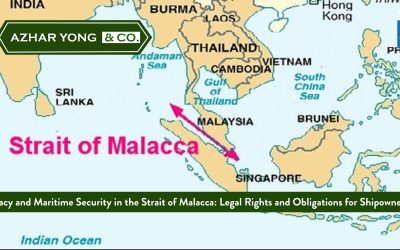
Piracy and Maritime Security in the Strait of Malacca: Legal Rights and Obligations for Shipowners
The Strait of Malacca — shared between Malaysia, Indonesia, and Singapore — was historically one of the world's most dangerous waterways for piracy and armed robbery at sea. Coordinated multinational patrols under the Malacca Straits Patrol (MSP) framework,...