
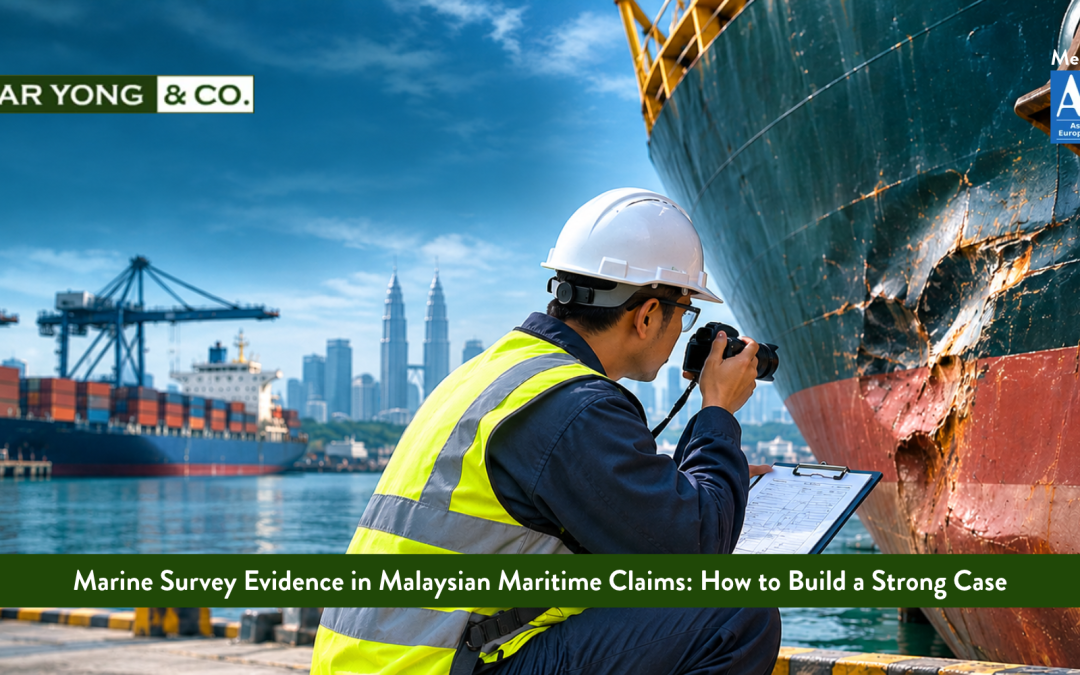
A marine survey is an independent technical inspection conducted by a qualified marine surveyor to assess the condition of a vessel, cargo, or piece of equipment — and to form a professional opinion on the cause, extent, and value of any loss or damage. In Malaysian maritime claims, the survey report is almost always the most important documentary evidence: courts and arbitral tribunals place significant weight on independent expert survey evidence, and a claim without a contemporaneous, independent survey is significantly harder to prove.
Marine surveyors in Malaysia are typically engaged by one or more of: the cargo owner’s insurance company (to assess the nature and extent of cargo damage and establish cause); the ship’s P&I Club (to investigate incidents, preserve evidence, and advise on liability); the hull insurer (to assess damage to the vessel and advise on repair scope and cost); or the shipowner or charterer directly (to document conditions relevant to a legal dispute). The timing and scope of the survey engagement are critical: a surveyor appointed promptly — before cargo is moved, before containers are re-stacked, before the vessel is repaired — captures contemporaneous evidence that simply cannot be recreated later.
In Malaysia, marine surveyors are not subject to a statutory licensing or accreditation regime in the same way as surveyors in some other jurisdictions. However, reputable surveyors are members of professional bodies such as the Institute of Marine Engineering, Science and Technology (IMarEST), the Society of Accredited Marine Surveyors (SAMS), or the National Association of Marine Surveyors (NAMS), and many are accredited through classification societies or internationally recognised survey organisations such as Lloyd’s Register, Bureau Veritas, DNV, or ClassNK.
For legal proceedings in Malaysia, a survey report is admissible as expert evidence under the Evidence Act 1950. The weight given to expert evidence by the court depends on the qualifications of the surveyor, the independence of their appointment, the methodology used, and the contemporaneous nature of the inspection — all of which must be addressed in the way the survey is commissioned and conducted.
When and How to Commission a Marine Survey in Malaysia
- Cargo damage: Commission a joint survey — attended by representatives of both the cargo claimant and the carrier — as soon as damaged cargo is identified, before goods are moved from their delivery location. A joint survey establishes agreed facts that narrow the subsequent dispute.
- Ship collision or grounding: Commission an independent hull survey immediately after the vessel is safely placed. The survey should document the extent and nature of the damage, the likely cause, and the repair scope and cost. Do not allow repairs to commence before the survey is complete.
- Reefer cargo disputes: Obtain the TDR (temperature data recorder) printout from the container before it is returned, and commission an independent reefer expert to analyse the data alongside the survey of the cargo condition.
- Vessel condition disputes (on/off hire): Commission an on-hire or off-hire condition survey to document the vessel’s condition at the commencement or termination of a time charter — essential evidence in redelivery condition disputes.
- General Average: The Average Adjuster will coordinate surveys across all interests — but individual cargo owners should appoint their own surveyor to protect their specific position in the GA adjustment.
Frequently Asked Questions: Marine Survey Evidence in Malaysia
Q: What makes a marine survey report admissible and persuasive in Malaysian court proceedings?
A: For a marine survey report to be admissible and persuasive in Malaysian court proceedings under the Evidence Act 1950, it must satisfy several requirements. First, the surveyor must be a qualified expert in the relevant field — their qualifications, experience, and professional accreditation must be clearly stated in the report and may need to be proven in court. Second, the survey must have been conducted contemporaneously — ideally within hours or days of the incident, before conditions change, repairs are made, or cargo is moved. Third, the methodology used must be sound and clearly explained — the report should describe what was inspected, how the inspection was conducted, and why the conclusions reached are supportable. Fourth, the surveyor must be genuinely independent — a surveyor appointed solely by one party whose conclusions happen to perfectly support that party’s claim will carry less weight than a truly independent survey. Where both parties have appointed their own surveyors and the reports conflict, the court will assess each surveyor’s evidence by reference to their qualifications, methodology, and the contemporaneous evidence available at the time of inspection.
Q: The other party’s surveyor attended the survey but I did not — am I prejudiced?
A: Yes — potentially significantly. Where the other party’s surveyor attended the inspection of damaged cargo, a collision casualty, or any other incident, and your surveyor was not present, the other party’s surveyor will have gathered contemporaneous evidence — photographs, measurements, samples, witness observations — that you cannot reproduce later. In adversarial maritime proceedings, a party whose surveyor was present at the critical inspection has a significant evidential advantage. The remedy is to insist on joint surveys wherever possible, and to appoint your own surveyor immediately on becoming aware of any incident — contacting a marine surveying company by phone and requesting emergency attendance before anything is disturbed. Where a joint survey is not possible (because the other party has acted without notice), you must still commission your own survey as quickly as possible and document the current state of the evidence, even if conditions have changed since the original inspection.
Q: Can I use a survey report produced by the shipping line’s own surveyor as evidence of my cargo claim?
A: Yes — and this is one of the most useful tools available to cargo claimants. Where the shipping line’s own surveyor inspected the damaged cargo and produced a report, that report may be disclosable in legal proceedings under the rules of discovery — even if the shipping line did not intend to rely on it. If the shipping line’s own surveyor’s report acknowledges damage, records the quantity of damaged goods, or makes any admission of fault or cause, those observations can be powerful evidence for the cargo claimant. To obtain the shipping line’s survey report, a cargo claimant should formally request disclosure of all survey reports in the carrier’s possession relating to the cargo in question — through the carrier’s agent, through a without-prejudice request, or if necessary through a discovery order from the Malaysian court. A maritime lawyer can advise on the most effective route to obtaining this evidence.
Q: What is a ‘joint survey’ and when should I insist on one?
A: A joint survey is a survey attended simultaneously by surveyors appointed by two or more of the interested parties — typically the cargo claimant and the carrier, or the shipowner and the charterer. Where a joint survey takes place, the surveyors typically produce either a joint report (recording agreed facts) or separate reports (recording each party’s interpretation of the same findings). Joint surveys are most common in cargo damage claims, vessel condition disputes (on/off hire surveys), and container surveys. You should insist on a joint survey in any case where: the damage is likely to be disputed; the cause of the damage is uncertain; the quantity of damage needs to be agreed; or where the cargo will be disposed of, cleaned up, or otherwise changed before formal proceedings are commenced. Giving the other party proper notice of the survey and inviting their surveyor to attend protects you against later claims that the survey was not conducted properly or that evidence was not preserved.
Q: The shipping line refused to admit any liability but offered a small ‘ex gratia’ payment. Should I accept?
A: An ex gratia payment — made by the carrier ‘without admitting liability’ — does not extinguish your legal claim unless you sign a full and final settlement release accepting it in satisfaction of all claims. Whether to accept an ex gratia offer depends on: the strength of your survey evidence of the extent and cause of the damage; the full commercial value of the goods damaged or lost; the likely costs and time of pursuing a formal claim; and whether the offer genuinely reflects the carrier’s liability exposure. Before accepting any ex gratia payment, you should: have an independent survey of the damage completed; consult your cargo insurer (who may have subrogation rights); and take legal advice on whether the offer is commercially reasonable. An ex gratia payment that is significantly lower than the surveyed damage value is not a fair settlement — and accepting it may prejudice any rights you have against other parties (such as the terminal operator or the freight forwarder) who may have contributed to the damage.
About the Author: Mr. Yong Chee Kong

Yong Chee Kong is an experienced Advocate & Solicitor with over three decades of legal experience, with principal areas of practice in Corporate Law and Shipping & Maritime Law. Called to the Bar in 1995, he has advised shipping companies, developers, financial institutions, and corporate entities on complex legal matters, including shipping disputes, development projects, project financing, mergers, takeovers, and acquisitions.
As a seasoned litigation lawyer, Yong Chee Kong regularly appears before the High Court, Court of Appeal, and Federal Court of Malaysia. His broad experience also extends to Banking, Finance, and Construction Law, enabling him to advise clients across a range of complex commercial and corporate matters.
Beyond legal practice, he is a registered Patent, Trade Marks and Industrial Design agent, as well as a Commissioner for Oaths and Notary Public. He has also served as a member of the Bar Council Disciplinary Committee and chaired numerous disciplinary investigations involving members of the Malaysian Bar.
His academic and professional qualifications include an LL.B (Hons) from the University of London, a Certificate in Legal Practice from University Malaya, and successful completion of the Patent Agent Examination conducted by the Intellectual Property Corporation of Malaysia.
-
Expertise: Corporate Law, Shipping & Maritime Law, Banking & Finance, Construction Law, Commercial Litigation, Intellectual Property
-
Professional Experience: 30+ years
-
Called to the Bar: High Court of Malaya, 1995
-
Professional Roles: Patent, Trade Marks & Industrial Design Agent; Commissioner for Oaths; Notary Public
Maritime Cyber Security in Malaysia: IMO Requirements and Legal Liability for Shipowners
A ransomware attack locks your vessel's bridge navigation systems at sea. A phishing email compromises your cargo booking platform. A GPS spoofing attack sends your vessel off course in the Strait of Malacca. Maritime cyber attacks are no longer hypothetical — they...
Malaysia’s Merchant Shipping Ordinance 2026: Key Changes Every Shipowner Must Know
The Merchant Shipping Ordinance 1952 (MSO 1952) has been the bedrock of Malaysian maritime law for over 70 years. It governs vessel registration, seafarer employment, casualty investigation, limitation of liability, port operations, and a vast range of other maritime...
Container Loss at Sea: Legal Rights When Your Cargo Goes Overboard in Malaysian Waters
Container loss overboard — where containers are lost from a vessel's deck during heavy weather or vessel instability — is a significant and growing problem in international shipping. High-profile incidents, including the loss of hundreds of containers from major...
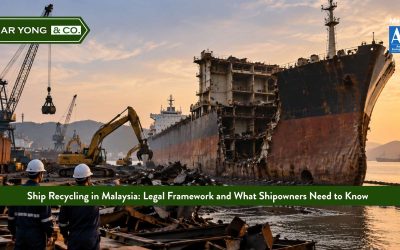
Ship Recycling in Malaysia: Legal Framework and What Shipowners Need to Know
Ship recycling — the dismantling and scrapping of end-of-life vessels — is a significant industry in the Asia-Pacific region. In Malaysia, ship breaking and recycling activities are conducted at yards in Pulau Indah (Port Klang), Pasir Gudang (Johor), and along the...
Maritime Liens in Malaysia: Priority Claims Against Vessels and How to Enforce Them
A maritime lien is a privileged security interest that arises automatically by operation of law against a vessel when certain defined claims are incurred. Unlike a registered ship mortgage — which requires formal registration to be effective — a maritime lien arises...
Manning Agency Liability in Malaysia: What Shipowners and Seafarers Need to Know
Malaysia is one of Southeast Asia's most active seafarer supply markets, with thousands of licensed manning agencies operating under the oversight of the Marine Department of Malaysia (Jabatan Laut) and the Department of Labour. Manning agencies — also known as crew...