
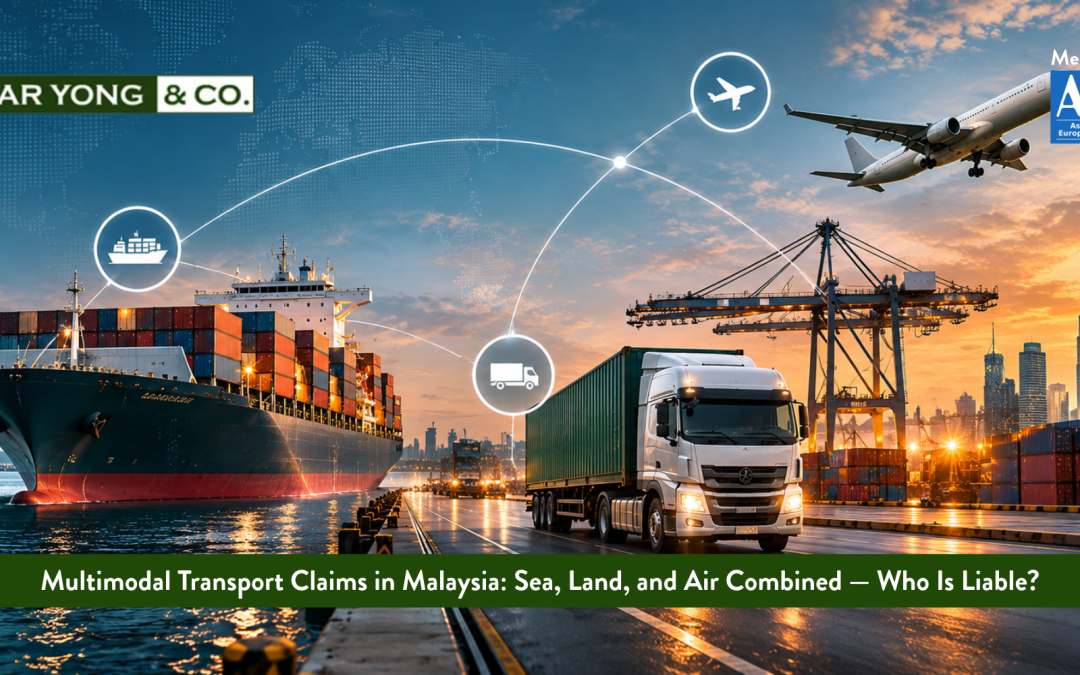
Modern supply chains rarely rely on a single mode of transport. Most commercial shipments involve at least two modes — typically sea and road — and many involve three or more: factory to port by truck, ocean freight, port to distribution centre by road, and sometimes domestic air freight for urgent goods. This combination of transport modes in a single end-to-end transaction is called multimodal or combined transport.
The legal complexity of multimodal transport arises because different modes of transport are governed by different liability regimes. Sea carriage is governed by the Hague Rules (via the Carriage of Goods by Sea Act 1950); road carriage is governed by the Contracts Act 1950 and the Road Transport Act 1987 in Malaysia; rail carriage by specific rail regulations; and air carriage by the Warsaw Convention or the Montreal Convention. When goods are damaged in a multimodal journey, the applicable liability regime depends on where — in which mode — the damage occurred.
Where damage can be attributed to a specific stage of the journey — for example, where survey evidence shows the damage occurred during the sea leg — the carrier responsible for that stage bears liability under the applicable regime. But where the damage cannot be localised — because the goods were in sealed containers, because the damage was only discovered at destination, or because the documentation trail is incomplete — the position becomes legally uncertain, and the multimodal transport operator (MTO) who issued the combined transport document may bear liability under a ‘network’ or ‘uniform’ liability principle.
In Malaysia, there is no single domestic statute specifically governing multimodal transport. The legal framework is constructed from the relevant single-modal conventions, the law of contract, and — where a freight forwarder has issued a combined transport document — the FIATA standard terms or the MFFA standard trading conditions, which contain their own liability provisions and limitation clauses.
Key Legal Issues in Malaysian Multimodal Transport Claims
-
Localisation of damage: Where in the journey did the damage occur? Survey evidence, photographic records, seal numbers, and delivery receipts at each modal interchange are critical to localising the damage to a specific carrier.
-
The network liability principle: Where damage is localised to a specific mode, the liability regime for that mode applies. Where it cannot be localised, the MTO’s overall liability under the combined transport document governs.
-
Freight forwarder as MTO: Where the freight forwarder issued a combined transport bill of lading (FIATA FBL), it is the contractual carrier for the whole journey and bears primary liability to the cargo owner, regardless of which sub-carrier caused the loss.
-
Time bars: The time bar applicable to the whole multimodal claim may differ depending on where the damage is localised. A cargo claim under the sea leg has a one-year Hague Rules bar; a road carriage claim in Malaysia may have a different limitation period.
-
Back-to-back claims: The freight forwarder or MTO who pays the cargo owner’s claim can then bring a back-to-back claim against the sub-carrier responsible for the damage — under the applicable single-modal convention.
Frequently Asked Questions: Multimodal Transport Claims in Malaysia
Q: My cargo was damaged somewhere during a sea-land journey from China to Malaysia. Who do I sue?
A: Your first step is to establish where in the journey the damage occurred — this determines who you sue and under which legal framework. The most important evidence is: the condition of the goods when they were handed to each carrier at each modal interchange (evidenced by delivery receipts, seal checks, and inspection records); the packaging integrity at each stage; and an independent survey of the damage at the point of discovery. Where the goods were in a sealed FCL container for the entire journey, localisation may be impossible without opening the container at each stage — which is impractical. In that case, your claim may lie against the freight forwarder or MTO who issued the combined transport document for the entire journey, under the applicable combined transport or freight forwarder standard terms. A maritime lawyer can assess the available evidence and identify the most effective target for your claim.
Q: The freight forwarder says it is only liable for loss during the sea leg, not the road leg. Is this correct?
A: It depends on the nature of the document issued. If the freight forwarder issued a FIATA Multimodal Transport Bill of Lading (FBL) — a combined transport document under which the forwarder accepts responsibility as principal carrier for the whole journey — then the forwarder is liable for loss or damage wherever in the multimodal journey it occurred, not just during the sea leg. If the freight forwarder acted purely as agent — booking a sea carrier and a road carrier separately on your behalf — then its liability is more limited, and your claim lies against the individual carrier responsible for the relevant stage. The key document is the transport contract: what exactly did the freight forwarder issue, and in what capacity did it act? A maritime lawyer can analyse the documentation and advise on the correct legal basis for your claim.
Q: What time bar applies to a multimodal transport claim in Malaysia?
A: The applicable time bar for a multimodal transport claim depends on where the damage is localised and which liability regime governs. If the damage occurred during the sea leg: the one-year Hague Rules limitation period under the Carriage of Goods by Sea Act 1950 applies — from the date of delivery or the date delivery should have been made. If the damage occurred during the road leg in Malaysia: the general six-year limitation period under the Limitation Act 1953 applies to the road carriage contract — though the road carrier’s standard terms may contain a shorter contractual time bar. If the damage cannot be localised and the freight forwarder’s combined transport terms govern: the time bar in the FIATA standard terms or MFFA standard trading conditions applies — typically nine months from delivery. The practical message is: do not assume the six-year period applies simply because the shipment was multimodal. Get legal advice on the applicable time bar as soon as the damage is discovered.
Q: Can I bring a claim against both the shipping line and the road carrier simultaneously?
A: Yes — and in practice, where the damage localisation is uncertain, pursuing multiple parties simultaneously is often the most effective strategy. A cargo claimant can issue claims against both the ocean carrier (in rem against the vessel or in personam against the carrier) and the road carrier (through the civil courts) simultaneously, to avoid the risk of missing one time bar while pursuing the other. The claims will then be narrowed as the evidence develops — once the survey evidence makes clear which stage of the journey was responsible, the claim against the non-responsible carrier can be withdrawn or settled. The procedural rules in Malaysia permit multiple claims to be brought in different courts or forums simultaneously, though careful management is required to avoid conflicts. A maritime lawyer can coordinate the multi-party claim strategy and manage the various proceedings efficiently.
Q: What is a FIATA Bill of Lading and how does it affect my claim?
A: A FIATA Multimodal Transport Bill of Lading (FIATA FBL) is a standard-form combined transport document issued by freight forwarders who are members of the International Federation of Freight Forwarders Associations (FIATA). When a freight forwarder issues an FBL, it acts as a multimodal transport operator (MTO) — accepting responsibility as principal carrier for the entire door-to-door movement, regardless of which sub-carriers actually perform the individual legs. The FBL is a negotiable document of title, meaning that the party who holds the original FBL has the right to demand delivery of the cargo at the destination. The FBL incorporates the FIATA Multimodal Transport Bill of Lading Standard Conditions, which set out the freight forwarder/MTO’s liability to the cargo owner — typically on a network liability basis (applying the relevant single-modal convention for the stage where damage is localised, or a uniform FIATA rate for non-localised damage). The FIATA standard conditions also contain a time bar — commonly nine months from delivery — which is shorter than the Hague Rules’ one-year period.
About the Author: Mr. Yong Chee Kong

Yong Chee Kong is an experienced Advocate & Solicitor with over three decades of legal experience, with principal areas of practice in Corporate Law and Shipping & Maritime Law. Called to the Bar in 1995, he has advised shipping companies, developers, financial institutions, and corporate entities on complex legal matters, including shipping disputes, development projects, project financing, mergers, takeovers, and acquisitions.
As a seasoned litigation lawyer, Yong Chee Kong regularly appears before the High Court, Court of Appeal, and Federal Court of Malaysia. His broad experience also extends to Banking, Finance, and Construction Law, enabling him to advise clients across a range of complex commercial and corporate matters.
Beyond legal practice, he is a registered Patent, Trade Marks and Industrial Design agent, as well as a Commissioner for Oaths and Notary Public. He has also served as a member of the Bar Council Disciplinary Committee and chaired numerous disciplinary investigations involving members of the Malaysian Bar.
His academic and professional qualifications include an LL.B (Hons) from the University of London, a Certificate in Legal Practice from University Malaya, and successful completion of the Patent Agent Examination conducted by the Intellectual Property Corporation of Malaysia.
-
Expertise: Corporate Law, Shipping & Maritime Law, Banking & Finance, Construction Law, Commercial Litigation, Intellectual Property
-
Professional Experience: 30+ years
-
Called to the Bar: High Court of Malaya, 1995
-
Professional Roles: Patent, Trade Marks & Industrial Design Agent; Commissioner for Oaths; Notary Public
Salvage Claims in Malaysia: What Shipowners and Cargo Interests Need to Know
Salvage is the service rendered by one party to rescue another party's vessel or cargo from peril at sea. In Malaysia, salvage is governed by common law principles and — for vessels party to Lloyd's Open Form (LOF) — by the International Salvage Convention 1989, which...
What Is Limitation of Liability and How Does It Protect Shipowners in Malaysia?
When a vessel is involved in a collision, grounding, or other serious incident, the financial claims that follow can be staggering — cargo loss, hull damage, personal injury, wreck removal, and environmental liability can all arise from the same event. Without a cap...
Limitation of Liability in Malaysian Maritime Law: A Complete Guide for Shipowners
Few legal concepts carry as much financial weight for a shipowner as limitation of liability. In the aftermath of a serious maritime incident — a collision in the Strait of Malacca, a grounding off the Sabah coast, an oil spill in Port Klang — claims from cargo...
Buying or Selling a Ship in Malaysia: The Legal Process Explained
The sale and purchase of a vessel in Malaysia is a multi-step legal transaction governed primarily by the Merchant Shipping Ordinance 1952 (MSO 1952), and the Contracts Act 1950, together with the specific terms of the Memorandum of Agreement (MOA) entered into...
Oil Pollution Liability at Sea in Malaysia: What Shipowners and Operators Need to Know
Malaysia's strategic position along the Strait of Malacca — through which an estimated 40% of global seaborne trade passes — makes it one of the most environmentally sensitive maritime jurisdictions in the world. A vessel grounding, collision, or structural failure in...
Maritime Arbitration vs Court Litigation in Malaysia: Which Route Is Right for Your Dispute?
Most maritime disputes in Malaysia are resolved through one of two routes: arbitration or litigation before the Admiralty Court. The route that applies to your dispute is largely determined by what your contract says — and understanding the difference before a dispute...