
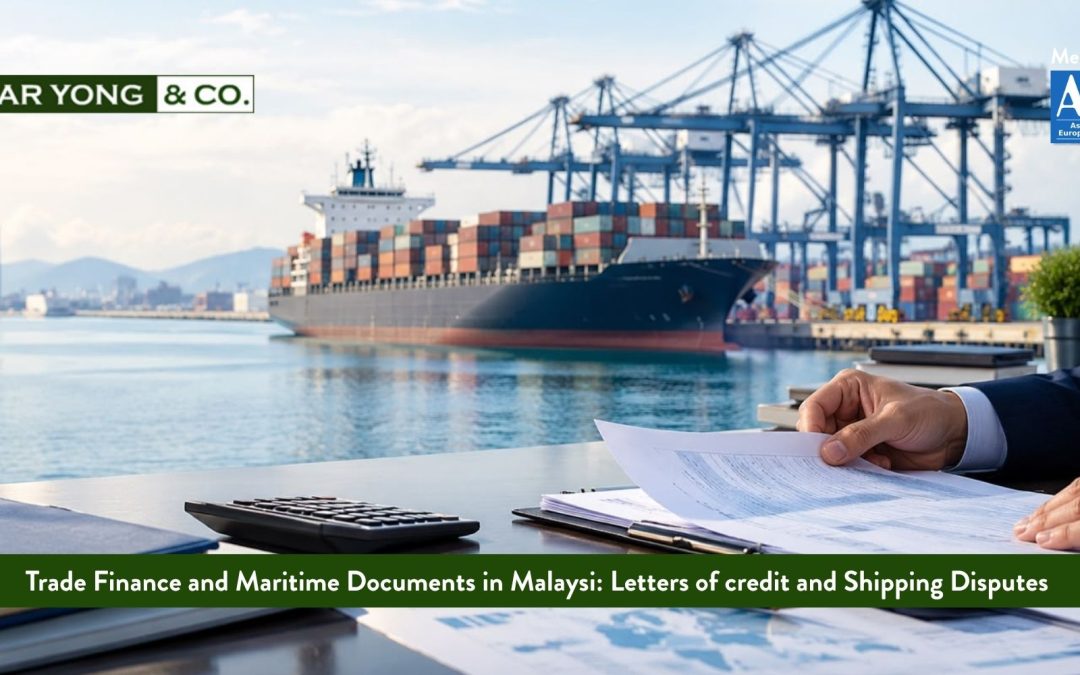
International trade between Malaysian exporters and their global buyers is predominantly financed through documentary letters of credit (LCs) — instruments issued by the buyer’s bank that guarantee payment to the seller upon presentation of conforming shipping documents. The shipping documents required under an LC typically include the commercial invoice, the packing list, the certificate of origin, the insurance certificate, and — critically — the original bill of lading, made out to the order of the bank or in a form that gives the bank control over the goods.
The bill of lading performs a unique dual function in LC transactions: it is both the document of title to the cargo (controlling who can claim the goods at the destination port) and the document that triggers payment under the LC. This makes the bill of lading the most legally significant piece of paper in any documentary credit transaction. A bill of lading that is claused (showing damage or shortage at loading), incorrectly dated, inconsistent with the LC’s requirements, or — most seriously — forged or fraudulently obtained can disrupt or destroy the entire trade finance transaction.
The governing rules for documentary credit practice are the Uniform Customs and Practice for Documentary Credits (UCP 600), published by the International Chamber of Commerce. Malaysian banks issue and confirm LCs under UCP 600, and disputes about whether a presentation of documents complies with an LC’s terms are governed by UCP 600 rules. However, UCP 600 does not govern the maritime law aspects of the underlying cargo transaction — the bill of lading, the carrier’s liability, and the delivery of the goods remain subject to Malaysian maritime law and the Carriage of Goods by Sea Act 1950.
The intersection of trade finance and maritime law creates a distinctive category of dispute — one that requires legal expertise in both areas simultaneously. When a bank refuses to pay under an LC because the bill of lading is defective; when an importer’s bank holds the bill of lading while the goods have been released at destination; or when a forged bill of lading has been used to obtain payment, the dispute spans both the banking and the maritime law worlds.
Common Trade Finance and Maritime Document Disputes in Malaysia
-
Discrepant documents: The bank refuses to pay under the LC because the bill of lading is dated after the latest shipment date, shows short delivery, or is inconsistent with other documents in the presentation.
-
Fraudulent bills of lading: Forged or fraudulently backdated bills are used to obtain payment under the LC before the goods have been shipped or before the quality issue is detected.
-
Goods released without original bill of lading: The carrier delivers cargo at the destination port without presentation of the original bill of lading — leaving the bank holding worthless security.
-
Stale documents: The bill of lading and other documents are presented to the bank after the presentation deadline specified in the LC, resulting in the bank treating them as discrepant.
-
Misdescription of goods: The goods delivered do not match the description in the bill of lading and commercial invoice — triggering both a cargo claim against the carrier and a trade finance dispute with the bank.
Frequently Asked Questions: Trade Finance and Maritime Documents in Malaysia
Q: The bank rejected my LC presentation because my bill of lading was dated after the shipping date. What can I do?
A: A bill of lading dated after the ‘latest date of shipment’ specified in the LC is a classic discrepancy under UCP 600 — and banks are entitled to refuse such a presentation without seeking waiver from the applicant (the buyer). Your options are: request the buyer to authorise a waiver of the discrepancy — if the buyer is willing, the bank can pay despite the discrepancy; ask the issuing or confirming bank to hold the documents and request waiver from the buyer; or re-present the documents under a reserve, where the bank pays under its own risk pending resolution of the discrepancy. If none of these routes succeed, you have a dispute with the carrier about why the bill of lading was dated incorrectly — the carrier may have issued the bill with a date earlier than the actual loading date (back-dating), which is a criminal offence, or the bill may have been correctly dated but the date is inconsistent with the LC because the vessel sailed late. A maritime lawyer can advise on the carrier’s liability and whether a claim for damages is available for the lost LC payment.
Q: The carrier released the goods without the original bill of lading and now the bank cannot recover. What is the bank’s position?
A: This is one of the most serious and commercially damaging scenarios in maritime trade finance. Where a carrier delivers cargo to the consignee without presentation of the original bill of lading — and the bank holds the original bills as security for the trade finance facility — the bank’s security has been destroyed. The bank’s primary legal remedy is a claim against the carrier for wrongful delivery — conversion of the cargo. Under Malaysian and English admiralty law, a carrier who delivers cargo without production of the original bill of lading is liable to the lawful holder of the bill for the full value of the cargo, without the benefit of the Hague Rules liability limitation. If the carrier obtained a Letter of Indemnity from the consignee before releasing the cargo, the bank may also have a direct claim against the LOI giver — though the LOI may not cover the bank’s full loss. A maritime lawyer can advise the bank on the most effective enforcement strategy and whether vessel arrest is available to secure the carrier’s liability.
Q: I suspect the seller used a fraudulent bill of lading to obtain payment under my LC. What legal action can I take in Malaysia?
A: Bill of lading fraud — where a seller presents a fraudulent, forged, or backdated bill of lading to a bank to obtain payment before the goods are shipped or before a problem with the goods is known — is both a civil and criminal matter in Malaysia. Civilly, the buyer has a claim against the seller for deceit and fraudulent misrepresentation, and can seek to recover the LC payment as damages. The bank may also have civil claims against the seller. Criminally, the seller may face charges of cheating and falsification of documents under the Penal Code. In Malaysia, emergency legal remedies are available: a Mareva injunction can freeze the seller’s assets pending the outcome of civil proceedings; an Anton Piller order can compel the production of documents and evidence; and if the fraudulent seller’s vessel is in Malaysian waters, it may be subject to arrest. Speed is everything — a maritime lawyer should be instructed immediately on discovering a suspected fraudulent bill of lading.
Q: My LC requires a ‘clean’ bill of lading, but the carrier has claused the bill because of packaging damage. What are my options?
A: A claused bill of lading — one that contains notations about damage or defects to the goods or their packaging at the time of loading — is a discrepant document under most LCs, which require a ‘clean’ (unclaused) bill. If the bank rejects your presentation because the bill is claused, your options are limited. You can: ask the buyer to waive the discrepancy and authorise payment — this requires the buyer’s commercial goodwill and may not be available; re-present the goods in better packaging and request a new clean bill from the carrier — but the carrier must be satisfied the goods are in good order before issuing a clean bill; ask the carrier to issue a clean bill against a Letter of Indemnity from you — accepting the risk that if the goods are damaged, the carrier will call the LOI. The last option is commercially tempting but legally risky: asking a carrier to issue a clean bill when it knows goods are damaged is potentially fraudulent and may expose both the carrier and the shipper to criminal liability. A maritime lawyer can advise on the specific options available in your case.
Q: What is the role of the UCP 600 in a Malaysian shipping document dispute?
A: The UCP 600 (Uniform Customs and Practice for Documentary Credits, 2007 revision) is the set of rules published by the International Chamber of Commerce that governs the obligations of banks in issuing, confirming, and examining documents under letters of credit. In Malaysia, LCs are routinely issued incorporating UCP 600 by reference — meaning the UCP 600 rules form part of the contractual framework between the bank, the buyer, and the seller. Under UCP 600, a bank examining a document presentation has five banking days to determine compliance and must reject (and return) discrepant documents within that period. However, UCP 600 governs only the banking and documentation aspects of the transaction — it does not replace Malaysian maritime law or the Hague Rules in governing the carrier’s obligations under the bill of lading. A dispute about whether the bank correctly rejected a document presentation is a UCP 600 issue; a dispute about whether the carrier delivered the cargo safely is a maritime law issue. Many trade finance disputes involve both simultaneously.
About the Author: Mr. Yong Chee Kong

Yong Chee Kong is an experienced Advocate & Solicitor with over three decades of legal experience, with principal areas of practice in Corporate Law and Shipping & Maritime Law. Called to the Bar in 1995, he has advised shipping companies, developers, financial institutions, and corporate entities on complex legal matters, including shipping disputes, development projects, project financing, mergers, takeovers, and acquisitions.
As a seasoned litigation lawyer, Yong Chee Kong regularly appears before the High Court, Court of Appeal, and Federal Court of Malaysia. His broad experience also extends to Banking, Finance, and Construction Law, enabling him to advise clients across a range of complex commercial and corporate matters.
Beyond legal practice, he is a registered Patent, Trade Marks and Industrial Design agent, as well as a Commissioner for Oaths and Notary Public. He has also served as a member of the Bar Council Disciplinary Committee and chaired numerous disciplinary investigations involving members of the Malaysian Bar.
His academic and professional qualifications include an LL.B (Hons) from the University of London, a Certificate in Legal Practice from University Malaya, and successful completion of the Patent Agent Examination conducted by the Intellectual Property Corporation of Malaysia.
-
Expertise: Corporate Law, Shipping & Maritime Law, Banking & Finance, Construction Law, Commercial Litigation, Intellectual Property
-
Professional Experience: 30+ years
-
Called to the Bar: High Court of Malaya, 1995
-
Professional Roles: Patent, Trade Marks & Industrial Design Agent; Commissioner for Oaths; Notary Public

Resolving Marine Insurance Claim Disputes under Marine Insurance Act 1906
Marine insurance provides the financial backbone for global trade, but when a loss occurs, the path to recovery often leads to complex legal friction. In local practice, marine insurance claim disputes under the Marine Insurance Act 1906 frequently arise because this...
Navigating IMO 2026 Decarbonization Compliance for Shipowners
The maritime industry currently faces a transformative era as global regulators tighten environmental standards. For vessel operators in Southeast Asia, achieving IMO 2026 decarbonization compliance for shipowners is no longer a future goal but an immediate...
Legal Liability for Cargo Damage under Carriage of Goods by Sea Act
Cargo damage remains a significant risk for Malaysian traders and shipowners. When goods arrive at Port Klang or Tanjung Pelepas in a damaged state, the Carriage of Goods by Sea Act (COGSA) provides the primary legal framework for seeking compensation. Navigating...
Navigating Legal Defence for Vessel Allision and Fixed Object Damage in Malaysia
In the busy waterways of Port Klang and the Port of Tanjung Pelepas, the margin for error is razor-thin. When a ship strikes a stationary structure—a specialised maritime incident known as an allision—the shipowner faces immediate and aggressive claims from port...

Legal Requirements for Registering a Ship Mortgage in Malaysia
Securing financing for a vessel requires more than just a signed loan agreement; it necessitates formal registration to establish priority over other creditors. In Malaysia, the legal requirements for registering a ship mortgage in Malaysia are governed strictly by...

Maritime Litigation Lawyers in Malaysia: Strategic Representation for Shipping Disputes
Maritime litigation lawyers in Malaysia play a vital role in resolving high-value disputes arising from shipping operations, vessel ownership, cargo movement, and marine insurance matters. Malaysia’s position as a major maritime hub exposes shipping businesses,...