
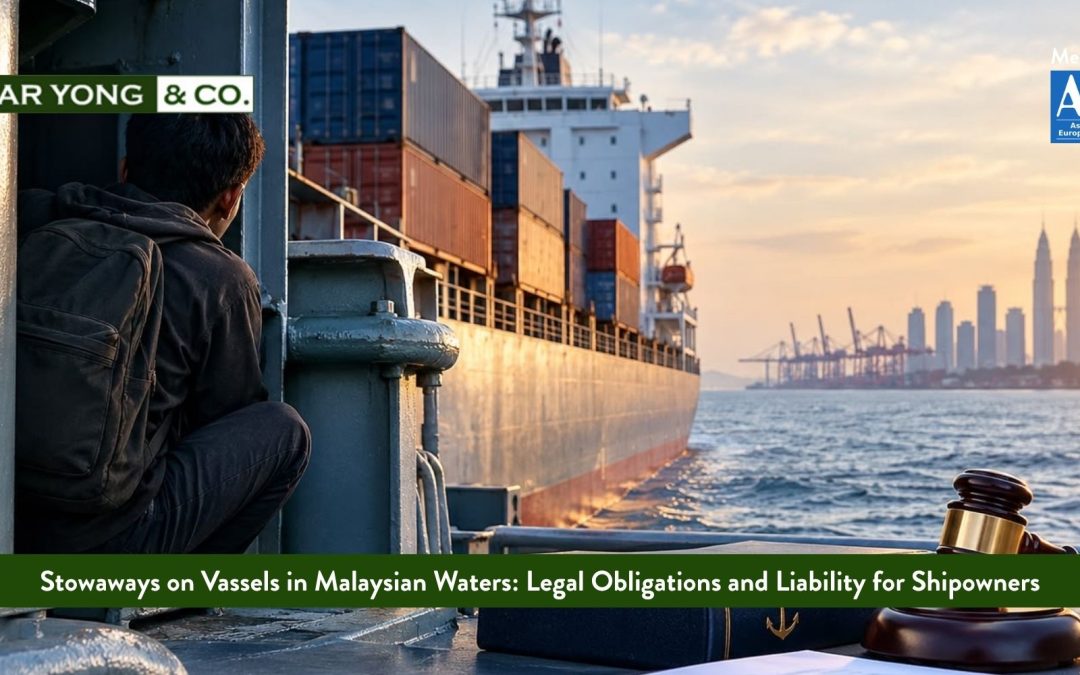
Stowaways — persons who secrete themselves on board a vessel without the knowledge or consent of the Master or shipowner — present a unique legal and humanitarian challenge. Malaysia’s position as a major transhipment hub and its proximity to several source countries for economic migration means that stowaway incidents are a regular occurrence at Malaysian ports. Port Klang, Penang, and East Malaysian ports have all seen stowaway discoveries, particularly on vessels arriving from certain African, Middle Eastern, and South Asian ports.
The international legal framework governing stowaways is the IMO’s Facilitation Committee Guidelines on the Allocation of Responsibilities to Seek the Successful Resolution of Stowaway Cases (FAL.7/Circ.8), which addresses the responsibilities of the shipowner, the flag state, the port state, and the country of embarkation. Malaysia is a signatory to the IMO’s Convention on Facilitation of International Maritime Traffic 1965 (FAL Convention), which creates obligations for the smooth movement of persons at sea, including stowaways.
Under Malaysian law, the Merchant Shipping Ordinance 1952 and the Immigration Act 1959/63 create a specific framework for the handling of stowaways discovered in Malaysian waters or ports. The shipowner bears primary responsibility for the stowaway: for ensuring their humane treatment on board; for notifying the port authority and immigration department upon discovery; for cooperating with authorities to determine the stowaway’s nationality and identity; and — in most cases — for repatriating the stowaway to their country of embarkation or nationality at the shipowner’s expense.
The P&I Club is the first point of contact for a stowaway incident — most Club rules cover the costs of stowaway handling, detention, and repatriation as a standard P&I risk, subject to prompt notification and cooperation with the Club’s appointed correspondents.
Immediate Steps When a Stowaway Is Found in Malaysia
Notify the Master immediately and conduct a full vessel search for additional stowaways.
Notify the P&I Club through the Club’s 24-hour emergency line — the Club will appoint a local correspondent to assist.
Notify the Malaysian port authority, Marine Department, and Immigration Department as required under the Immigration Act 1959/63.
Document the stowaway’s condition, any documents in their possession, and the circumstances of discovery — this evidence is critical for repatriation proceedings.
Ensure the stowaway receives appropriate food, water, medical care, and humane accommodation on board — the MLC 2006 standards apply by analogy.
Engage a maritime lawyer — particularly where the stowaway claims asylum, makes allegations of trafficking, or where the port authority is refusing permission for the vessel to depart.
Frequently Asked Questions: Stowaways in Malaysia
Q: Is the shipowner responsible for the costs of handling a stowaway in Malaysia?
A: Yes — the shipowner bears primary financial responsibility for stowaway handling costs in Malaysia, including: the cost of maintaining the stowaway on board (food, accommodation, medical care) during the period they are held; the cost of detention in an immigration facility if the stowaway is taken ashore; the cost of repatriation to the country of embarkation or the stowaway’s home country; and fines imposed under the Immigration Act 1959/63 for arriving with an undocumented person on board. These costs can be substantial — particularly where the stowaway’s nationality is difficult to establish, where the country of origin refuses to accept the stowaway’s return, or where the stowaway makes an asylum claim that requires a prolonged determination process. P&I Club rules typically cover stowaway expenses as a standard P&I risk — but the Club must be notified promptly and the owner must cooperate with the Club’s management of the case.
Q: What happens if the stowaway claims asylum in Malaysia?
A: This is one of the most complex scenarios in stowaway law. Malaysia is not a signatory to the UN Refugee Convention 1951, and does not have a domestic asylum system in the formal legal sense — meaning that a stowaway’s claim to refugee status or protection is not processed through a dedicated asylum procedure in the same way as in signatory states. In practice, asylum claims from stowaways in Malaysia are referred to the United Nations High Commissioner for Refugees (UNHCR), which has an office in Kuala Lumpur and conducts refugee status determination. Where a stowaway is registered with the UNHCR, their forced return may be challenged, and the vessel’s departure may be delayed while the claim is pending. The shipowner’s P&I Club correspondent will coordinate with the immigration authorities and the UNHCR in these circumstances. A maritime lawyer experienced in immigration and maritime law is essential where an asylum claim is made.
Q: Can the Master be criminally liable for bringing a stowaway into Malaysian waters?
A: Under the Immigration Act 1959/63, a person who brings an illegal immigrant (including a stowaway) into Malaysia without authority commits a criminal offence. However, the Act provides that where a person (including the Master) can prove they did not know and had no reason to believe the stowaway was on board, the criminal offence is not made out. In practice, where the stowaway was genuinely undetected until arrival in Malaysia — and the vessel can demonstrate that reasonable search procedures were conducted at the port of embarkation — the Master is unlikely to face criminal prosecution. However, where the vessel failed to conduct a proper pre-departure search, or where there is evidence that the crew was complicit in the stowaway’s boarding, criminal liability becomes a real risk. A maritime lawyer should advise the Master on their rights before any statement is made to Malaysian immigration or police officers.
Q: The stowaway is refusing to leave the vessel and the port authority says we cannot sail. What are our options?
A: This situation — where a stowaway refuses repatriation and the port authority will not permit the vessel to sail — is one of the most commercially costly stowaway scenarios. The vessel is detained in port, accruing costs, with no resolution in sight. The shipowner’s options depend on the specific facts: where the stowaway is making an asylum claim that is being processed by the UNHCR, the shipowner must cooperate with that process and cannot forcibly remove the stowaway. Where there is no valid legal basis for the stowaway to remain in Malaysia, the shipowner can apply to the Malaysian courts — through a maritime lawyer — for an order compelling the immigration authorities to process the stowaway’s removal and permit the vessel to depart. The P&I Club’s correspondent will be instrumental in managing relations with the immigration authorities. In the most intractable cases, negotiation between the Club, the owner’s lawyers, and the immigration authority is the only practical route to resolution.
Q: How can a shipowner prevent stowaways from boarding in high-risk ports?
A: Prevention is far cheaper than the cost of a stowaway incident. Effective stowaway prevention measures include: conducting a thorough search of the vessel — all cargo spaces, voids, containers, machinery spaces, and lifeboats — before departure from any port identified as high-risk; maintaining an accurate crew manifest and accounting for all persons on board at departure; restricting gangway access to authorised personnel during the port call, with a qualified crew member posted as gangway watch at all times; locking all below-deck spaces that are not operationally required to be open during the port call; coordinating with the port authority to request additional port security support in high-risk ports; and ensuring that the vessel’s Ship Security Plan (required under the ISPS Code for vessels subject to SOLAS) includes appropriate anti-stowaway procedures. Where a vessel regularly calls at high-risk ports, the P&I Club’s correspondent in those ports can provide local intelligence on stowaway risk levels and recommend additional precautions.
About the Author: Mr. Yong Chee Kong

Yong Chee Kong is an experienced Advocate & Solicitor with over three decades of legal experience, with principal areas of practice in Corporate Law and Shipping & Maritime Law. Called to the Bar in 1995, he has advised shipping companies, developers, financial institutions, and corporate entities on complex legal matters, including shipping disputes, development projects, project financing, mergers, takeovers, and acquisitions.
As a seasoned litigation lawyer, Yong Chee Kong regularly appears before the High Court, Court of Appeal, and Federal Court of Malaysia. His broad experience also extends to Banking, Finance, and Construction Law, enabling him to advise clients across a range of complex commercial and corporate matters.
Beyond legal practice, he is a registered Patent, Trade Marks and Industrial Design agent, as well as a Commissioner for Oaths and Notary Public. He has also served as a member of the Bar Council Disciplinary Committee and chaired numerous disciplinary investigations involving members of the Malaysian Bar.
His academic and professional qualifications include an LL.B (Hons) from the University of London, a Certificate in Legal Practice from University Malaya, and successful completion of the Patent Agent Examination conducted by the Intellectual Property Corporation of Malaysia.
-
Expertise: Corporate Law, Shipping & Maritime Law, Banking & Finance, Construction Law, Commercial Litigation, Intellectual Property
-
Professional Experience: 30+ years
-
Called to the Bar: High Court of Malaya, 1995
-
Professional Roles: Patent, Trade Marks & Industrial Design Agent; Commissioner for Oaths; Notary Public
Ship Recycling in Malaysia: Legal Framework and What Shipowners Need to Know
Ship recycling — the dismantling and scrapping of end-of-life vessels — is a significant industry in the Asia-Pacific region. In Malaysia, ship breaking and recycling activities are conducted at yards in Pulau Indah (Port Klang), Pasir Gudang (Johor), and along the...
Maritime Liens in Malaysia: Priority Claims Against Vessels and How to Enforce Them
A maritime lien is a privileged security interest that arises automatically by operation of law against a vessel when certain defined claims are incurred. Unlike a registered ship mortgage — which requires formal registration to be effective — a maritime lien arises...
Manning Agency Liability in Malaysia: What Shipowners and Seafarers Need to Know
Malaysia is one of Southeast Asia's most active seafarer supply markets, with thousands of licensed manning agencies operating under the oversight of the Marine Department of Malaysia (Jabatan Laut) and the Department of Labour. Manning agencies — also known as crew...
Reefer Cargo Disputes in Malaysia: Who Pays When Temperature-Sensitive Goods Are Damaged?
Malaysia is a major exporter of temperature-sensitive goods — including palm oil products, pharmaceutical ingredients, fresh tropical produce, rubber products, and frozen seafood — and a significant importer of cold chain goods including dairy, meat, vaccines, and...
Dangerous Goods at Sea in Malaysia: Legal Obligations and Liability Under the IMDG Code
Malaysia is a major hub for the regional chemical and petrochemical trade, with significant volumes of Class 3 flammable liquids, Class 2 compressed gases, Class 6 toxic substances, and Class 9 miscellaneous dangerous goods moving through Port Klang and other ports...
Towage Contracts in Malaysia: Who Is Liable When a Tug Causes Damage?
Towage is the service of using one vessel (the tug) to move, guide, or assist another vessel (the tow). In Malaysian ports, towage services are provided by licensed tug operators — including Bumi Armada, Maju Maritime, and port authority-operated tugs — and are a...