
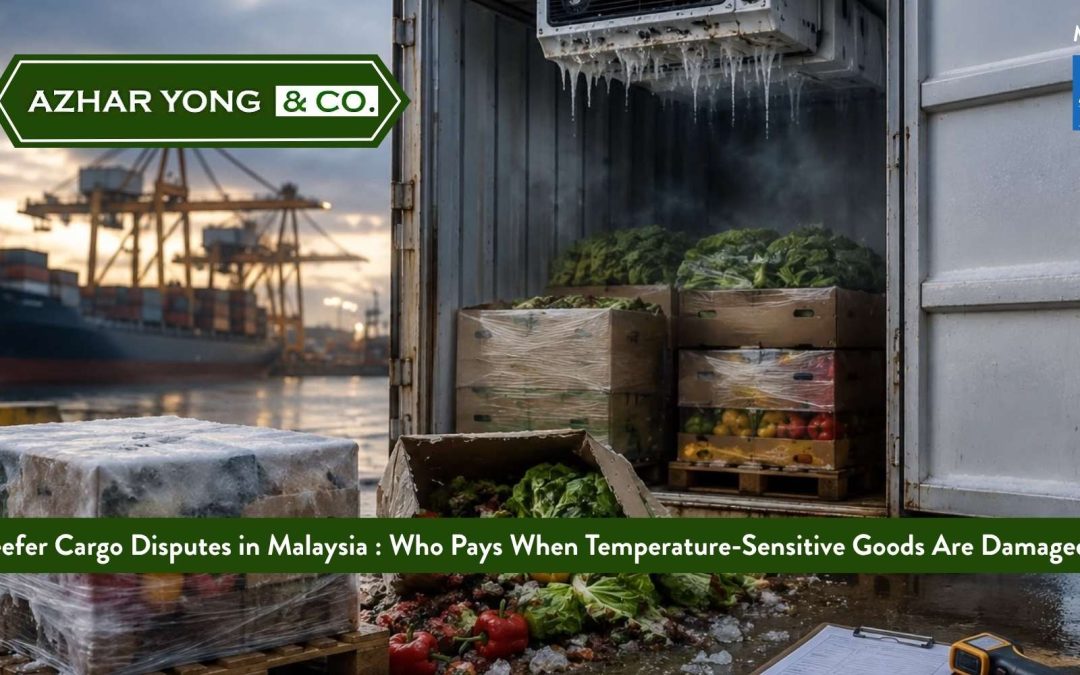
Malaysia is a major exporter of temperature-sensitive goods — including palm oil products, pharmaceutical ingredients, fresh tropical produce, rubber products, and frozen seafood — and a significant importer of cold chain goods including dairy, meat, vaccines, and electronics requiring controlled humidity. The reefer (refrigerated) container is the workhorse of this trade, and when a temperature excursion occurs — whether from equipment failure, power interruption, incorrect settings, or mishandling — the losses can be substantial.
Reefer cargo disputes have a distinctive legal character. They combine the standard framework of the Carriage of Goods by Sea Act 1950 (Hague Rules) with highly technical questions about temperature management, equipment performance, and the allocation of responsibility across multiple parties: the shipper who set the required temperature; the shipping line whose reefer container was used; the freight forwarder who booked the space; the terminal operator who maintained power to the plug-in point; and the port fumigation or inspection authority whose intervention may have caused a door opening and temperature breach.
The carrier’s obligations under the Hague Rules include the duty to properly and carefully load, handle, stow, carry, keep, care for, and discharge the goods. For reefer cargo, ‘keep and care’ includes maintaining the required temperature throughout the voyage. Where the carrier fails to do so — whether through equipment malfunction, power failure, incorrect temperature setting, or failure to monitor — the carrier is prima facie liable for the resulting damage. The carrier’s defences include: proof that the loss falls within a Hague Rules excepted peril (such as latent defect of the container, which is not discoverable by due diligence); or that the temperature excursion was caused by the shipper’s own instructions or the inherent nature of the cargo.
Temperature data recorders (TDRs) — the digital logs embedded in reefer containers — are the primary evidence in virtually every reefer dispute. Securing the TDR data immediately upon delivery is the single most important step a cargo claimant can take.
Common Causes of Reefer Cargo Loss in Malaysia
-
Equipment failure: Compressor breakdown, refrigerant leaks, or control system malfunction during the voyage.
-
Power interruption: Loss of shore power at the terminal — including during port congestion when stacking arrangements are reorganised.
-
Incorrect temperature setting: Carrier or terminal sets the container to the wrong temperature — particularly common where the shipper’s instructions are unclear or recorded incorrectly in the booking.
-
Door opening during transit: Customs inspection, veterinary inspection, or fumigation requires the container to be opened, causing a temperature excursion.
-
Inherent vice: The cargo itself was not properly pre-cooled before stuffing, or had a limited shelf life that the voyage period exceeded.
Frequently Asked Questions: Reefer Cargo Disputes in Malaysia
Q: How do I prove the carrier caused the temperature excursion rather than the shipper?
A: The primary evidence for establishing carrier liability in a reefer dispute is the Temperature Data Recorder (TDR) printout from the reefer container. The TDR records continuous temperature readings throughout the voyage and at the terminal, identifying the exact time and duration of any temperature excursion. You should obtain the TDR printout immediately upon delivery — before the container is returned to the shipping line — and have it reviewed by a qualified reefer expert or marine surveyor. The TDR will show whether the excursion occurred during the voyage (carrier’s custody), at the terminal (terminal operator’s period), or before stuffing (shipper’s responsibility). Supporting evidence includes: the booking confirmation showing the agreed temperature setting; the pre-trip inspection report for the container; the bill of lading noting the temperature required; the terminal’s power event log; and — where applicable — records of any inspection or fumigation that required the container to be opened. A maritime lawyer can advise on the evidence strategy for your specific claim.
Q: The carrier says the damage was caused by ‘inherent vice’ of the cargo. What does this mean and can I challenge it?
A: Inherent vice is one of the carrier’s recognised defences under the Hague Rules — it covers damage that results from the natural characteristics of the cargo itself, rather than from any fault in carriage. For reefer cargo, inherent vice arguments typically arise where: the cargo was not pre-cooled to the required temperature before stuffing; the cargo had a shorter shelf life than the voyage duration allowed; the cargo was already deteriorating before loading; or the cargo was particularly sensitive to temperature fluctuations that were within the normal range for the route. To challenge an inherent vice defence, you must establish that the cargo was in good condition when stuffed and delivered to the carrier, and that the damage resulted from an external cause — temperature excursion in the carrier’s custody — rather than the cargo’s own properties. Independent expert evidence on the cargo’s condition at loading (pre-shipment survey reports, packing certificates, and export inspection records) is essential.
Q: Who is responsible for power interruptions to reefer containers at a Malaysian terminal?
A: The terminal operator is responsible for maintaining adequate power to reefer container plug-in points within the terminal. Where power to a reefer point fails and the resulting temperature excursion damages the cargo, the terminal operator is liable to the cargo owner — in contract (under the terminal handling agreement) and in negligence. However, proving that the temperature excursion occurred during the terminal’s period of custody — rather than during the voyage — requires precise TDR data and corroboration from the terminal’s own power event records. Terminal operators sometimes dispute the cause by arguing that the temperature excursion predated their period of custody, or was caused by a congestion-driven reorganisation of stacking that was reasonable in the circumstances. A maritime lawyer and a reefer expert working together can establish the factual timeline and identify the correct target for the claim.
Q: My reefer cargo was inspected by Malaysian customs and the door was opened — causing a temperature breach. Can I claim?
A: This is a common and contested scenario. Where Malaysian customs authorities (Royal Malaysian Customs Department — RMCD) require a reefer container to be opened for inspection, the door opening is a mandated government action — not the carrier’s or terminal operator’s choice. Under the Hague Rules, carriers are exempt from liability for loss caused by an ‘act of public enemies’ or interference by ‘public authorities’ — an argument that customs inspection might attract. However, this defence is narrow: it applies to unavoidable governmental interference, not to foreseeable inspection events that the carrier could have managed by pre-cooling and minimising the door-open period. Where the temperature excursion was worsened by the carrier’s or terminal operator’s failure to manage the inspection properly (for example, by failing to re-seal and restore power promptly), they may retain partial liability. The practical solution is to ensure all reefer inspections are conducted in a temperature-controlled environment — and to reserve rights against all parties immediately after any inspection that results in a temperature breach.
Q: How long do I have to claim for reefer cargo damage in Malaysia?
A: The limitation period for cargo damage claims against a carrier under the Hague Rules (as applied in Malaysia through the Carriage of Goods by Sea Act 1950) is one year from the date of delivery of the cargo — or the date on which delivery should have been made. This is a strict period that cannot be extended by agreement after it has expired. In practice, the one-year period can pass very quickly in reefer disputes — particularly where the loss is only discovered after the goods are distributed to end customers and tested. The one-year period runs from delivery at the Malaysian destination port, not from the date the loss is discovered. For claims against terminal operators (in contract), the general six-year limitation period under the Limitation Act 1953 applies — but terminal operating terms may impose shorter contractual time bars. Take legal advice and file your claim notice as early as possible.
About the Author: Mr. Yong Chee Kong

Yong Chee Kong is an experienced Advocate & Solicitor with over three decades of legal experience, with principal areas of practice in Corporate Law and Shipping & Maritime Law. Called to the Bar in 1995, he has advised shipping companies, developers, financial institutions, and corporate entities on complex legal matters, including shipping disputes, development projects, project financing, mergers, takeovers, and acquisitions.
As a seasoned litigation lawyer, Yong Chee Kong regularly appears before the High Court, Court of Appeal, and Federal Court of Malaysia. His broad experience also extends to Banking, Finance, and Construction Law, enabling him to advise clients across a range of complex commercial and corporate matters.
Beyond legal practice, he is a registered Patent, Trade Marks and Industrial Design agent, as well as a Commissioner for Oaths and Notary Public. He has also served as a member of the Bar Council Disciplinary Committee and chaired numerous disciplinary investigations involving members of the Malaysian Bar.
His academic and professional qualifications include an LL.B (Hons) from the University of London, a Certificate in Legal Practice from University Malaya, and successful completion of the Patent Agent Examination conducted by the Intellectual Property Corporation of Malaysia.
-
Expertise: Corporate Law, Shipping & Maritime Law, Banking & Finance, Construction Law, Commercial Litigation, Intellectual Property
-
Professional Experience: 30+ years
-
Called to the Bar: High Court of Malaya, 1995
-
Professional Roles: Patent, Trade Marks & Industrial Design Agent; Commissioner for Oaths; Notary Public

Navigating UK Maritime Law: Expertise of a Marine Lawyer
The Shipowner's Challenge: A Complex Legal Dispute Imagine a UK-based shipping company faces a dispute with a port authority over a vessel arrest due to alleged environmental breaches. The regulations are complex, and the potential fines are staggering. This scenario...

The Indispensable Role of an International Maritime Lawyer
The Challenge of Multi-Jurisdictional Disputes A complex scenario for any vessel owner is a dispute that spans multiple countries. A ship registered in one country, chartered by a company in another, and carrying cargo that is damaged in international waters must...
China’s Maritime Legal Landscape: The Role of an Admiralty Lawyer
The Shipping Challenge: A Dispute in Chinese Waters Consider a shipping company whose vessel is involved in a collision in a busy Chinese port, resulting in significant damage to another ship and cargo. The legal and financial implications are immense. Dealing with...
Understanding Maritime Law in the UAE
Why Expertise in UAE Maritime Law Is Non-Negotiable Consider a scenario where your vessel is involved in a collision at sea near the United Arab Emirates, resulting in damage and a complex liability claim. The situation is compounded by a web of jurisdictions and...

Navigating the East: Why You Need a Marine Law Firm in China
The Challenge: A Disrupted Voyage Imagine your company's vessel is detained in a Chinese port due to a complex dispute over a charter party agreement. Negotiations have stalled, and with every day of delay, operational costs are skyrocketing. This is a common and...

Azhar Yong & Co. Wins Landmark Bunker Dispute,Recognized by NUS
MECK Petroleum DMCC v The Owners and/or Demise Charterers of the Ship or Vessel 'Global Falcon'Acknowledgment from NUS: https://cmlcmidatabase.org/meck-petroleum-dmcc-v-owners-andor-demise-charterers-ship-or-vessel-global-falcon CaseID: CMI2524 Summary: The...