
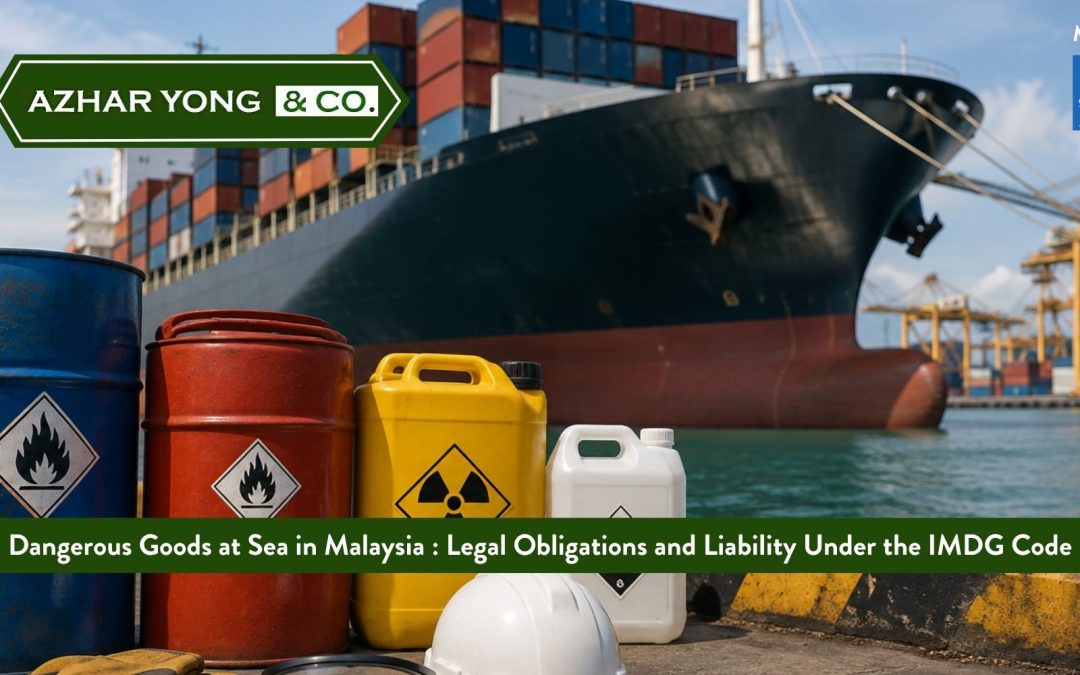
Malaysia is a major hub for the regional chemical and petrochemical trade, with significant volumes of Class 3 flammable liquids, Class 2 compressed gases, Class 6 toxic substances, and Class 9 miscellaneous dangerous goods moving through Port Klang and other ports each year. The legal framework governing the carriage of dangerous goods by sea in Malaysia is built around two pillars: the International Maritime Dangerous Goods (IMDG) Code — which is mandatory under SOLAS Chapter VII and given legal force in Malaysia through the MSO 1952 — and the domestic port by-laws of each port authority, including the Port Klang Authority (Scale of Rates, Dues and Charges) By-Laws 2012.
The IMDG Code imposes obligations across the entire dangerous goods supply chain. The shipper (consignor) is responsible for correctly classifying the goods, preparing accurate dangerous goods declarations, packaging goods to IMDG standards, and affixing the correct labels and placards. The carrier (shipping line) is responsible for verifying that the dangerous goods declaration is complete and correct, stowing the goods in accordance with IMDG segregation requirements, and ensuring the vessel carries the required documentation. The freight forwarder who books the cargo and the terminal operator who handles it in port also carry obligations — and potential liability — for dangerous goods incidents.
Where dangerous goods are misdeclared — as has occurred in several significant incidents including Malaysian port fires — the shipper bears primary liability for the resulting damage under both SOLAS/IMDG and Malaysian domestic law. A shipper who intentionally or negligently misdeclares dangerous goods as innocuous cargo can face criminal prosecution under the MSO 1952, civil liability to the carrier and other cargo owners for damage caused, and claims from the terminal operator and port authority for damage to infrastructure.
The carrier is not without responsibility: if the carrier accepts cargo that it knows or should know is dangerous — or fails to properly stow and segregate declared dangerous goods — the carrier can be held liable for resulting damage to the vessel, other cargo, and third parties. The duty to properly stow dangerous goods is a non-delegable duty of the carrier under the Hague Rules.
Key Legal Obligations for Dangerous Goods in Malaysia
-
Shipper’s declaration: The shipper must submit an accurate Dangerous Goods Declaration in the correct IMDG format before the goods can be accepted for loading. Misdeclaration is a criminal offence and a strict civil liability trigger.
-
Segregation and stowage: The IMDG Code specifies which dangerous goods classes must be segregated from each other and how they must be stowed on board. Non-compliance is grounds for vessel detention by port state control.
-
Emergency response information: Ships carrying IMDG goods must carry the appropriate Emergency Response documentation (EmS) and the Medical First Aid Guide (MFAG) for each class of dangerous goods on board.
-
Port notification: Port Klang Authority and other port authorities require advance notification of dangerous goods before the vessel enters port limits. Failure to notify can result in the vessel being denied entry.
-
IMDG Code enforcement: Port state control officers in Malaysia inspect dangerous goods compliance as part of routine PSC inspections. Non-compliance is a detention ground and can result in criminal prosecution of the Master.
Frequently Asked Questions: Dangerous Goods at Sea in Malaysia
Q: Who is liable if misdeclared dangerous goods cause a fire on a vessel in Malaysian waters?
A: In a misdeclaration scenario, primary liability rests with the shipper who provided the false or incorrect dangerous goods declaration. Under Malaysian law and established admiralty principles, a shipper who ships dangerous goods without disclosing their nature to the carrier is liable for all damage caused to the vessel, its cargo, and third parties as a result — even if the carrier was unaware of the danger. The carrier cannot rely on the Hague Rules defences (such as fire defence or perils of the sea) where the cause of the fire was the shipper’s misdeclaration. Additionally, the shipper faces criminal exposure under the MSO 1952 and potentially the Penal Code for dangerous conduct causing injury or death. Other cargo owners affected by the fire have independent claims against the misdeclaring shipper for their cargo losses. Where the carrier also failed to exercise proper care — for example, by accepting obviously suspicious cargo without investigation — the carrier’s contributory negligence may reduce but not eliminate the shipper’s liability.
Q: What documentation must accompany dangerous goods shipped through Malaysian ports?
A: All dangerous goods shipped through Malaysian ports must be accompanied by: a Dangerous Goods Declaration (DGD) completed and signed by the shipper, identifying the goods by their UN number, proper shipping name, class, packing group, and quantity; a Container Packing Certificate (CPC) where goods are packed into a container, confirming that the container has been packed in accordance with IMDG requirements; and the vessel’s Dangerous Goods Manifest (part of the ship’s required documentation under SOLAS). For radioactive materials (Class 7), additional competent authority approvals and special documentation requirements apply. The shipping line or its agent must check these documents for completeness and correctness before accepting the booking. Port Klang Authority requires pre-arrival notification for vessels carrying certain categories of dangerous goods. A freight forwarder who prepares deficient DG documentation on behalf of the shipper may share liability for any resulting incident.
Q: Can a cargo owner claim against the carrier for damage caused by another shipper’s dangerous goods?
A: Yes — and this is one of the most significant practical issues in dangerous goods liability. Where misdeclared or improperly stowed dangerous goods belonging to Shipper A cause a fire, explosion, or toxic release that damages the cargo of Shipper B, Shipper B has a claim against: the carrier (for breach of the duty to properly stow and carry the cargo safely); the misdeclaring Shipper A (for the damage caused by their dangerous goods); and — potentially — the terminal operator (if improper terminal handling contributed to the incident). The carrier may in turn seek a full indemnity from Shipper A. For Shipper B, the most practical immediate step is to make a formal cargo claim against the carrier under the bill of lading within the one-year Hague Rules time limit, while preserving all rights against Shipper A and other parties.
Q: What are the criminal penalties for transporting dangerous goods illegally in Malaysia?
A: The criminal penalties for dangerous goods violations in Malaysia are substantial. Under the MSO 1952, a shipper who ships dangerous goods without proper declaration, or a carrier who accepts and carries dangerous goods in violation of IMDG requirements, commits a criminal offence punishable by fine and, in serious cases, imprisonment. The penalties are more severe where the violation results in death, injury, or significant environmental damage — in which case charges under the Penal Code (negligence causing death, or rash and negligent acts endangering human life) may be added. Port state control detention of the vessel is virtually certain if IMDG non-compliance is detected during a Malaysian PSC inspection. Where a fire or explosion results from dangerous goods mishandling in a Malaysian port, the Marine Department will conduct a formal investigation, and the MMEA and PDRM may be involved in any criminal proceedings.
Q: The terminal operator damaged my dangerous goods container, causing a chemical leak. Who is responsible?
A: Where a terminal operator’s handling equipment — a gantry crane, a straddle carrier, a reach stacker — damages a dangerous goods container, causing a chemical leak or spill, the terminal operator is liable for: the damage to the container and its contents; the cost of emergency response and clean-up; any damage to other cargo or property in the terminal affected by the spill; injury to port workers or third parties caused by the chemical release; and environmental liability for contamination of port waters or land. The terminal operator’s liability to the cargo owner arises in contract (under the terminal handling agreement) and in negligence. Environmental liability under the Environmental Quality Act 1974 is strict and personal — meaning the terminal operator cannot contract out of it. The shipper may also face liability if the container was not properly packaged or if the DG declaration was deficient. A maritime lawyer can advise on the full range of liability and the most effective route to recovery.
About the Author: Mr. Yong Chee Kong

Yong Chee Kong is an experienced Advocate & Solicitor with over three decades of legal experience, with principal areas of practice in Corporate Law and Shipping & Maritime Law. Called to the Bar in 1995, he has advised shipping companies, developers, financial institutions, and corporate entities on complex legal matters, including shipping disputes, development projects, project financing, mergers, takeovers, and acquisitions.
As a seasoned litigation lawyer, Yong Chee Kong regularly appears before the High Court, Court of Appeal, and Federal Court of Malaysia. His broad experience also extends to Banking, Finance, and Construction Law, enabling him to advise clients across a range of complex commercial and corporate matters.
Beyond legal practice, he is a registered Patent, Trade Marks and Industrial Design agent, as well as a Commissioner for Oaths and Notary Public. He has also served as a member of the Bar Council Disciplinary Committee and chaired numerous disciplinary investigations involving members of the Malaysian Bar.
His academic and professional qualifications include an LL.B (Hons) from the University of London, a Certificate in Legal Practice from University Malaya, and successful completion of the Patent Agent Examination conducted by the Intellectual Property Corporation of Malaysia.
-
Expertise: Corporate Law, Shipping & Maritime Law, Banking & Finance, Construction Law, Commercial Litigation, Intellectual Property
-
Professional Experience: 30+ years
-
Called to the Bar: High Court of Malaya, 1995
-
Professional Roles: Patent, Trade Marks & Industrial Design Agent; Commissioner for Oaths; Notary Public
Navigating Malaysian Ship Registry Requirements for Foreign Owned Vessels
For international shipping companies, expanding into Southeast Asia often begins with a strategic presence in Malaysia. While traditional registration requires local majority ownership, the Malaysian Ship Registry requirements for foreign-owned vessels are...
Resolving Marine Insurance Claim Disputes under Marine Insurance Act 1906
Marine insurance provides the financial backbone for global trade, but when a loss occurs, the path to recovery often leads to complex legal friction. In local practice, marine insurance claim disputes under the Marine Insurance Act 1906 frequently arise because this...
Navigating IMO 2026 Decarbonization Compliance for Shipowners
The maritime industry currently faces a transformative era as global regulators tighten environmental standards. For vessel operators in Southeast Asia, achieving IMO 2026 decarbonization compliance for shipowners is no longer a future goal but an immediate...
Legal Liability for Cargo Damage under Carriage of Goods by Sea Act
Cargo damage remains a significant risk for Malaysian traders and shipowners. When goods arrive at Port Klang or Tanjung Pelepas in a damaged state, the Carriage of Goods by Sea Act (COGSA) provides the primary legal framework for seeking compensation. Navigating...
Navigating Legal Defence for Vessel Allision and Fixed Object Damage in Malaysia
In the busy waterways of Port Klang and the Port of Tanjung Pelepas, the margin for error is razor-thin. When a ship strikes a stationary structure—a specialised maritime incident known as an allision—the shipowner faces immediate and aggressive claims from port...

Legal Requirements for Registering a Ship Mortgage in Malaysia
Securing financing for a vessel requires more than just a signed loan agreement; it necessitates formal registration to establish priority over other creditors. In Malaysia, the legal requirements for registering a ship mortgage in Malaysia are governed strictly by...