
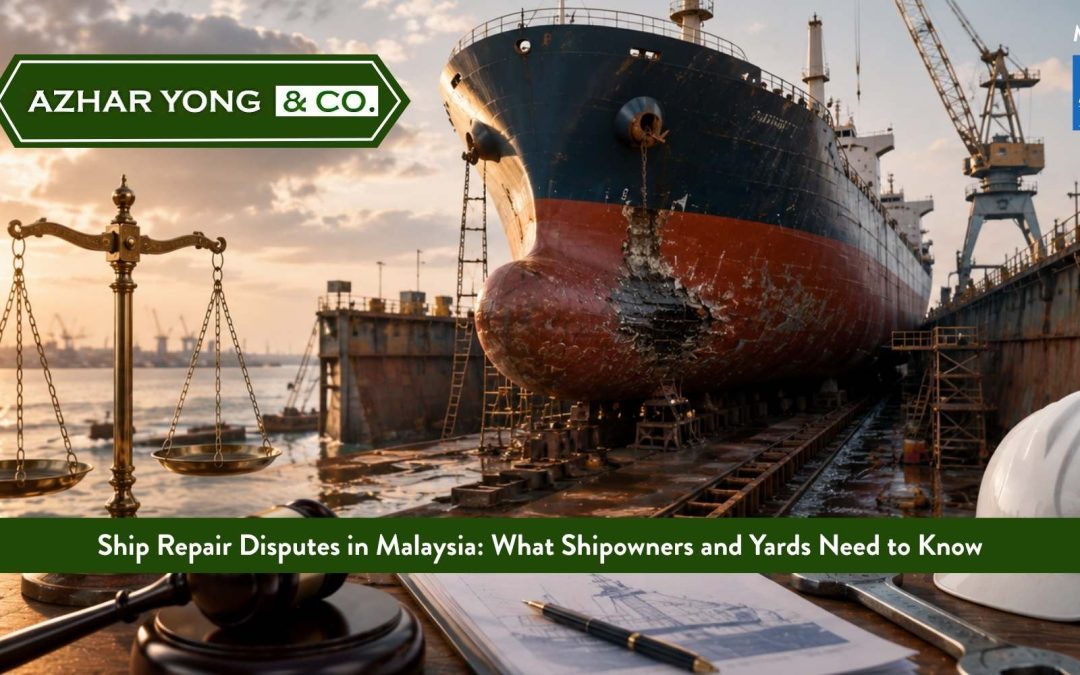
Malaysia’s ship repair industry is substantial, with yards in Port Klang, Penang, Johor Bahru, Labuan, and Kuching handling routine dry-docking, emergency repairs, and major conversions for both domestic and international vessels. The ship repair relationship is governed by a contract between the shipowner and the yard — which may range from a detailed written repair specification to a simple verbal quotation and handshake.
Ship repair contracts are commercial contracts governed by the Contracts Act 1950 and the Sale of Goods Act 1957. The yard’s obligations include completing the agreed repairs to a workmanlike standard, within the agreed time, and for the agreed price. Where any of these elements goes wrong — defective workmanship, delay, or price escalation — both parties have legal rights and remedies that depend on the specific contract terms and the circumstances of the failure.
One of the most important features of a ship repair relationship is the shipbuilder’s or repairer’s lien. Under Malaysian law, a shipyard has a possessory lien over the vessel in its possession — meaning it is entitled to retain the vessel until all outstanding repair invoices are paid. This lien is a common law right that arises automatically upon non-payment, without any court order. A shipowner who disputes a repair invoice but wants the vessel back faces a difficult commercial position: in practice, the dispute must be resolved — or secured — before the yard will release the vessel.
Conversely, where a yard releases the vessel without securing payment — for example, under commercial pressure from a shipowner threatening to take the vessel to a competitor — the yard loses its possessory lien and must pursue payment through litigation or arbitration, without the leverage of holding the vessel.
Common Ship Repair Disputes in Malaysia
-
Price escalation: Yard claims costs have increased beyond the original quotation due to the discovery of additional defects. The key question: does the contract allow for price variation, and were the additional works authorised in writing?
-
Defective workmanship: Repairs completed by the yard fail shortly after the vessel returns to service. The yard’s warranty period and the procedure for making warranty claims are critical.
-
Delivery delay: Yard detains the vessel beyond the agreed repair period, causing off-hire losses and missed commercial commitments for the owner.
-
Disputed invoice: Owner refuses to pay the full invoice. Yard exercises possessory lien, refusing to release the vessel until payment or security is provided.
-
Damage during repair: The yard damages the vessel during the repair process. Is the yard liable? The answer depends on whether the damage was caused by the yard’s negligence and whether the contract contains any limitation or exclusion of liability.
Frequently Asked Questions: Ship Repair Disputes in Malaysia
Q: The yard has issued an invoice much higher than the original quotation. Do I have to pay?
A: It depends on the terms of the repair contract and how the additional works arose. If the contract was for a fixed price for defined works, and the yard carried out additional works without obtaining the owner’s written authorisation, the owner is generally not obliged to pay for the unauthorised additions. However, if the yard discovered additional defects during the repair — and gave the owner notice and the owner directed the yard to proceed — the additional works may be payable even if no formal variation order was signed. The Sale of Goods Act 1957’s implied terms as to reasonable price may also be relevant where no price was agreed for additional works. The strength of your position depends on what was agreed in writing, what instructions were given during the repair, and whether the additional works were necessary to complete the contracted repairs. A maritime lawyer can assess the specific facts and advise on your payment obligations.
Q: The yard is holding my vessel and refusing to release it until I pay a disputed invoice. What can I do?
A: A yard’s possessory lien is a legally recognised right under Malaysian common law, entitling the yard to retain the vessel until all outstanding repair charges are paid. You cannot simply demand the vessel back — the lien is valid even if you dispute the invoice. Your options are: pay the disputed amount under protest (preserving your right to claim the excess back); provide security (such as a bank guarantee or P&I Club LOI) in lieu of payment, if the yard agrees; or apply to the Admiralty Court for an order compelling release of the vessel, which the court may grant if the lien is being exercised unconscionably or in breach of the repair contract. In practice, most disputes of this nature are resolved through negotiation — the yard wants payment, the owner wants the vessel. A maritime lawyer can often break the impasse by proposing a commercially workable security arrangement.
Q: The vessel was damaged while in the yard. Is the yard liable?
A: A shipyard that damages a vessel in its care is liable for that damage in negligence, provided the damage was caused by the yard’s failure to exercise reasonable care. The yard owes a duty of care to the shipowner as a bailee of the vessel — and a bailee for reward (which a yard is) must take reasonable care of the property in its possession. If the damage was caused by the yard’s employees, equipment, or failure of the yard’s fire suppression or flood prevention systems, the yard will generally be liable. However, repair contracts sometimes contain exclusion or limitation of liability clauses — these may limit the yard’s liability for damage caused during the repair. The enforceability of such clauses depends on whether they were properly incorporated into the contract and whether they are reasonable under Malaysian contract law. Always check the repair contract for any liability exclusions before signing.
Q: I am a yard and the shipowner has taken the vessel without paying my invoice. What are my remedies?
A: If the owner has removed the vessel without paying — thereby defeating your possessory lien — you lose the lien itself (since it depends on possession) but you retain a contractual claim for the unpaid invoice. You can pursue this through litigation in the Malaysian courts or through the arbitration procedure specified in the repair contract. More usefully, a ship repair claim for services rendered in connection with a ship is a recognised admiralty claim under Malaysian law — meaning you may be able to proceed in rem against the vessel and arrest it if it returns to Malaysian waters. The arrest secures your claim and creates immediate pressure for payment. Time is important: if the vessel leaves Malaysian jurisdiction, the opportunity for arrest is lost until it returns.
Q: How long is a yard’s warranty period for repairs in Malaysia?
A: There is no statutory warranty period specifically applicable to ship repairs under Malaysian law. The warranty period — its duration, scope, and the procedure for making claims — is entirely a matter of contract. Repair contracts often include a 12-month warranty period from delivery of the vessel, within which the yard is obliged to rectify defects attributable to defective materials or workmanship at no additional cost. Shorter warranty periods (three to six months) are also common for routine dry-docking work. A shipowner who discovers a warranty defect must give notice within the warranty period in the form required by the contract — failure to give timely notice may extinguish the warranty claim. If the repair contract is silent on warranty, the Sale of Goods Act 1957’s implied conditions as to quality and fitness for purpose may provide a basis for a claim, subject to the general limitation period of six years under the Limitation Act 1953.
Limitation of Liability in Malaysian Maritime Law: A Complete Guide for Shipowners
Few legal concepts carry as much financial weight for a shipowner as limitation of liability. In the aftermath of a serious maritime incident — a collision in the Strait of Malacca, a grounding off the Sabah coast, an oil spill in Port Klang — claims from cargo...
Buying or Selling a Ship in Malaysia: The Legal Process Explained
The sale and purchase of a vessel in Malaysia is a multi-step legal transaction governed primarily by the Merchant Shipping Ordinance 1952 (MSO 1952), and the Contracts Act 1950, together with the specific terms of the Memorandum of Agreement (MOA) entered into...

Oil Pollution Liability at Sea in Malaysia: What Shipowners and Operators Need to Know
Malaysia's strategic position along the Strait of Malacca — through which an estimated 40% of global seaborne trade passes — makes it one of the most environmentally sensitive maritime jurisdictions in the world. A vessel grounding, collision, or structural failure in...
Maritime Arbitration vs Court Litigation in Malaysia: Which Route Is Right for Your Dispute?
Most maritime disputes in Malaysia are resolved through one of two routes: arbitration or litigation before the Admiralty Court. The route that applies to your dispute is largely determined by what your contract says — and understanding the difference before a dispute...
Bunker Disputes in Malaysia: What to Do When Fuel Quality or Quantity Is Disputed
Malaysia is a significant bunkering market, with licensed suppliers operating across 19 ports, including Port Klang, Port of Tanjung Pelepas, Pasir Gudang, Penang, and Labuan. Vessels transiting the Strait of Malacca regularly bunker in Malaysian waters, and where...

Ship Collision Claims in Malaysia: Who Is Liable and How Do You Claim?
Malaysia's position along the Strait of Malacca — one of the world's busiest and most congested shipping lanes — means that ship collisions are a real and recurring risk. When two vessels collide, the legal consequences are immediate and potentially enormous: hull...