
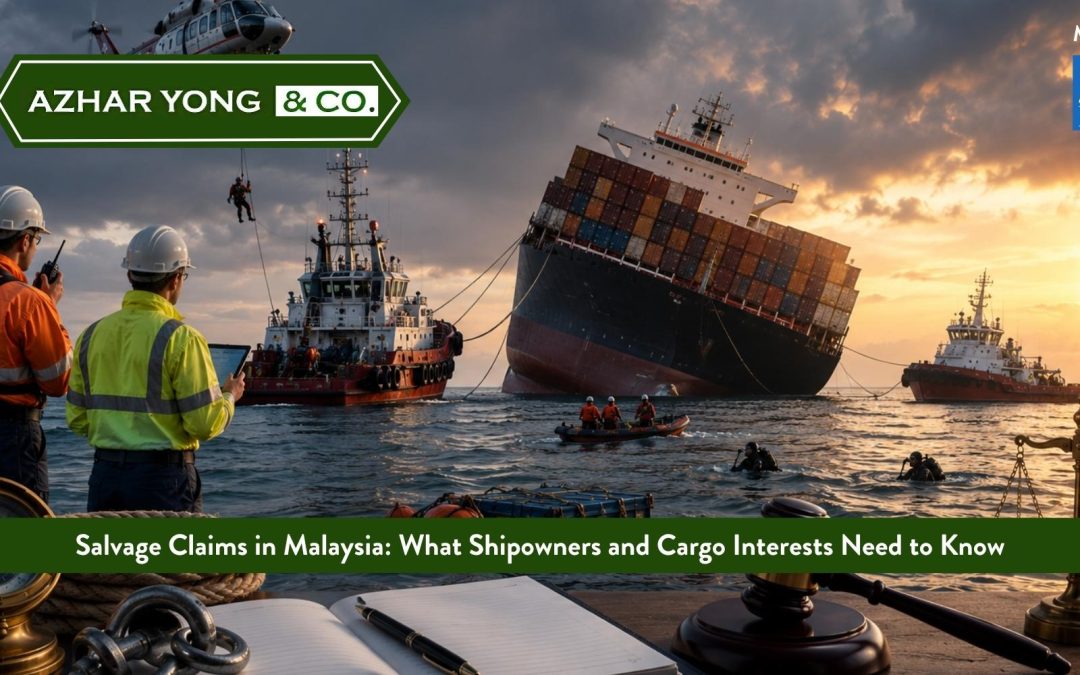
Salvage is the service rendered by one party to rescue another party’s vessel or cargo from peril at sea. In Malaysia, salvage is governed by common law principles and — for vessels party to Lloyd’s Open Form (LOF) — by the International Salvage Convention 1989, which Malaysia has incorporated through the Merchant Shipping Ordinance 1952 (MSO 1952). A successful salvor has the right to claim a salvage award — not just reimbursement of costs, but a reward reflecting the value of the property saved, the skill deployed, the risk taken, and the environmental protection achieved.
Salvage gives rise to one of the five recognised maritime liens in Malaysia — a privileged security interest that attaches to the vessel and its cargo and follows the property regardless of subsequent change of ownership. This means that if a salvor’s award is not paid, the salvor can apply to the Admiralty Court to arrest the salved vessel and enforce the lien against it, ahead of most other creditors, including registered mortgagees.
The most common form of international salvage agreement is Lloyd’s Open Form (LOF), under which salvage is conducted on a ‘no cure, no pay’ basis — the salvor receives nothing if the salvage attempt fails, but is entitled to an award (assessed by a Lloyd’s arbitrator in London) if the property is saved. LOF also incorporates the Special Compensation P&I Club clause (SCOPIC), which provides a safety net for environmental salvage operations where the saved property values are low.
For shipowners whose vessels operate in the Strait of Malacca — statistically one of the world’s highest-risk shipping corridors for grounding and collision — understanding salvage obligations before an incident occurs can mean the difference between a managed response and a chaotic one.
Key Issues in Malaysian Salvage Claims
-
A salvor’s maritime lien ranks ahead of ship mortgages and most other creditors in the distribution of sale proceeds.
-
A salvor is entitled to limit their liability under the LLMC 1996 in the same way as a shipowner.
-
Environmental salvage — protecting Malaysian waters from pollution — is rewarded under the Special Compensation provisions of the 1989 Salvage Convention.
-
Cargo owners share proportionately in the salvage award through General Average contributions.
-
Wrongful interference with salvage operations — including refusing to cooperate with a salvor — can affect the shipowner’s legal position significantly.
Frequently Asked Questions:
Q: What makes a service qualify as ‘salvage’ under Malaysian law?
A: For a service to qualify as salvage under Malaysian law and the 1989 Salvage Convention, several elements must be present. First, the vessel or cargo must have been in genuine peril — a real and present danger, not merely a hypothetical risk. Second, the service must have been rendered voluntarily — a vessel’s own crew performing their ordinary duties does not give rise to a salvage claim. Third, the salvage must have been successful — under the ‘no cure, no pay’ principle, a salvor who attempts but fails to save the vessel is generally entitled to nothing (though SCOPIC provides an exception for environmental protection efforts). The assessment of peril, voluntariness, and success is all factual questions that can be contested, and a maritime lawyer should be engaged immediately after any salvage operation to protect the shipowner’s position.
Q: How is a salvage award calculated in Malaysia?
A: For LOF salvage, the award is assessed by a Lloyd’s arbitrator in London applying the criteria set out in Article 13 of the 1989 Salvage Convention. These include: the salved value of the vessel, cargo, and bunkers; the skill and efforts of the salvors; the success of the operation; the degree of danger to the vessel, cargo, and crew; the risk to the salvors and their equipment; the environmental threat and the effectiveness of measures taken to prevent pollution; and the time and expense involved. The award cannot exceed the salved value of the property. For salvage operations not governed by LOF, the award is assessed by the court. In Malaysia, salvage awards in non-LOF cases may be assessed by the Admiralty Court applying the same Article 13 criteria.
Q: Can the salvor arrest my vessel in Malaysia to secure its award?
A: Yes — and this is one of the most powerful features of a salvage lien. A salvage claim gives rise to a maritime lien, which means the salvor has an immediate and privileged security interest in the salved property. If the salvage award is not paid or secured, the salvor can apply to the Malaysian Admiralty Court to arrest the vessel — even if ownership has changed since the salvage was performed. The lien follows the property, not the owner. In practice, most P&I Clubs will provide security in the form of a Letter of Undertaking to secure the release of a vessel arrested for salvage, allowing the vessel to return to trade while the quantum of the award is determined. A maritime lawyer should be instructed immediately to manage the security negotiation.
Q: What is SCOPIC, and when does it apply?
A: SCOPIC — the Special Compensation P&I Club clause — is an optional addition to Lloyd’s Open Form salvage contracts that provides a safety net for salvors in cases where the salved property values are low but significant environmental protection efforts are required. Under Article 14 of the 1989 Salvage Convention, a salvor is entitled to special compensation from the shipowner where the salvage operation has prevented or minimised damage to the environment, even where the salvage was unsuccessful, or the property values do not support a substantial award. SCOPIC effectively replaces Article 14 with a more predictable tariff-based calculation. It is typically invoked where a tanker or other vessel poses a significant pollution risk in environmentally sensitive waters — including Malaysian waters along the Strait of Malacca. The shipowner’s P&I Club is responsible for paying SCOPIC compensation, not the cargo insurers.
Q: Do cargo owners have to contribute to salvage awards?
A: Yes — and this is often a surprise to importers and exporters. When a vessel is salved, and cargo is saved as part of the operation, the cargo owners are required to contribute to the salvage award in proportion to the value of their cargo as a fraction of the total salved property (vessel, cargo, and bunkers). This contribution is collected through the General Average process — the shipowner will issue a General Average declaration, and cargo owners will be required to provide a General Average bond or cash deposit before their goods are released at the port of discharge. Marine cargo insurance typically covers General Average contributions — but only if the policy is in force at the time of the incident. Cargo owners without valid insurance may find themselves personally liable for substantial General Average contributions.

Marine Insurance Dispute Lawyer in Malaysia: Managing Coverage and Claim Disputes
A marine insurance dispute lawyer in Malaysia plays a crucial role in protecting the rights of policyholders when insurers dispute coverage or deny claims following maritime incidents. Marine insurance claims often involve substantial financial exposure, whether...

Ship Arrest in Malaysia: Legal Procedures, Risks, and Strategic Considerations
Ship arrest in Malaysia is one of the most powerful remedies available to maritime claimants seeking to secure unpaid debts or enforce maritime rights. This legal mechanism allows a claimant to detain a vessel as security for a recognised maritime claim, often...

Admiralty Jurisdiction of Malaysian Courts: Enforcement of Maritime Rights
The admiralty jurisdiction of Malaysian courts plays a central role in the enforcement of maritime rights and obligations within Malaysia. It allows maritime claimants to pursue legal action directly against vessels and shipping interests, making it an essential...

Protecting Assets at Sea: The Evolution of Marine Insurance Claims Malaysia
Marine insurance claims Malaysia have become a core element of corporate risk management as the global shipping and logistics industry faces new operational risks, regulatory pressures, and mounting asset values. Globally, premiums for marine insurance surpassed USD...

Resolving Complexities: The Role of Cargo Dispute Lawyer in Malaysia
Globally, cargo dispute lawyer in Malaysia plays an increasingly critical role amid growing international trade and evolving shipping regulations. Traditionally, legal professionals in this field were associated mainly with resolving claims of lost or damaged goods....

Securing Justice at Sea: The Evolving Approach to Vessel Arrest in Malaysia
Globally, Vessel Arrest in Malaysia is increasingly acknowledged as a crucial legal safeguard for shipowners, cargo interests, and creditors navigating today’s complex maritime industry. In past years, Vessel Arrest in Malaysia was seen as an extreme measure, used...