
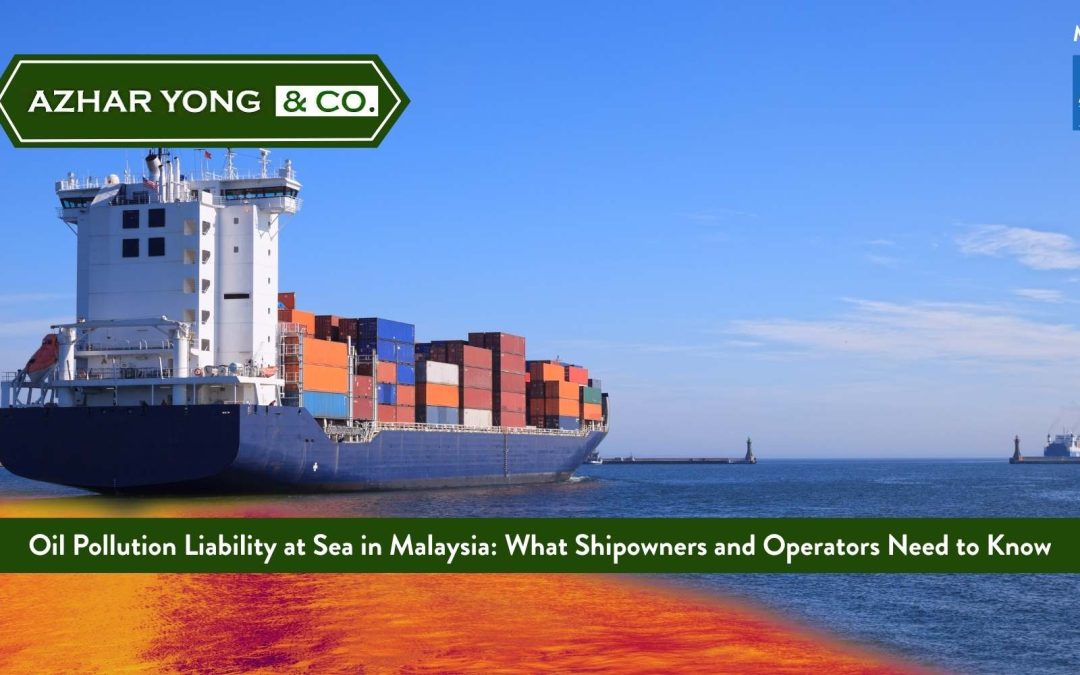
Malaysia’s strategic position along the Strait of Malacca — through which an estimated 40% of global seaborne trade passes — makes it one of the most environmentally sensitive maritime jurisdictions in the world. A vessel grounding, collision, or structural failure in Malaysian waters can cause catastrophic oil pollution damage to coastlines, fisheries, marine ecosystems, and local communities. The legal and financial consequences for the shipowner are severe, and they arise automatically — without the need to prove fault.
In Malaysia, civil liability for oil pollution damage is governed by the Merchant Shipping (Liability and Compensation for Oil and Bunker Oil Pollution) Act 1994 (Act 515), which gives effect to the 1992 International Convention on Civil Liability for Oil Pollution Damage (1992 CLC) and the 1992 International Oil Pollution Compensation Fund Convention (1992 Fund Convention). Malaysia is a party to both conventions.
Under Act 515 and the 1992 CLC, a shipowner whose vessel causes oil pollution damage in Malaysian waters is strictly liable — meaning liability arises from the fact of the spill, not from proof of negligence or fault. The claimant needs only to show that pollution damage was caused by oil discharged from a vessel covered by the Convention. The shipowner cannot avoid liability unless the damage resulted from an act of war, an exceptional natural phenomenon, the wrongful act of a third party, or the negligence of the competent authority responsible for navigational aids.
Separate from civil liability, MARPOL — the International Convention for the Prevention of Pollution from Ships, given force in Malaysia through the Merchant Shipping Ordinance 1952 — imposes criminal penalties for operational discharges of oil at sea. A vessel found to have discharged oil in violation of MARPOL faces fines, detention, and the arrest of the vessel by Malaysian port state control officers.
Malaysia’s Oil Pollution Liability Limits Under Act 515 (1992 CLC)
|
Vessel Size |
Liability Cap (SDR) |
Tier |
|
Up to 5,000 GT |
4.51 million SDR |
Tier 1 — Shipowner |
|
Over 5,000 GT |
4.51M SDR + 631 SDR per additional ton (max 89.77M SDR) |
Tier 1 — Shipowner |
|
All vessels (aggregate) |
203 million SDR (standard) / 300.74 million SDR (enhanced) |
Tier 2 — IOPC Fund |
What Losses Can Be Claimed for Oil Pollution Damage in Malaysia?
- Under Act 515 and the 1992 CLC, claimants who suffer pollution damage in Malaysian waters — including the territorial sea and exclusive economic zone — can recover a broad range of losses:
- Costs of clean-up and remediation: The direct cost of removing oil from the water, coastlines, beaches, and affected ecosystems — including the deployment of booms, skimmers, dispersants, and manual labour.
- Economic losses of affected industries: Fishermen, aquaculture operators, tourism businesses, and port operators who suffer loss of income as a direct result of the pollution damage can claim compensation.
- Property damage: Damage to vessels, fishing gear, aquaculture infrastructure, and other property contaminated or physically damaged by the oil spill.
- Preventive measures: Even where no actual spill occurs, the reasonable costs of preventive measures taken to prevent or minimise pollution damage are recoverable under the Convention.
- Environmental reinstatement: The reasonable cost of measures taken to restore the damaged environment to its condition before the incident.
Frequently Asked Questions
Q: Does strict liability mean a shipowner is always liable for an oil spill in Malaysia, regardless of fault?
A: Under Act 515 and the 1992 CLC, yes — strict liability means the shipowner is liable for oil pollution damage caused by a discharge from their vessel, regardless of whether they were negligent or at fault. The claimant does not need to prove the shipowner did anything wrong: proof that the pollution damage was caused by oil from the vessel is sufficient. The only defences available to the shipowner are narrow and specific: that the damage resulted from an act of war or hostilities; an exceptional, inevitable, and irresistible natural phenomenon; the wrongful act of a third party with intent to cause damage; or the negligence of a competent authority responsible for maintaining navigational lights or aids. If none of these defences applies, the shipowner is liable — and the liability limit provides the only financial ceiling, provided the shipowner did not act with personal fault or wilful misconduct.
Q: What is the IOPC Fund, and how does it help oil pollution victims in Malaysia?
A: The International Oil Pollution Compensation (IOPC) Fund is an intergovernmental organisation that provides supplementary compensation to victims of oil pollution damage when the shipowner’s liability — capped under the 1992 CLC — is insufficient to cover the full amount of the loss. Malaysia is a party to the 1992 Fund Convention, which means that victims of oil pollution damage in Malaysian waters can claim from the IOPC Fund when the shipowner’s insurance payout under the CLC is exhausted. The standard aggregate limit under the Fund is 203 million SDR (approximately USD 270 million), with an enhanced limit of 300.74 million SDR available where qualifying conditions are met. The IOPC Fund has its own claims process, and a maritime lawyer can assist claimants in presenting claims to both the shipowner’s P&I insurer and the Fund simultaneously.
Q: Our vessel caused a bunker oil spill — does the CLC apply?
A: The 1992 CLC applies specifically to spills of persistent oil carried as cargo — it covers laden oil tankers and tankers in ballast following an oil cargo voyage, but does not cover bunker oil spills from non-tanker vessels. However, Malaysia’s Act 515 was amended to also cover bunker oil pollution damage, giving effect to the International Convention on Civil Liability for Bunker Oil Pollution Damage 2001 (Bunkers Convention). Under the Bunkers Convention framework incorporated into Malaysian law, the registered owner, bareboat charterer, manager, or operator of a vessel from which bunker oil escapes can be held strictly liable for the resulting pollution damage. Ships of 1,000 GT and above are required to maintain insurance covering bunker oil pollution liability. This means that virtually all vessels of commercial size operating in Malaysian waters carry potential strict liability exposure for bunker spills.
Q: What criminal penalties can a vessel face for discharging oil in Malaysian waters?
A: Beyond civil liability, a vessel that discharges oil or oily water in violation of MARPOL faces significant criminal consequences in Malaysia. The Merchant Shipping Ordinance 1952 empowers the Marine Department of Malaysia and Malaysian port state control officers to inspect vessels, detain non-compliant ships, and prosecute offenders. Offences include: illegal discharge of oil or oily mixtures (in violation of MARPOL Annex I); failure to maintain an accurate Oil Record Book; and failure to hold valid MARPOL certificates. Penalties include substantial fines against both the vessel and its officers, and in serious cases, criminal prosecution of the Master. A vessel detained by Malaysian port state control for MARPOL violations may only be released after the violation is remedied and any fine or security is paid, which can result in significant commercial delay and reputational damage.
Q: As a shipowner, what insurance do I need to operate in Malaysian waters?
A: Shipowners operating in Malaysian waters should ensure they carry adequate Protection and Indemnity (P&I) Club insurance, which covers oil pollution liability, third-party injury and property damage claims, wreck removal, and crew liability. For oil tankers carrying more than 2,000 tons of oil in bulk as cargo, Act 515 requires a valid CLC Certificate of Insurance — issued by a P&I Club or approved insurer — to be on board whenever the vessel enters or leaves a Malaysian port. For vessels of 1,000 GT and above, a Bunkers Certificate is also required. Operating without these certificates is a criminal offence and can result in vessel detention by the Marine Department. A maritime lawyer can advise on the specific insurance and documentation requirements applicable to your vessel type and trading area, and assist with any disputes arising from a pollution incident.
Facing an oil pollution incident or liability claim in Malaysia? Azhar Yong & Co. advises shipowners, operators, P&I Clubs, and pollution victims on oil pollution liability, claims under Act 515 and the IOPC Fund, and MARPOL compliance across Malaysia.
Strategic Charterparty Dispute Resolution and Arbitration in Kuala Lumpur
In the fast-paced world of global shipping, a single breach in a charterparty agreement can disrupt entire supply chains. When negotiations fail, Charterparty dispute resolution and arbitration in Kuala Lumpur offers a sophisticated, cost-effective alternative to...
Navigating Malaysian Ship Registry Requirements for Foreign Owned Vessels
For international shipping companies, expanding into Southeast Asia often begins with a strategic presence in Malaysia. While traditional registration requires local majority ownership, the Malaysian Ship Registry requirements for foreign-owned vessels are...
Resolving Marine Insurance Claim Disputes under Marine Insurance Act 1906
Marine insurance provides the financial backbone for global trade, but when a loss occurs, the path to recovery often leads to complex legal friction. In local practice, marine insurance claim disputes under the Marine Insurance Act 1906 frequently arise because this...
Navigating IMO 2026 Decarbonization Compliance for Shipowners
The maritime industry currently faces a transformative era as global regulators tighten environmental standards. For vessel operators in Southeast Asia, achieving IMO 2026 decarbonization compliance for shipowners is no longer a future goal but an immediate...
Legal Liability for Cargo Damage under Carriage of Goods by Sea Act
Cargo damage remains a significant risk for Malaysian traders and shipowners. When goods arrive at Port Klang or Tanjung Pelepas in a damaged state, the Carriage of Goods by Sea Act (COGSA) provides the primary legal framework for seeking compensation. Navigating...
Navigating Legal Defence for Vessel Allision and Fixed Object Damage in Malaysia
In the busy waterways of Port Klang and the Port of Tanjung Pelepas, the margin for error is razor-thin. When a ship strikes a stationary structure—a specialised maritime incident known as an allision—the shipowner faces immediate and aggressive claims from port...