
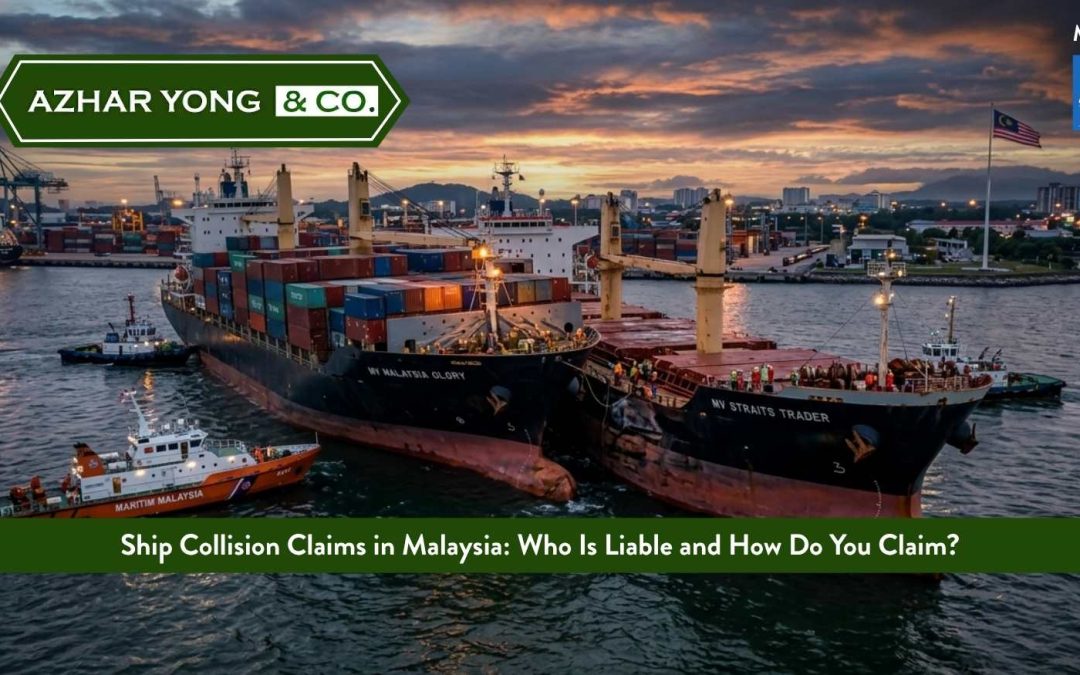
Malaysia’s position along the Strait of Malacca — one of the world’s busiest and most congested shipping lanes — means that ship collisions are a real and recurring risk. When two vessels collide, the legal consequences are immediate and potentially enormous: hull damage, cargo loss, fuel spills, crew injuries, and third-party claims from port operators or other vessels can follow in rapid succession.
In Malaysia, civil liability for ship collisions is governed by the law of negligence, as applied through the admiralty jurisdiction of the High Court. The foundational rules of navigation at sea — the International Regulations for Preventing Collisions at Sea 1972 (ColRegs) — are incorporated into Malaysian law through the Merchant Shipping (Collisions Regulations) Order 1984, made under the Merchant Shipping Ordinance 1952 (MSO 1952). A breach of the ColRegs is strong evidence of fault, though it is not by itself a presumption of liability — the breach must have actually caused the collision and the resulting damage.
To succeed in a collision claim, the claimant must establish three things: that the other vessel owed a duty of care; that it breached that duty — typically by violating a ColRegs rule such as maintaining a proper lookout (Rule 5), proceeding at a safe speed (Rule 6), or giving way when required (Rules 13 to 17); and that the breach caused the collision and the damage claimed.
Where both vessels are found to have contributed to the collision, liability is apportioned between them according to their respective degrees of fault. This is known as contributory negligence, and it is the norm in most collision cases — pure single-vessel fault is the exception, not the rule. A shipowner found 60% at fault, for example, pays 60% of the total damages across both vessels. The financial consequences can be significant, and the importance of preserving evidence and engaging a maritime lawyer immediately after a collision cannot be overstated.
Immediate Steps to Take After a Ship Collision
-
Preserve all navigational data: Secure the Voyage Data Recorder (VDR) or Simplified VDR immediately. Also, preserve radar plots, AIS data, engine room logs, bridge logs, and any CCTV footage. This data is perishable — do not delay.
-
Obtain a marine survey: Commission an independent marine surveyor as soon as possible to attend the vessel and document the extent, nature, and likely cause of the damage. A prompt survey is critical to establishing liability and quantum.
-
Notify your P&I Club: Your Protection and Indemnity insurer must be notified of the collision without delay. P&I Clubs provide experienced collision handlers and legal support — but prompt notification is a condition of cover.
-
Do not admit liability: No statement admitting fault should be made — whether in writing, verbally, or in any report — before taking legal advice. Admissions can bind you in subsequent proceedings.
-
Engage a maritime lawyer: A specialist maritime lawyer should be instructed immediately. They will protect your legal position, manage communications with the other vessel and their insurers, and advise on whether to arrest the other vessel to secure your claim.
Frequently Asked Questions
Q: What is the ColRegs and why does it matter in a collision claim?
A: The ColRegs — the International Regulations for Preventing Collisions at Sea 1972 — are the universal rules of the road for vessels at sea. They cover everything from keeping a proper lookout and maintaining a safe speed to the right-of-way rules between different types of vessels. In Malaysia, the ColRegs are given legal force through the Merchant Shipping (Collisions Regulations) Order 1984. In a collision claim, courts examine whether each vessel complied with the applicable ColRegs rules. A breach of the ColRegs is compelling evidence of negligence — but only if that breach actually caused or contributed to the collision. A non-causative breach will not, by itself, give rise to liability.
Q: Both vessels were at fault. How is liability apportioned?
A: In the vast majority of ship collisions, fault is shared between the vessels involved. Malaysian admiralty law — following established English admiralty principles — allows the court to apportion liability between the vessels according to their respective degrees of fault. Each vessel then bears responsibility for that percentage of the total loss across both ships. For example, if Vessel A is found 70% at fault and Vessel B is 30% at fault, and total damages across both vessels are USD 5 million, Vessel A pays USD 3.5 million and Vessel B pays USD 1.5 million. Apportionment is not a mathematical formula — it reflects the court’s judgment on the gravity and causative weight of each vessel’s navigational failures.
Q: Can I arrest the other vessel to secure my collision claim?
A: Yes — and doing so promptly may be essential. A claim for damage done by a ship is a recognised admiralty claim under Malaysian law, entitling the claimant to proceed in rem against the vessel that caused the damage. If that vessel is in Malaysian waters, an application can be made to the Admiralty Court for a Warrant of Arrest. The arrest secures the claim and creates immediate commercial pressure for the other side to provide acceptable security — typically a P&I Club Letter of Undertaking — allowing the vessel to be released while the substantive claim proceeds. Acting quickly is critical: once the vessel leaves Malaysian waters, the arrest opportunity is lost.
Q: What damages can I recover in a ship collision claim?
A: The range of recoverable damages in a ship collision claim is broad, but recovery depends on establishing causation for each head of loss. Recoverable losses typically include: the cost of repairing or, if the vessel is a total loss, the market value of the vessel immediately before the collision; loss of use of the vessel during the repair period, calculated as the net earnings the vessel would have made; cargo damage or loss suffered as a result of the collision; damage to port infrastructure, buoys, or other fixed objects; crew injury claims; and fuel or bunker losses. Each head of loss must be properly evidenced — repair invoices, survey reports, charter market evidence, and expert valuations will all be required.
Q: How long do I have to bring a ship collision claim in Malaysia?
A: Under the Maritime Conventions Act 1911, as applied in Malaysia, the limitation period for collision damage claims is two years from the date of the collision. This is shorter than the general six-year contract limitation period under the Limitation Act 1953, and it is strictly applied. Where the claimant was unable to arrest a vessel within the two-year period through no fault of their own, the court may extend the limitation period — but such extensions are granted sparingly. Do not assume that because the two-year period has not yet expired, there is no urgency. Gathering evidence, commissioning surveys, and identifying the responsible vessel all take time. Engage a maritime lawyer as soon as possible after the collision.
Has your vessel been involved in a collision in Malaysian waters? Azhar Yong & Co. advises shipowners, P&I Clubs, and cargo interests on collision claims, vessel arrests, and admiralty proceedings across Malaysia. Contact us immediately — time and evidence are critical.
Navigating Malaysian Ship Registry Requirements for Foreign Owned Vessels
For international shipping companies, expanding into Southeast Asia often begins with a strategic presence in Malaysia. While traditional registration requires local majority ownership, the Malaysian Ship Registry requirements for foreign-owned vessels are...
Resolving Marine Insurance Claim Disputes under Marine Insurance Act 1906
Marine insurance provides the financial backbone for global trade, but when a loss occurs, the path to recovery often leads to complex legal friction. In local practice, marine insurance claim disputes under the Marine Insurance Act 1906 frequently arise because this...
Navigating IMO 2026 Decarbonization Compliance for Shipowners
The maritime industry currently faces a transformative era as global regulators tighten environmental standards. For vessel operators in Southeast Asia, achieving IMO 2026 decarbonization compliance for shipowners is no longer a future goal but an immediate...
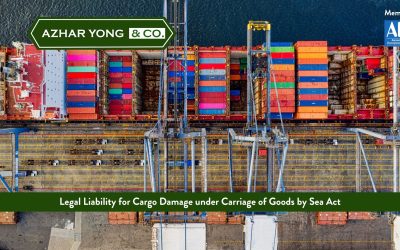
Legal Liability for Cargo Damage under Carriage of Goods by Sea Act
Cargo damage remains a significant risk for Malaysian traders and shipowners. When goods arrive at Port Klang or Tanjung Pelepas in a damaged state, the Carriage of Goods by Sea Act (COGSA) provides the primary legal framework for seeking compensation. Navigating...
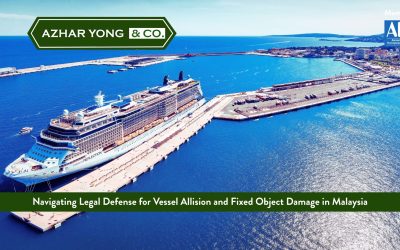
Navigating Legal Defence for Vessel Allision and Fixed Object Damage in Malaysia
In the busy waterways of Port Klang and the Port of Tanjung Pelepas, the margin for error is razor-thin. When a ship strikes a stationary structure—a specialised maritime incident known as an allision—the shipowner faces immediate and aggressive claims from port...

Legal Requirements for Registering a Ship Mortgage in Malaysia
Securing financing for a vessel requires more than just a signed loan agreement; it necessitates formal registration to establish priority over other creditors. In Malaysia, the legal requirements for registering a ship mortgage in Malaysia are governed strictly by...