
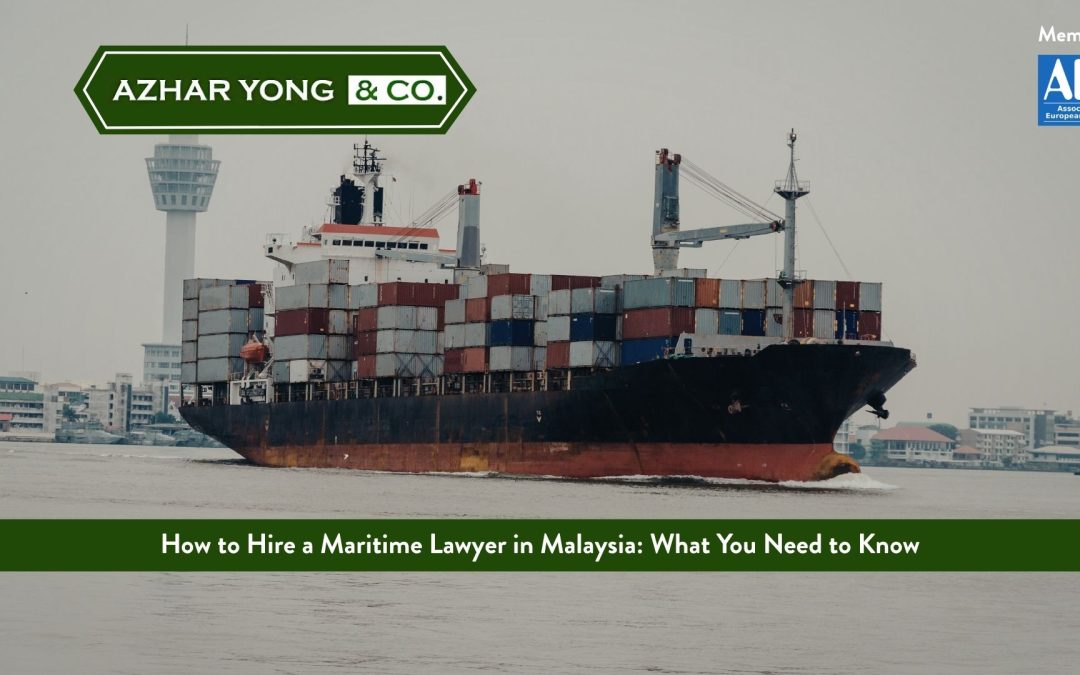
Whether you are a shipowner, cargo operator, seafarer, or freight forwarder, understanding when and how to engage a maritime lawyer in Malaysia can protect your business and your livelihood. This guide covers everything you need to know — from what maritime lawyers actually do, to the key questions you should ask before retaining one.
Malaysia sits at one of the busiest maritime crossroads in the world. The Strait of Malacca, one of the world’s most critical shipping lanes, passes through its waters daily — carrying an estimated 40% of global seaborne trade. Ports like Port Klang, Penang, and Johor are key nodes in the Asia-Pacific supply chain. With this level of maritime activity comes significant legal complexity, and disputes at sea — from cargo damage to vessel arrests — can result in enormous financial losses if not handled correctly.
Yet many businesses and individuals involved in Malaysia’s maritime industry do not know when they need a maritime lawyer, what such a lawyer actually does, or how to choose the right one. This guide answers all of those questions in plain language.
What Is Maritime Law in Malaysia?
Maritime law — also known as admiralty law — governs legal matters arising from activities at sea. In Malaysia, this body of law covers shipping, navigation, marine commerce, cargo transportation, marine insurance, vessel registration, seafarer rights, and marine environmental protection.
Malaysia’s maritime legal framework draws from both domestic legislation and English admiralty law, which was imported into the country’s legal system. The primary pieces of legislation governing maritime matters in Malaysia include:
-
The Merchant Shipping Ordinance 1952 (MSO 1952) — the foundational legislation covering vessel registration, crew welfare, and liability.
-
The Carriage of Goods by Sea Act 1950 — governing the terms of sea transport contracts and cargo liability.
-
The Courts of Judicature Act 1964 — which vests the Malaysian High Court with the same admiralty jurisdiction as the English High Court.
-
The Arbitration Act 2005 — providing the framework for resolving maritime disputes outside of court.
-
International conventions, including UNCLOS and the Maritime Labour Convention 2006 (MLC 2006), ratified by Malaysia in 2013.
Disputes arising under this framework are typically heard by the Admiralty Court — a specialised division of the High Court of Malaya in Kuala Lumpur. This court handles everything from ship arrests and cargo claims to marine insurance disputes and seafarer wage claims.
What Does a Maritime Lawyer in Malaysia Do?
A maritime lawyer — sometimes called an admiralty lawyer — specialises in the legal issues that arise from shipping and sea-based commerce. Unlike a general civil litigator, a maritime lawyer has deep knowledge of both domestic legislation and international maritime conventions, as well as the practical realities of the shipping industry.
In Malaysia, maritime lawyers typically handle the following:
1. Ship Arrests and Vessel Release
One of the most distinctive powers in admiralty law is the ability to physically arrest a vessel — that is, to obtain a court order that prevents a ship from leaving port until a claim is resolved or security is provided. Maritime lawyers advise both parties seeking to arrest a vessel and shipowners looking to have their vessel released quickly.
2. Cargo Damage and Loss Claims
When goods are damaged, lost, or delayed in transit by sea, both cargo owners and carriers need legal guidance. Maritime lawyers help establish liability, navigate the terms of bills of lading and charterparties, and pursue or defend claims through negotiation or litigation.
3. Marine Insurance Disputes
When insurers reject or delay marine insurance claims, maritime lawyers can challenge those decisions and pursue the compensation their clients are owed. This includes disputes over hull insurance, cargo insurance, P&I (Protection and Indemnity) cover, and freight liability insurance.
4. Seafarer Rights and Injury Claims
Seafarers who suffer injuries at sea or face unpaid wages have legal rights under both Malaysian law and international conventions like the MLC 2006. Maritime lawyers help crew members pursue compensation claims and ensure their rights under employment contracts and maritime statutes are protected.
5. Charterparty and Shipping Contract Disputes
Disputes between shipowners and charterers — arising from time charters, voyage charters, or bareboat charters — are a significant portion of maritime legal work. This includes disputes over freight, demurrage, off-hire, laytime, and breach of charter terms.
6. Maritime Arbitration and Dispute Resolution
Many shipping contracts contain arbitration clauses, requiring disputes to be resolved outside of court — often in London or Singapore. Malaysian maritime lawyers represent clients in international arbitration proceedings and also assist with enforcing arbitral awards in Malaysia.
7. Ship Sale, Purchase, and Registration
Buying or selling a vessel is a complex transaction involving vessel surveys, title searches, financing, and registration with the Malaysian Marine Department. Maritime lawyers ensure these transactions are legally sound and protect their clients from undisclosed liabilities.
When Do You Need a Maritime Lawyer in Malaysia?
Not every shipping-related problem requires a lawyer. But there are certain situations where professional legal advice is not just helpful — it is essential. Here are the most common scenarios:
-
Your vessel has been detained or arrested, or you need to arrest another vessel to secure a claim.
-
Your goods have been damaged, lost, or delayed at sea, and the carrier or insurer is disputing liability.
-
Your marine insurance claim has been rejected or is taking an unreasonably long time to settle.
-
You are a seafarer who has been injured on the job or who has not received wages owed to you.
-
There is a dispute with a charterer or counterparty over the terms of a shipping contract.
-
Your vessel has been involved in a collision or grounding, and you are facing third-party claims.
-
You are buying or selling a vessel and want to ensure the transaction is legally watertight.
In all of these situations, acting quickly matters. Maritime law has strict time limits for filing claims. For example, cargo claims under the Hague-Visby Rules typically must be brought within one year of delivery. Missing these deadlines can mean losing your right to sue entirely.
Understanding the Malaysian Admiralty Court
Malaysia’s Admiralty Court — established formally in 2010 and housed within the High Court of Malaya at Kuala Lumpur — is the primary forum for resolving maritime disputes in Peninsular Malaysia. It is staffed by specialist judges who understand the technical and commercial realities of the shipping industry, making it far more efficient than a general civil court for complex maritime matters.
The court handles a wide range of matters, including ship arrests and releases, cargo claims, marine insurance disputes, charterparty litigation, shipbuilding disputes, vessel collisions, seafarer claims, and maritime arbitration-related applications.
One important feature of admiralty law is the distinction between in rem and in personam actions. An in rem action is brought against the vessel itself, allowing creditors to arrest the ship as security for their claim — even if the shipowner cannot be personally served. An in personam action is brought against a named party, similar to a regular civil claim. A maritime lawyer will advise which type of action is appropriate for your case.
For disputes involving vessels operating from East Malaysian ports, the relevant High Courts in Sabah and Sarawak handle admiralty matters. The jurisdiction of the Admiralty Court in Kuala Lumpur covers the whole of Peninsular Malaysia and the Federal Territory of Labuan.
How to Choose the Right Maritime Lawyer in Malaysia
Not all lawyers who describe themselves as maritime practitioners have the depth of experience needed to handle complex admiralty matters. When evaluating a maritime lawyer in Malaysia, here are the key factors to consider:
Specialist Experience
Maritime law is a highly specialised field. You want a lawyer or firm that handles shipping and admiralty matters as a core practice area — not as an occasional sideline. Ask how many maritime cases they have handled in the past two to three years, and whether those cases are similar to yours in nature and scale.
Admiralty Court Track Record
A lawyer who regularly appears before the Admiralty Court in Kuala Lumpur will have strong relationships with the court’s procedures, its registry staff, and its judges. This familiarity can make a significant practical difference in the speed and outcome of your case.
Regional Reach
Malaysia’s maritime sector extends across a wide geographic area. If your dispute involves vessels calling at East Malaysian ports — or if your counterparty is based in Singapore, Indonesia, or elsewhere in Asia — you want a law firm with regional connections and cross-border experience.
Knowledge of International Conventions
Maritime disputes often involve international elements — vessels flagged in foreign countries, cargo owners in multiple jurisdictions, and contracts governed by English law or subject to London arbitration. Your lawyer should be comfortable navigating these international dimensions.
Responsiveness
Maritime emergencies — an arrested vessel, a sinking ship, a time-sensitive claim — cannot wait. When a vessel is arrested, every hour matters, as detention costs the shipowner money. Choose a lawyer or firm that is genuinely available and can move quickly when the situation demands it.
Key Questions to Ask Before Retaining a Maritime Lawyer
Before you commit to working with any maritime law firm, it is worth asking a few direct questions during your initial consultation:
-
How many cases similar to mine have you handled in the past three years?
-
Have you appeared before the Admiralty Court in Kuala Lumpur?
-
Who will be handling my case on a day-to-day basis, and how will I be kept updated?
-
What is your fee structure — fixed fee, hourly, or contingency?
-
Do you have experience handling cross-border disputes or international arbitration?
-
Are there any time limits I need to be aware of for filing my claim?
A reputable maritime law firm will answer these questions confidently and clearly. If a lawyer is vague, dismissive, or unable to cite relevant experience, that is a signal to look elsewhere.
Litigation vs Arbitration: Which Route is Right for You?
One of the first strategic decisions in any maritime dispute is whether to pursue the matter through court litigation or arbitration. Each has its advantages, and the right choice depends on the nature of your dispute, the applicable contract, and your priorities.
Court litigation through the Admiralty Court in Malaysia offers:
-
The powerful remedy of ship arrest, which arbitration alone cannot provide.
-
A public, enforceable judgment.
-
Access to the specialist expertise of an admiralty judge.
Maritime arbitration — commonly conducted under KLRCA, SIAC, or LMAA rules — offers:
-
Confidentiality, which can be important for commercial relationships.
-
Flexibility in choosing arbitrators with industry-specific expertise.
-
Easier international enforceability of awards under the New York Convention.
It is worth noting that in Malaysia, a vessel can be arrested even when the underlying dispute is subject to an arbitration clause. Courts can grant interim measures — including ship arrest — in support of ongoing or intended arbitration proceedings. This makes it possible to secure your claim immediately while the substantive dispute proceeds through arbitration.
Why Work with Azhar Yong & Co. for Your Maritime Legal Needs?
At Azhar Yong & Co., maritime and admiralty law is not a peripheral practice area — it is our core focus. We act for a wide range of clients across the maritime industry in Malaysia and throughout the Asia-Pacific region, including shipowners, cargo interests, freight forwarders, marine insurers, charterers, port operators, and seafarers.
Our team has direct, hands-on experience across the full spectrum of maritime legal matters — from urgent ship arrest applications filed at speed, to complex multi-party cargo claims, to lengthy charterparty arbitrations. We understand that for clients in the shipping industry, time and money are inseparable — delays in resolving a dispute mean ongoing costs, disrupted operations, and financial uncertainty.
What sets us apart:
-
Deep expertise in Malaysian admiralty law and Admiralty Court procedure.
-
Regional reach across the Asia-Pacific, with an understanding of the legal environments in neighbouring jurisdictions.
-
Proven ability to move quickly when urgent action — such as ship arrest — is required.
-
A commitment to practical, commercially-minded legal advice — not just theoretical legal analysis.
-
Clear, transparent communication throughout every stage of your matter.
Final Thoughts: Do Not Wait Until a Dispute Escalates
One of the most common mistakes businesses and individuals make in maritime matters is waiting too long to get legal advice. They attempt to resolve disputes informally, miss critical deadlines, or take actions that inadvertently weaken their legal position — all before contacting a lawyer.
Maritime law is unforgiving in this regard. Time limits are strict, the procedures are technical, and the stakes — vessels worth millions, cargo shipments, and business relationships that span borders — are high. The earlier you engage a specialist maritime lawyer, the more options you will have.
Whether you are facing an urgent crisis at sea or planning to protect your maritime business interests, Azhar Yong & Co. is here to help. Contact us for a confidential consultation, and let us help you navigate the legal waters ahead.
Need a maritime lawyer in Malaysia? Contact Azhar Yong & Co. today for expert admiralty and maritime legal advice across Malaysia and the Asia-Pacific region.
Visit: www.azharyong.com