
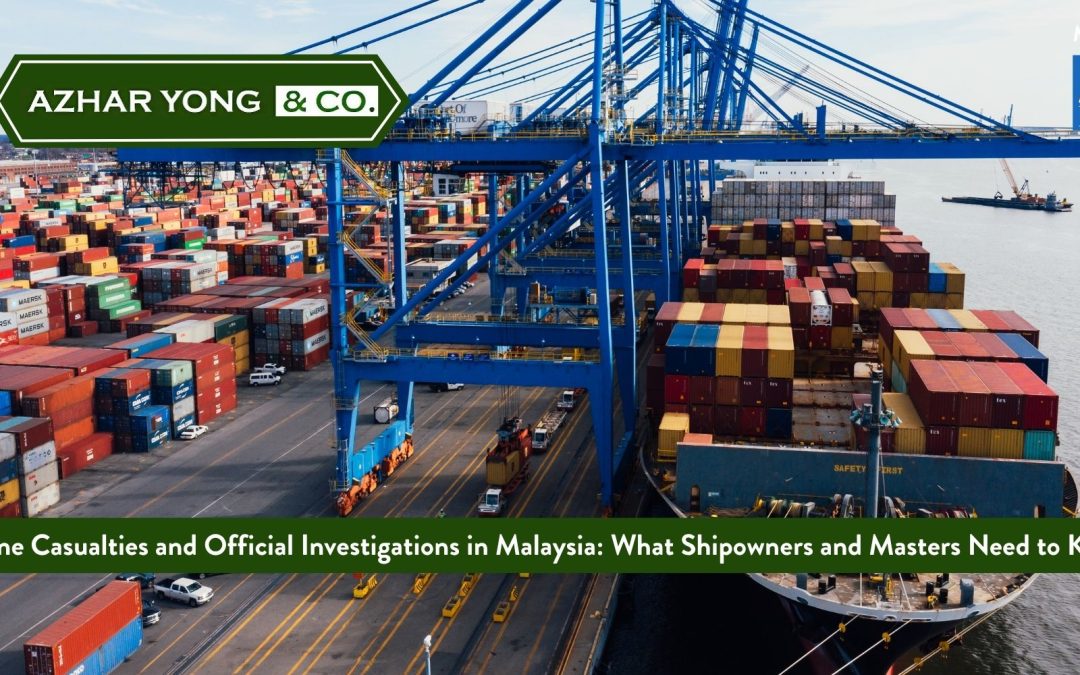
A marine casualty — whether a grounding, fire, flooding, collision, or structural failure — triggers a cascade of simultaneous legal, regulatory, and commercial obligations. In Malaysia, the primary investigative authority for marine casualties is the Marine Department of Malaysia (Jabatan Laut Malaysia), operating under the Merchant Shipping Ordinance 1952 (MSO 1952). Depending on the nature and severity of the incident, the Malaysian Maritime Enforcement Agency (MMEA), the Department of Environment, and — for incidents involving loss of life — the Royal Malaysia Police may also be involved.
Under the MSO 1952, the Marine Department has broad powers to investigate any casualty involving a vessel in Malaysian waters — including the power to summon witnesses, require the production of documents, and hold a formal inquiry. A formal inquiry can result in the suspension or cancellation of the certificate of competency of a vessel’s Master or officers, if their conduct is found to have caused or contributed to the casualty. This is a significant professional consequence that Masters and officers must take seriously — and for which they require their own independent legal representation, separate from the shipowner’s lawyers.
For shipowners, a casualty triggers immediate P&I Club notification obligations — failure to notify promptly is a condition breach that can affect coverage. It also triggers potential claims from cargo interests, third parties, and environmental authorities; potential criminal prosecution of the vessel and its officers; and — where the casualty creates a pollution risk — urgent response obligations under MARPOL and the Environmental Quality Act 1974.
Evidence preservation is the most critical immediate action. VDR data, bridge logs, cargo manifests, engineer’s logs, and communications should be secured and protected from alteration before investigators arrive. In a world where VDR data can be overwritten within days, prompt preservation can make or break the subsequent legal proceedings.
Immediate Steps After a Marine Casualty in Malaysia
-
Notify the Marine Department: The Master is legally obliged to report any casualty to the nearest Marine Department office as soon as practicable. Failure to report is a criminal offence under the MSO 1952.
-
Notify the MMEA: For incidents in Malaysian waters involving environmental risk, collision, or distress, the MMEA should also be notified through its operations centre.
-
Notify the P&I Club: Immediate notification is a condition of P&I cover. The Club will deploy a surveyor and a Club correspondent to assist with the immediate response.
-
Preserve all evidence: Secure the VDR, bridge logs, engine room logs, cargo manifests, AIS data, CCTV footage, and all communications. Instruct crew not to alter or destroy any records.
-
Engage a maritime lawyer immediately: Legal representation for the shipowner and — separately — for the Master and officers should be secured before any formal investigative interview or statement is given.
-
Commission independent surveys: An independent hull surveyor, cargo surveyor, and — where relevant — a structural or fire investigation expert should be appointed as soon as the vessel is safe to board.
Frequently Asked Questions: Marine Casualty Investigations in Malaysia
Q: What is a Marine Department formal inquiry and what are the consequences?
A: A formal inquiry under the MSO 1952 is a judicial-style proceeding conducted by a Wreck Commissioner (a magistrate or senior court official) with the assistance of assessors who provide technical expertise. The inquiry examines the circumstances of the casualty, determines its cause, and — if the evidence supports it — considers whether any person’s conduct (including the Master, officers, or shipowner) caused or contributed to the incident. The inquiry has the power to: censure any person whose conduct contributed to the casualty; suspend or cancel the certificate of competency of a Master, officer, or engineer; and make recommendations to prevent future casualties. The proceedings are public, and findings are published. A certificate suspension or cancellation has direct and immediate consequences for a seafarer’s career. The Master and any officer at risk of such a finding should be separately represented by a maritime lawyer throughout the inquiry.
Q: Can the Master be criminally prosecuted following a marine casualty in Malaysia?
A: Yes — and this is a real risk that all Masters must take seriously. Under the MSO 1952 and the Penal Code, a Master whose negligent navigation causes death, injury, or serious damage to property may face criminal charges including causing death by negligence, endangering the safety of others, and — where MARPOL violations are involved — criminal charges under the Merchant Shipping Ordinance. Where the casualty causes an oil spill, the Environmental Quality Act 1974 provides for criminal penalties against both the vessel and its officers. The Master’s right to legal representation begins the moment an investigation commences — and the Master should not make any statement to investigators, or give evidence at a formal inquiry, without having spoken to an independent maritime lawyer. Statements made without legal advice can have lasting consequences in both criminal and civil proceedings.
Q: Who investigates marine casualties in Malaysian waters — the Marine Department or the MMEA?
A: Both agencies have jurisdiction, depending on the nature of the incident. The Marine Department of Malaysia investigates casualties under the MSO 1952 — its focus is on the technical causes of the casualty, the condition of the vessel, and the conduct of the crew. The MMEA has broader maritime law enforcement responsibilities, including responding to distress, enforcing safety and environmental regulations, and — where criminal conduct is suspected — referring matters to the PDRM. In practice, both agencies may be involved in the immediate response to a major casualty: the MMEA provides search and rescue and enforcement response; the Marine Department conducts the technical investigation and any formal inquiry. For incidents causing oil pollution, the Department of Environment will also be involved, and its officers have independent powers of investigation under the Environmental Quality Act 1974.
Q: What evidence should I preserve after a marine casualty, and for how long?
A: The evidence that matters most in marine casualty proceedings includes: Voyage Data Recorder (VDR) data — this should be downloaded by a certified VDR specialist immediately after the casualty, before the memory loop overwrites it (VDRs typically retain only 12 to 48 hours of data). Bridge logs and watch records — all handwritten and electronic entries must be preserved in their original form. Engine room logs and maintenance records — particularly relevant for engineering casualties. AIS data — downloadable from the vessel’s AIS transponder and independently verifiable from commercial AIS tracking services. CCTV footage — from bridge cameras, engine room cameras, and external deck cameras. Cargo documentation — manifests, stowage plans, dangerous goods declarations, and temperature records. All communications — VHF recordings, satellite phone logs, email, and messaging platform records. The general rule is to preserve all potentially relevant evidence for the duration of any investigation, litigation, or arbitration — which can extend for years after a major casualty. A maritime lawyer can advise on the specific evidence obligations in your case.
Q: Can cargo owners sue the shipowner directly for losses arising from a marine casualty?
A: Yes — and cargo claims arising from marine casualties are among the largest and most complex maritime claims. Where cargo is damaged, lost, or delayed as a result of a marine casualty caused by the vessel’s unseaworthiness or the negligence of the crew, cargo owners have a direct claim against the carrier — typically the shipowner or charterer — under the Carriage of Goods by Sea Act 1950 and the bill of lading. These claims are subject to the one-year limitation period under the Hague Rules. Cargo claims arising from a casualty may also intersect with limitation of liability proceedings under the LLMC 1996 — where the total claims across all cargo interests exceed the limitation fund, each claimant recovers only a pro rata share. In a serious casualty with multiple cargo interests, both the individual cargo claims and the overall limitation proceedings require careful legal management from the very early stages.
Securing Your Cargo: The Power of the Maritime Insurance Act
Securing Your Cargo: The Power of the Maritime Insurance ActShipping assets faces countless perils. From vast oceans to complex logistics, risks are ever-present. The Maritime Insurance Act provides essential legal protection. It standardises marine insurance...
The Critical Role of Your Admiralty and Maritime Lawyer
Navigating the Evolving Tides: The Critical Role of Your Admiralty and Maritime LawyerThe global maritime industry is dynamic and complex. Understanding the role of an admiralty and maritime lawyer is more crucial than ever. Azhar Yong & Co. stand ready to...
Cruising with Confidence: The Indispensable Cruise Ship Lawyer
Cruising with Confidence: The Indispensable Cruise Ship LawyerThe global cruise industry offers unique adventures. It also presents complex legal challenges. A specialized cruise ship lawyer is vital for navigating these waters. They represent passengers, crew, and...
Admiralty Lawyers: The Pillars of Global Maritime Justice
Admiralty Lawyers: The Pillars of Global Maritime JusticeThe world’s oceans are the arteries of global trade, with over 90% of international goods transported by sea. In this high-stakes industry, admiralty lawyers play a crucial role. From resolving complex disputes...

Marine Lawyers: Global to Future Outlook
The Evolving Role of a Marine Lawyer: A Global, Asian, and Future OutlookIn the global maritime industry, a marine lawyer is often seen as a niche legal expert, responsible for resolving complex disputes at sea. From ship collisions to cargo damages, international...
Azhar Yong & Co.: One of the Best Maritime Law Firms in Kuala Lumpur
Azhar Yong & Co.: One of the Best Maritime Law Firms in Kuala LumpurIn a thriving port city like Klang Valley, the demand for specialised maritime legal services is on the rise. Among the legal firms making waves in this sector, Azhar Yong & Co. is widely...