
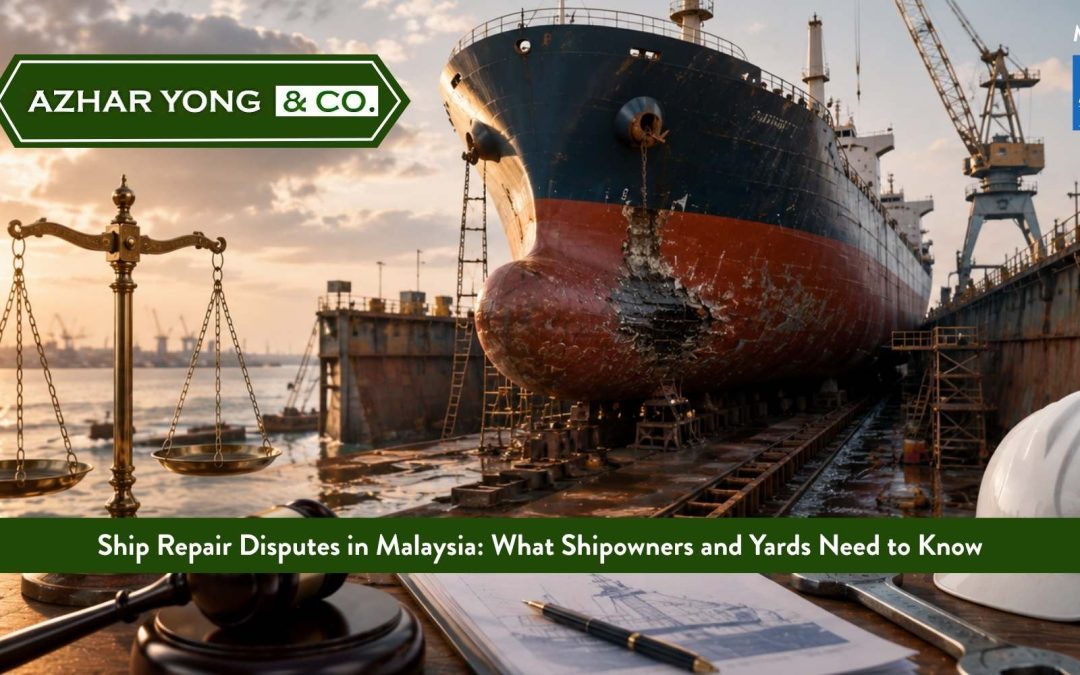
Malaysia’s ship repair industry is substantial, with yards in Port Klang, Penang, Johor Bahru, Labuan, and Kuching handling routine dry-docking, emergency repairs, and major conversions for both domestic and international vessels. The ship repair relationship is governed by a contract between the shipowner and the yard — which may range from a detailed written repair specification to a simple verbal quotation and handshake.
Ship repair contracts are commercial contracts governed by the Contracts Act 1950 and the Sale of Goods Act 1957. The yard’s obligations include completing the agreed repairs to a workmanlike standard, within the agreed time, and for the agreed price. Where any of these elements goes wrong — defective workmanship, delay, or price escalation — both parties have legal rights and remedies that depend on the specific contract terms and the circumstances of the failure.
One of the most important features of a ship repair relationship is the shipbuilder’s or repairer’s lien. Under Malaysian law, a shipyard has a possessory lien over the vessel in its possession — meaning it is entitled to retain the vessel until all outstanding repair invoices are paid. This lien is a common law right that arises automatically upon non-payment, without any court order. A shipowner who disputes a repair invoice but wants the vessel back faces a difficult commercial position: in practice, the dispute must be resolved — or secured — before the yard will release the vessel.
Conversely, where a yard releases the vessel without securing payment — for example, under commercial pressure from a shipowner threatening to take the vessel to a competitor — the yard loses its possessory lien and must pursue payment through litigation or arbitration, without the leverage of holding the vessel.
Common Ship Repair Disputes in Malaysia
-
Price escalation: Yard claims costs have increased beyond the original quotation due to the discovery of additional defects. The key question: does the contract allow for price variation, and were the additional works authorised in writing?
-
Defective workmanship: Repairs completed by the yard fail shortly after the vessel returns to service. The yard’s warranty period and the procedure for making warranty claims are critical.
-
Delivery delay: Yard detains the vessel beyond the agreed repair period, causing off-hire losses and missed commercial commitments for the owner.
-
Disputed invoice: Owner refuses to pay the full invoice. Yard exercises possessory lien, refusing to release the vessel until payment or security is provided.
-
Damage during repair: The yard damages the vessel during the repair process. Is the yard liable? The answer depends on whether the damage was caused by the yard’s negligence and whether the contract contains any limitation or exclusion of liability.
Frequently Asked Questions: Ship Repair Disputes in Malaysia
Q: The yard has issued an invoice much higher than the original quotation. Do I have to pay?
A: It depends on the terms of the repair contract and how the additional works arose. If the contract was for a fixed price for defined works, and the yard carried out additional works without obtaining the owner’s written authorisation, the owner is generally not obliged to pay for the unauthorised additions. However, if the yard discovered additional defects during the repair — and gave the owner notice and the owner directed the yard to proceed — the additional works may be payable even if no formal variation order was signed. The Sale of Goods Act 1957’s implied terms as to reasonable price may also be relevant where no price was agreed for additional works. The strength of your position depends on what was agreed in writing, what instructions were given during the repair, and whether the additional works were necessary to complete the contracted repairs. A maritime lawyer can assess the specific facts and advise on your payment obligations.
Q: The yard is holding my vessel and refusing to release it until I pay a disputed invoice. What can I do?
A: A yard’s possessory lien is a legally recognised right under Malaysian common law, entitling the yard to retain the vessel until all outstanding repair charges are paid. You cannot simply demand the vessel back — the lien is valid even if you dispute the invoice. Your options are: pay the disputed amount under protest (preserving your right to claim the excess back); provide security (such as a bank guarantee or P&I Club LOI) in lieu of payment, if the yard agrees; or apply to the Admiralty Court for an order compelling release of the vessel, which the court may grant if the lien is being exercised unconscionably or in breach of the repair contract. In practice, most disputes of this nature are resolved through negotiation — the yard wants payment, the owner wants the vessel. A maritime lawyer can often break the impasse by proposing a commercially workable security arrangement.
Q: The vessel was damaged while in the yard. Is the yard liable?
A: A shipyard that damages a vessel in its care is liable for that damage in negligence, provided the damage was caused by the yard’s failure to exercise reasonable care. The yard owes a duty of care to the shipowner as a bailee of the vessel — and a bailee for reward (which a yard is) must take reasonable care of the property in its possession. If the damage was caused by the yard’s employees, equipment, or failure of the yard’s fire suppression or flood prevention systems, the yard will generally be liable. However, repair contracts sometimes contain exclusion or limitation of liability clauses — these may limit the yard’s liability for damage caused during the repair. The enforceability of such clauses depends on whether they were properly incorporated into the contract and whether they are reasonable under Malaysian contract law. Always check the repair contract for any liability exclusions before signing.
Q: I am a yard and the shipowner has taken the vessel without paying my invoice. What are my remedies?
A: If the owner has removed the vessel without paying — thereby defeating your possessory lien — you lose the lien itself (since it depends on possession) but you retain a contractual claim for the unpaid invoice. You can pursue this through litigation in the Malaysian courts or through the arbitration procedure specified in the repair contract. More usefully, a ship repair claim for services rendered in connection with a ship is a recognised admiralty claim under Malaysian law — meaning you may be able to proceed in rem against the vessel and arrest it if it returns to Malaysian waters. The arrest secures your claim and creates immediate pressure for payment. Time is important: if the vessel leaves Malaysian jurisdiction, the opportunity for arrest is lost until it returns.
Q: How long is a yard’s warranty period for repairs in Malaysia?
A: There is no statutory warranty period specifically applicable to ship repairs under Malaysian law. The warranty period — its duration, scope, and the procedure for making claims — is entirely a matter of contract. Repair contracts often include a 12-month warranty period from delivery of the vessel, within which the yard is obliged to rectify defects attributable to defective materials or workmanship at no additional cost. Shorter warranty periods (three to six months) are also common for routine dry-docking work. A shipowner who discovers a warranty defect must give notice within the warranty period in the form required by the contract — failure to give timely notice may extinguish the warranty claim. If the repair contract is silent on warranty, the Sale of Goods Act 1957’s implied conditions as to quality and fitness for purpose may provide a basis for a claim, subject to the general limitation period of six years under the Limitation Act 1953.
![Meck Petroleum DMCC v The Owners and/or Demise Charterers of The Ship or Vessel “Global Falcon” of The Port of Cook Islands [2024] CLJU 1372, High Court](https://azharyong.com/wp-content/uploads/2025/01/2-2-400x250.png)
Meck Petroleum DMCC v The Owners and/or Demise Charterers of The Ship or Vessel “Global Falcon” of The Port of Cook Islands [2024] CLJU 1372, High Court
This case revolves around a dispute between Meck Petroleum DMCC, a UAE-based company specializing in marine services, and the owners of the vessel Global Falcon. The issue pertains to the supply of 2,699.740 metric tons of high-sulfur fuel oil (HSFO) at the Port of...
![Sintrans Asia Services Pte Ltd v Inai Kiara Sdn Bhd [2016] 5 CLJ 746, Court of Appeal](https://azharyong.com/wp-content/uploads/2025/01/3-1-400x250.png)
Sintrans Asia Services Pte Ltd v Inai Kiara Sdn Bhd [2016] 5 CLJ 746, Court of Appeal
This case concerns a charter hire agreement dated February 15, 2013, between SINTRANS ASIA SERVICES PTE LTD (plaintiff), the disponent owner of the dredger Gibraltar, and INAI KIARA SDN BHD (defendant), the charterer. Under the agreement, the defendant hired the...
![Terengganu Forest Products Sdn Bhd v Cosco Container Lines Co Ltd & Anor and other applications [2011] 1 MLJ 25, Federal Court](https://azharyong.com/wp-content/uploads/2025/01/4-2-400x250.png)
Terengganu Forest Products Sdn Bhd v Cosco Container Lines Co Ltd & Anor and other applications [2011] 1 MLJ 25, Federal Court
The Federal Court of Malaysia convened a special panel to address inconsistencies in interpreting Section 96 of the Courts of Judicature Act 1964, which governs leave to appeal to the Federal Court. The panel reviewed two key precedents: Datuk Syed Kechik bin Syed...
![Cosco Container Lines Co Ltd & Anor v Trengganu Forest Products Sdn Bhd and another appeal [2011] 1 MLJ 617, Court of Appeal](https://azharyong.com/wp-content/uploads/2025/01/5-1-400x250.png)
Cosco Container Lines Co Ltd & Anor v Trengganu Forest Products Sdn Bhd and another appeal [2011] 1 MLJ 617, Court of Appeal
The Malaysian Court of Appeal addressed key issues in the case of Cosco Container Lines Co Ltd and another v. Trengganu Forest Products Sdn Bhd, which centered on alleged fraudulent misrepresentation in a bill of lading. The case highlighted critical points concerning...
![Pioneer Sun-Mix Concrete Sdn Bhd v Pembinaan BYT Sdn Bhd [2007] 1 LNS 693, High Court (Johor Baru)](https://azharyong.com/wp-content/uploads/2025/01/1-3-400x250.png)
Pioneer Sun-Mix Concrete Sdn Bhd v Pembinaan BYT Sdn Bhd [2007] 1 LNS 693, High Court (Johor Baru)
In this significant case, Dato’ Jeffrey Tan, sitting as a High Court judge, delivered a judgment involving a winding-up petition filed under section 218 of the Companies Act 1965. This case is pivotal in understanding the legal process of winding up and the...
![Lau Jick Ing v Lim Heng Sean @ Eddie Lim & Anor [2021] 8 MLJ 9, High Court (Kuala Lumpur) Civil Procedure — Injunction — Interim Injunction Under the Companies Act](https://azharyong.com/wp-content/uploads/2025/01/2-3-400x250.png)
Lau Jick Ing v Lim Heng Sean @ Eddie Lim & Anor [2021] 8 MLJ 9, High Court (Kuala Lumpur) Civil Procedure — Injunction — Interim Injunction Under the Companies Act
This case involves the application of the Companies Act to address disputes between shareholder-directors and protect the interests of a company from potential harm. One of the two shareholder-directors of the company sought leave to initiate a derivative action on...