
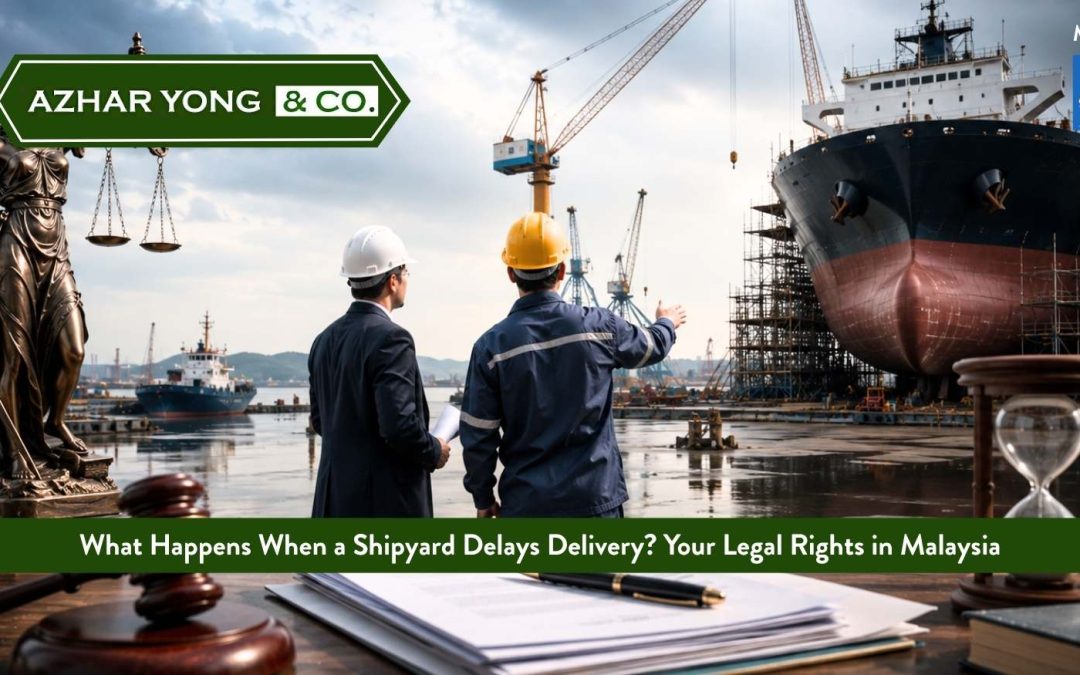
Delivery delays are the most common disputes in shipbuilding. When a yard fails to deliver a vessel by the contractual date — even accounting for permitted extensions — the buyer has clearly defined legal rights. The challenge is exercising them correctly, within the framework of the contract, without inadvertently triggering a breach by the buyer.
Under most shipbuilding contracts, a non-permissible delay entitles the buyer to claim liquidated damages at the daily rate fixed in the contract. This rate is capped — typically at a percentage of the contract price (commonly 5% to 10%). Once the accumulated delay exceeds the cap, the buyer is generally entitled to cancel the contract, demand the return of all instalments paid, and call the refund guarantee.
The yard’s most common defence is that the delay is permissible — caused by force majeure events or by the buyer’s own conduct. Under the SAJ Form and most standard shipbuilding contracts, force majeure events must be notified within a specified number of days of occurrence — typically five to fifteen days. A yard that misses these notice deadlines loses its entitlement to the extension, regardless of whether the underlying event was genuine. Buyers should scrutinise every force majeure claim carefully and insist on documentary evidence.
In Malaysia, the governing law of the contract determines the available remedies. Under the Contracts Act 1950, where a party repudiates a contract — by indicating it will not perform — the innocent party can accept the repudiation and claim damages immediately, without waiting for the formal delivery date to pass. This principle — anticipatory breach — can be important where a yard is clearly unable to complete the vessel but has not formally acknowledged failure.
Steps to Take When Your Vessel Is Delayed
-
Review the contract: Check the permitted delay provisions, the force majeure clause, the notice requirements, and the liquidated damages cap. Understanding your contractual position is the first step.
-
Assess force majeure claims: Require the yard to substantiate any force majeure claim with documentary evidence. Does the claimed event actually qualify under the contract’s definition? Was the notice given in time?
-
Issue formal notices: Preserve your rights by issuing written notices of delay, demand for delivery, and — when the cap is reached — notice of cancellation in the form required by the contract.
-
Call the refund guarantee: If cancellation is justified, make a complying demand under the refund guarantee promptly. Banks have limited grounds to resist payment under an on-demand guarantee — but the demand must be technically correct.
-
Engage a maritime lawyer: Cancellation of a shipbuilding contract is a high-stakes decision with potentially irreversible consequences. Take specialist legal advice before taking any step that cannot be undone.
Frequently Asked Questions: Shipbuilding Delays in Malaysia
Q: Is the yard entitled to a delivery extension for COVID-19 or supply chain disruptions?
A: It depends entirely on the contract wording. Most standard shipbuilding contracts (SAJ, NEWBUILDCON) define qualifying force majeure events specifically — including epidemic or pandemic, acts of God, strikes, and material shortages — but require the yard to give written notice within a fixed number of days (often five to fifteen) of the event occurring. If the yard gives timely, compliant notice, and the event genuinely caused the delay, an extension is likely available. If the notice was late, deficient, or the event is not within the contractual definition, the extension may not be available — even if the disruption was genuine and severe. Supply chain delays that are foreseeable (rather than exceptional and unforeseeable) may also fall outside a typical force majeure clause. Each case turns on the specific contract terms and the evidence of causation.
Q: Can I cancel the contract if the yard says it cannot deliver on time?
A: Yes — but only if the contractual conditions for cancellation are met. Most shipbuilding contracts allow the buyer to cancel once accumulated permissible delays exhaust the buyer’s patience period and the contract-specified cap on liquidated damages is reached. Additionally, if the yard repudiates the contract — by clearly indicating it will not or cannot complete the vessel — the buyer may be entitled to accept that repudiation and cancel immediately under the doctrine of anticipatory breach, without waiting for the contractual cancellation trigger. Cancellation must be carried out correctly: in the required form, to the required addressee, and with the required grounds stated. A defective cancellation notice can expose the buyer to a claim for wrongful repudiation — potentially leading to forfeiture of instalments already paid.
Q: The yard has gone insolvent. Can I recover my instalments?
A: If you have a valid refund guarantee from an acceptable bank, the insolvency of the yard is a straightforward refund guarantee call situation. The guarantee should be on demand — meaning the bank is obliged to pay upon a complying demand, without being entitled to rely on the yard’s insolvency as a reason to resist. If the guarantee is not on demand, or if it contains conditions that have not been satisfied, recovery may be more complex. In the absence of a refund guarantee — for example, where the buyer failed to require one, or where the guarantee has expired — the buyer becomes an unsecured creditor of the insolvent yard, with limited recovery prospects. This underscores why the refund guarantee should be a non-negotiable condition of every shipbuilding contract.
Q: The yard says the delay was caused by my own slow approvals. Is that a valid defence?
A: Yes — buyer-caused delays are a recognised category of permissible delay under most shipbuilding contracts. The SAJ Form and NEWBUILDCON both provide for extensions where the buyer’s acts or omissions — including late return of approved drawings, slow response to change order requests, or unreasonable conduct during inspections — cause delays to the construction programme. However, the yard must be able to demonstrate a causal link between the buyer’s conduct and the specific delays claimed. Vague or general complaints about the buyer’s conduct will not support an extension claim. A maritime lawyer can assess the strength of a yard’s buyer-delay argument and advise on the most effective counter-strategy.
Q: How long do I have to commence arbitration after cancelling for delay?
A: This depends on the arbitration clause and the governing law of the contract. For LMAA arbitrations (English law), the general limitation period is six years under the Limitation Act 1980. However, many shipbuilding contracts contain shorter contractual time bars — requiring arbitration to be commenced within twelve months of the dispute arising, or within twelve months of the final delivery date. These contractual time bars are strictly enforced. Under Malaysian law, the general limitation period for contract claims is six years under the Limitation Act 1953 — but again, a shorter contractual time bar will prevail. The safest approach is to appoint an arbitrator immediately on cancellation, even if the parties are still negotiating, to preserve the right to arbitrate if negotiations break down.

Maritime Litigation Lawyers in Malaysia: Strategic Representation for Shipping Disputes
Maritime litigation lawyers in Malaysia play a vital role in resolving high-value disputes arising from shipping operations, vessel ownership, cargo movement, and marine insurance matters. Malaysia’s position as a major maritime hub exposes shipping businesses,...

Marine Insurance Claim Rejected in Malaysia: Steps Policyholders Should Take
A marine insurance claim rejected in Malaysia can place shipowners, cargo interests, and marine businesses under immediate financial pressure. Insurers may deny claims following incidents such as cargo loss, vessel damage, collisions, or delays, often citing policy...

Ship Arrest Legal Services in Malaysia: Enforcing Maritime Claims Effectively
Ship arrest legal services in Malaysia play a crucial role in helping maritime claimants secure unpaid debts and enforce legal rights against vessels. Malaysia’s strategic position along major international shipping routes makes its ports frequent locations for ship...

Shipping Lawyers in Kuala Lumpur: Legal Support for Complex Maritime Disputes
Shipping Lawyers in Kuala Lumpur provide essential legal support to businesses involved in maritime trade, logistics, and vessel operations across Malaysia. Kuala Lumpur’s close proximity to major ports such as Port Klang makes it a strategic base for shipping...

Maritime Dispute Resolution in Malaysia: Practical Solutions for Shipping Conflicts
Maritime dispute resolution in Malaysia plays a vital role in managing conflicts arising from shipping operations, marine trade, and vessel ownership. Malaysia’s position along major international shipping routes exposes maritime businesses to frequent disputes...

P&I (Protection & Indemnity) Legal Services In Malaysia: Essential Support for Maritime Liabilities
Understanding the Scope of P&I (Protection & Indemnity) Legal Services Malaysia Maritime operations expose shipowners and operators to complex third-party liabilities that standard insurance does not cover. P&I (Protection & Indemnity) Legal Services...