
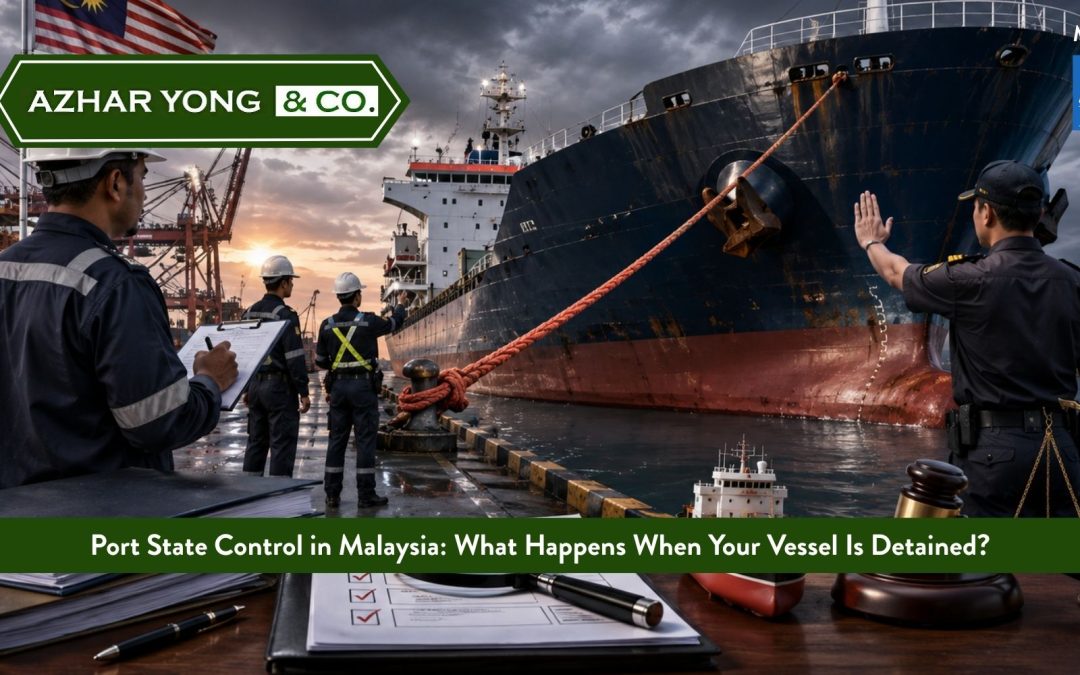
PSC officers have broad powers. They can board any foreign vessel calling at a Malaysian port, inspect the vessel’s condition and documentation, interview the Master and crew, and — where significant deficiencies are found — issue a detention order preventing the vessel from sailing. A detention is not a fine or a criminal conviction: it is an administrative order requiring deficiencies to be rectified before departure. But the commercial consequences of a detention can be severe — hire continues running under a time charter; cargo misses loading windows; port dues accumulate; and the vessel’s PSC inspection record is published publicly in the Tokyo MOU database, damaging the operator’s commercial reputation.
The most common grounds for detention in Malaysia include: structural or equipment deficiencies rendering the vessel unseaworthy; failure to carry valid certificates (SOLAS, MARPOL, MLC 2006, ISM Code, ISPS Code); crew certification deficiencies; manning shortfalls; failure to comply with ISM Code safety management procedures; and MLC 2006 violations relating to seafarer working hours, wages, or living conditions.
Once a detention order is issued, the Master should immediately notify the shipowner, the vessel’s classification society, the P&I Club, and a maritime lawyer. Time is of the essence — each day of detention generates commercial losses and risks escalating legal exposure.
Steps to Take When Your Vessel Is Detained in Malaysia
Notify the classification society immediately: The surveyor can attend the vessel, assess the deficiencies, and certify that they have been rectified — which is the primary route to lifting the detention.
Contact your P&I Club: P&I Clubs have specialist correspondents in Malaysian ports who can assist with managing the detention, coordinating repairs, and liaising with the PSC officer.
Engage a maritime lawyer: If the detention involves disputed deficiencies, potential criminal charges against the Master, or claims from charterers for off-hire, legal representation is essential.
Document everything: Photograph the vessel’s condition, retain all PSC inspection reports and correspondence, and keep a contemporaneous record of all actions taken to address the deficiencies.
Appeal if appropriate: Where a detention order is issued on grounds you believe are wrong or disproportionate, there is a formal appeals process — but it must be initiated promptly and with proper legal support.
Frequently Asked Questions: Port State Control in Malaysia
Q: Which vessels are subject to PSC inspection in Malaysia?
A: All foreign-flagged vessels calling at Malaysian ports are potentially subject to PSC inspection. Under the Tokyo MOU targeting system, the frequency and intensity of inspections are risk-based — vessels with a poor PSC inspection record, older vessels, vessels flying flags of convenience, and vessels in high-risk categories (such as bulk carriers and tankers) are inspected more frequently and more intensively. Malaysian-flagged vessels are not subject to PSC inspections in Malaysia — they are instead subject to flag state inspections by the Marine Department. However, Malaysian-flagged vessels calling at other Tokyo MOU member state ports (including Singapore, China, Australia, and Japan) are subject to full PSC inspections in those jurisdictions.
Q: What is the difference between a ‘deficiency’ and a ‘detention’?
A: A deficiency is a non-conformity identified during a PSC inspection — it records that a specific requirement of an international convention has not been met. Many deficiencies are minor and can be rectified while the vessel remains in port without any restriction on sailing. A detention is a formal order that prevents the vessel from departing — it is issued when the deficiencies identified are serious enough to render the vessel unsafe to sail, or when the total number and nature of deficiencies indicates a systemic failure in the vessel’s management. Common grounds for detention include: no valid SOLAS or MARPOL certificates; ISM Code deficiencies indicating a breakdown in the safety management system; insufficient crew; and significant structural, machinery, or equipment failures. A detention cannot be lifted simply by promising to fix deficiencies — the PSC officer must be satisfied that the deficiencies have actually been rectified before they will issue a release.
Q: Can a vessel be detained for MLC 2006 violations in Malaysia?
A: Yes — and MLC 2006 detentions are increasingly common. Malaysia ratified the MLC 2006 in 2013, and Malaysian PSC officers are specifically empowered to inspect vessels for MLC compliance as part of the Tokyo MOU framework. Grounds for MLC-based detention include: seafarers not being paid their wages on time or in full; failure to maintain minimum rest hours; inadequate food and accommodation; absence of valid MLC certificates (DMLC Part I and Part II); and lack of financial security for repatriation or abandonment. Where a vessel is detained for MLC violations, there may also be a simultaneous obligation on the shipowner to remedy any outstanding wages or welfare issues before the vessel is released — making prompt engagement with a maritime lawyer essential.
Q: Does a PSC detention affect my time charter and hire obligations?
A: A PSC detention can trigger an off-hire claim by the charterer, depending on the specific wording of the time charterparty. Most standard time charter forms (such as NYPE) provide that the vessel goes off-hire if it is not in a full and efficient state to perform the required service — and a detained vessel is clearly not performing. Whether a particular PSC detention triggers off-hire depends on the cause of the detention and the precise charter wording. Where the detention arises from the shipowner’s failure to maintain the vessel (for example, machinery defects or expired certificates), off-hire is likely. Where the detention arises from factors outside the owner’s control (for example, port authority error or a disputed inspection finding), the position is more complex. A maritime lawyer can advise on the off-hire implications specific to your charter terms and the circumstances of the detention.
Q: What happens if the PSC officer finds evidence of a criminal offence during an inspection?
A: PSC inspections are administrative, not criminal — but where a PSC officer finds evidence of a criminal offence during an inspection (such as an illegal discharge of oil, falsification of the Oil Record Book, or abandonment of crew), they may refer the matter to the relevant Malaysian authorities for criminal investigation. Under the Merchant Shipping Ordinance 1952 and the Environmental Quality Act 1974, serious violations can result in prosecution of the vessel’s Master and officers, substantial fines, and in some cases imprisonment. Where a PSC inspection escalates into a criminal matter, a maritime lawyer with experience in both maritime and criminal proceedings must be engaged immediately. The Master should not make any statements to investigators without legal representation.
A Strategic Guide to Maritime Risk: Understanding General Average in Malaysia
General Average is one of the oldest principles in maritime law — and one of the least understood by modern importers and exporters. It applies when, during a voyage, the shipowner or Master makes a deliberate sacrifice or incurs an extraordinary expenditure to save...
Salvage Claims in Malaysia: What Shipowners and Cargo Interests Need to Know
Salvage is the service rendered by one party to rescue another party's vessel or cargo from peril at sea. In Malaysia, salvage is governed by common law principles and — for vessels party to Lloyd's Open Form (LOF) — by the International Salvage Convention 1989, which...
What Is Limitation of Liability and How Does It Protect Shipowners in Malaysia?
When a vessel is involved in a collision, grounding, or other serious incident, the financial claims that follow can be staggering — cargo loss, hull damage, personal injury, wreck removal, and environmental liability can all arise from the same event. Without a cap...
Limitation of Liability in Malaysian Maritime Law: A Complete Guide for Shipowners
Few legal concepts carry as much financial weight for a shipowner as limitation of liability. In the aftermath of a serious maritime incident — a collision in the Strait of Malacca, a grounding off the Sabah coast, an oil spill in Port Klang — claims from cargo...
Buying or Selling a Ship in Malaysia: The Legal Process Explained
The sale and purchase of a vessel in Malaysia is a multi-step legal transaction governed primarily by the Merchant Shipping Ordinance 1952 (MSO 1952), and the Contracts Act 1950, together with the specific terms of the Memorandum of Agreement (MOA) entered into...
Oil Pollution Liability at Sea in Malaysia: What Shipowners and Operators Need to Know
Malaysia's strategic position along the Strait of Malacca — through which an estimated 40% of global seaborne trade passes — makes it one of the most environmentally sensitive maritime jurisdictions in the world. A vessel grounding, collision, or structural failure in...