
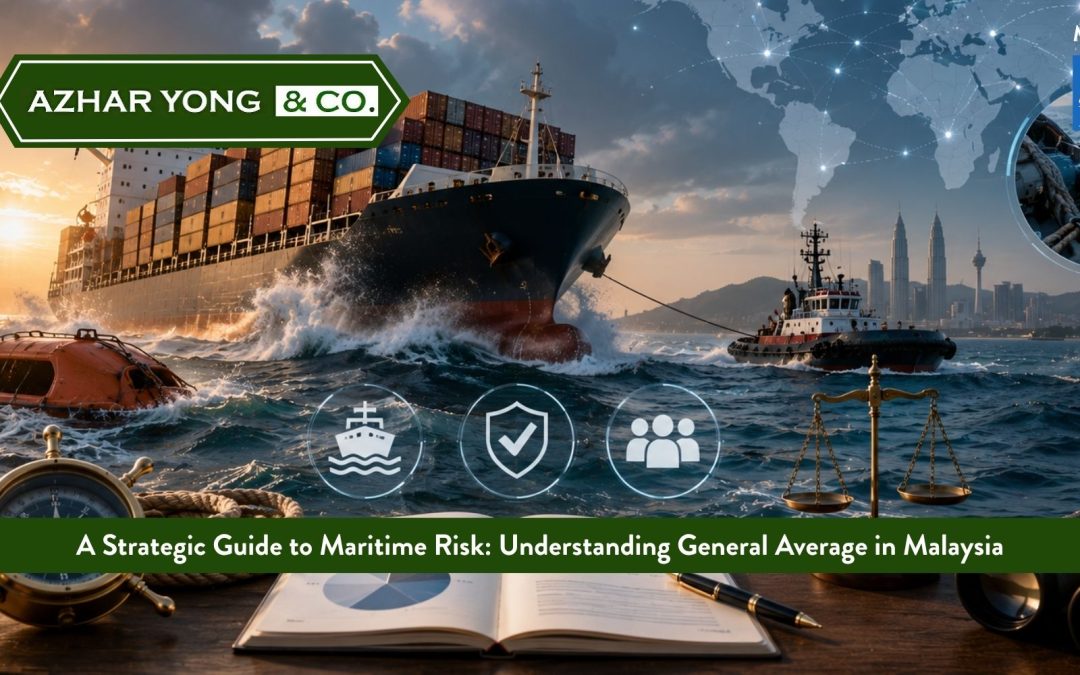
General Average is one of the oldest principles in maritime law — and one of the least understood by modern importers and exporters. It applies when, during a voyage, the shipowner or Master makes a deliberate sacrifice or incurs an extraordinary expenditure to save the vessel, cargo, and freight from a common peril. Classic examples include jettisoning cargo to refloat a grounded vessel, engaging tugs and salvors in an emergency, or flooding a hold to extinguish a fire.
When a General Average act occurs, the loss is not borne by whoever suffered it — it is shared proportionately among all parties who benefited from the sacrifice: the shipowner, cargo owners, and freight interests, each contributing in proportion to the value of their interest at risk. This is the General Average adjustment.
In practice, General Average is most commonly encountered by cargo owners when their goods arrive at the port of discharge, and the shipping line refuses to release the cargo until the owner provides security for their General Average contribution. That security typically takes the form of a General Average bond (signed by the cargo owner or their insurer) and, for higher-value contributions, a cash deposit or bank guarantee.
In Malaysia and in most international shipping contracts, General Average is adjusted under the York-Antwerp Rules — the current version being the York-Antwerp Rules 2016 — which set out in detail which expenditures and sacrifices qualify for General Average and how contributions are calculated. The adjustment is typically carried out by a specialist Average Adjuster, appointed by the shipowner, whose final adjustment statement can take months or years to produce for complex incidents.
What Cargo Owners Need to Know About General Average
-
Your cargo insurance policy almost certainly covers your General Average contribution — but only if the policy was in force at the time of the incident and the cargo was properly declared.
-
You must provide security (a GA bond and sometimes a cash deposit) before your cargo will be released. Refusing to provide security does not make the obligation go away — it simply means your goods remain held.
-
The Average Adjuster’s final statement is not issued immediately — complex General Average adjustments can take years. Your insurer will manage the process on your behalf if you have cover.
-
Cargo owners without insurance may be personally liable for their General Average contribution, which can be substantial where the shipowner has incurred large emergency expenditures.
-
If you believe the General Average declaration is unjustified — for example, because the incident was caused by the shipowner’s negligence — there may be grounds to challenge the obligation to contribute.
Frequently Asked Questions:
Q: Does Malaysian law require cargo owners to pay General Average contributions?
A: Yes — the obligation to contribute to General Average is a fundamental principle of maritime law recognised in Malaysia. It arises from the contract of carriage (the bill of lading), which typically incorporates the York-Antwerp Rules and requires all cargo interests to contribute to properly declared General Average. The obligation is not optional — a cargo owner who refuses to provide the required security will find their goods withheld at the port of discharge until the obligation is met or a court order is obtained. The Admiralty Court in Malaysia has jurisdiction to hear disputes about the validity of a General Average declaration or the quantum of contributions claimed.
Q: What is a General Average bond, and why do I need to sign one?
A: A General Average bond is a document signed by the cargo owner (or their insurer) acknowledging the General Average claim and undertaking to pay the contribution assessed by the Average Adjuster once the adjustment is complete. It is the standard form of security required by the shipping line before cargo is released. If the cargo is insured, your marine cargo insurer will typically sign the bond on your behalf and deal directly with the Average Adjuster — provided you notify your insurer promptly, and the policy covers the cargo in question. Where cargo is uninsured, the cargo owner must sign the bond personally and may also be required to provide a cash deposit as additional security.
Q: Can I challenge a General Average declaration if the incident was the shipowner’s fault?
A: Yes — and in the right circumstances, this is a valid and important defence. Under the York-Antwerp Rules and general maritime law principles, cargo interests are not obliged to contribute to General Average where the General Average act arose out of the actionable fault of the shipowner — for example, where the grounding that triggered the emergency was caused by the vessel’s unseaworthiness or navigational negligence. This defence — known as the ‘fault of ship’ defence — requires the cargo owner to establish the shipowner’s fault and demonstrate that it caused the General Average situation. If successful, the cargo owner’s contribution obligation is extinguished, and any security already provided must be returned. A maritime lawyer can assess the strength of this defence in the specific circumstances of your incident.
Q: How long does a General Average adjustment take?
A: General Average adjustments are notoriously slow — particularly for complex incidents involving multiple cargo interests, competing insurance claims, and disputed liability. A straightforward GA adjustment may be completed within 12 to 18 months. A complex one — involving a major casualty with hundreds of cargo owners and disputed salvage liability — can take three to five years or longer. During this period, any security provided at the port of discharge remains in place. The final General Average adjustment statement, produced by the Average Adjuster, allocates the total General Average expenditure among all contributing interests and triggers the final payment or refund of any deposit. Cargo owners are entitled to receive a copy of the adjustment and to challenge its contents through their lawyers or insurers.
Q: What if my cargo was not involved in the General Average sacrifice — do I still have to contribute?
A: Yes — this is one of the most counterintuitive aspects of General Average. Even if your specific cargo was not jettisoned, damaged, or used in the General Average act, you are still required to contribute to the General Average if your cargo was saved as a result of the act. The principle is that all parties who benefited from the sacrifice — meaning their property arrived safely — must share in the cost of that sacrifice. The only cargo interests that are entirely exempt from General Average contribution are those whose goods were lost or destroyed in the very act that constituted the General Average (for example, cargo that was jettisoned). Those parties suffer the loss that others contribute to compensate for.

Legal Requirements for Registering a Ship Mortgage in Malaysia
Securing financing for a vessel requires more than just a signed loan agreement; it necessitates formal registration to establish priority over other creditors. In Malaysia, the legal requirements for registering a ship mortgage in Malaysia are governed strictly by...

Maritime Litigation Lawyers in Malaysia: Strategic Representation for Shipping Disputes
Maritime litigation lawyers in Malaysia play a vital role in resolving high-value disputes arising from shipping operations, vessel ownership, cargo movement, and marine insurance matters. Malaysia’s position as a major maritime hub exposes shipping businesses,...

Marine Insurance Claim Rejected in Malaysia: Steps Policyholders Should Take
A marine insurance claim rejected in Malaysia can place shipowners, cargo interests, and marine businesses under immediate financial pressure. Insurers may deny claims following incidents such as cargo loss, vessel damage, collisions, or delays, often citing policy...

Ship Arrest Legal Services in Malaysia: Enforcing Maritime Claims Effectively
Ship arrest legal services in Malaysia play a crucial role in helping maritime claimants secure unpaid debts and enforce legal rights against vessels. Malaysia’s strategic position along major international shipping routes makes its ports frequent locations for ship...

Shipping Lawyers in Kuala Lumpur: Legal Support for Complex Maritime Disputes
Shipping Lawyers in Kuala Lumpur provide essential legal support to businesses involved in maritime trade, logistics, and vessel operations across Malaysia. Kuala Lumpur’s close proximity to major ports such as Port Klang makes it a strategic base for shipping...

Maritime Dispute Resolution in Malaysia: Practical Solutions for Shipping Conflicts
Maritime dispute resolution in Malaysia plays a vital role in managing conflicts arising from shipping operations, marine trade, and vessel ownership. Malaysia’s position along major international shipping routes exposes maritime businesses to frequent disputes...