
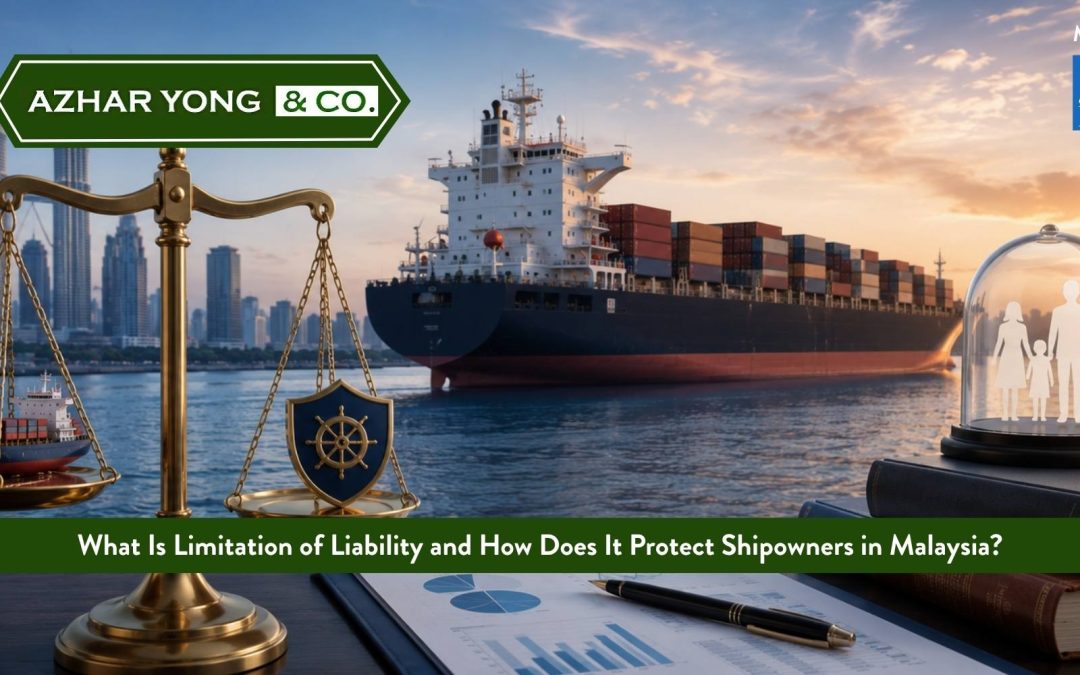
When a vessel is involved in a collision, grounding, or other serious incident, the financial claims that follow can be staggering — cargo loss, hull damage, personal injury, wreck removal, and environmental liability can all arise from the same event. Without a cap on total liability, a shipowner’s entire business could be at risk from a single incident.
Limitation of liability is the international legal framework that prevents this outcome. Under Malaysia’s limitation regime — the LLMC 1996 in Peninsular Malaysia and Labuan, and the 1957 Convention in Sabah and Sarawak — a shipowner can limit their total financial exposure for all claims arising from one incident to a figure calculated by reference to the tonnage of the vessel. Once a limitation fund is constituted with the Admiralty Court, claimants share from that fund, and cannot pursue the shipowner’s other assets beyond it.
The limits in Peninsular Malaysia under the LLMC 1996 are expressed in Special Drawing Rights (SDR). For property claims, the fund starts at 1.51 million SDR for vessels up to 5,000 gross tons. For personal claims (death and injury), the fund starts at 3.02 million SDR. These figures increase incrementally with vessel tonnage. Under the LLMC 1996, limitation can only be broken if a claimant proves the loss resulted from the shipowner’s personal act or omission, committed with the intent to cause such loss, or recklessly and with knowledge that such loss would probably result — a standard that has never been successfully met in Peninsular Malaysian courts.
Limitation is not automatic. A shipowner must apply to the court to constitute a limitation fund. Acting quickly — before claimants obtain judgments or arrest vessels — is essential.
Claims That Can Be Limited in Malaysia
-
Cargo damage and loss arising from the vessel’s operation
-
Collision damage to other vessels, port infrastructure, and aids to navigation
-
Personal injury and death claims connected with the vessel’s operation
-
Wreck removal costs ordered by the Marine Department or port authority
-
Delay claims by cargo owners or charterers
Frequently Asked Questions: Limitation of Liability in Malaysia
Q: Is the limitation of liability automatic in Malaysia?
A: No — limitation does not apply automatically. A shipowner must actively invoke the regime by applying to the Malaysian Admiralty Court (for incidents in Peninsular Malaysia) or the relevant High Court in Sabah or Sarawak to constitute a limitation fund. The fund is constituted by depositing security equal to the applicable limitation amount. Once constituted, claimants must pursue their claims from the fund and cannot enforce judgments against the shipowner’s other assets. Failing to constitute a fund — or doing so too late — can significantly weaken the shipowner’s position.
Q: Does the limitation regime protect charterers and ship managers, not just vessel owners?
A: Yes — under the LLMC 1996, as applied in Peninsular Malaysia and Labuan, the right to limit liability extends far beyond the registered owner. The definition of ‘shipowner’ includes the charterer (whether time, voyage, or bareboat), the manager, and the operator of the vessel. Salvors and liability insurers are also entitled to limit. This means that if a cargo claim is brought against a charterer, the charterer can constitute its own limitation fund to the same amount as the registered owner. The broad scope of the regime is one of its most commercially valuable features.
Q: Can a claimant arrest a vessel after a limitation fund has been constituted?
A: Not in respect of claims subject to limitation. Under the LLMC 1996, where a shipowner has constituted a limitation fund in the court of a state party, any arrest of the vessel obtained by a claimant whose claim is subject to limitation must be lifted, and any security provided to obtain a vessel’s release must be returned. This is a significant practical benefit of constituting a fund early: it can release the vessel from arrest while capping total liability. A maritime lawyer can advise on the timing and strategy for constituting a fund in relation to any ongoing arrest proceedings.
Q: What is the difference between the LLMC 1996 and the 1957 Convention in East Malaysia?
A: The 1957 Convention, which applies in Sabah and Sarawak, is an older and less favourable regime for shipowners in two key respects. First, the financial limits under the 1957 Convention are lower than those under the LLMC 1996. Second, the standard for breaking limitation is less demanding for claimants — proof of actual fault or privity of the shipowner is sufficient, compared to the stricter personal intent or recklessness standard under the LLMC 1996. As a result, limitations have been successfully broken in Malaysian courts in cases governed by the 1957 Convention, whereas it has not been broken in LLMC 1996 cases. The applicable regime depends on where the incident occurs and where proceedings are brought — making the geographic split a critical factor in post-incident legal strategy.
Q: Does the limitation of liability apply to oil pollution claims in Malaysia?
A: Oil pollution claims are excluded from the general LLMC limitation regime and are instead governed by the separate CLC 1992 framework, implemented in Malaysia through the Merchant Shipping (Liability and Compensation for Oil and Bunker Oil Pollution) Act 1994 (Act 515). The CLC 1992 has its own limitation structure based on vessel tonnage, with shipowner liability capped at between 4.51 million SDR (for vessels up to 5,000 GT) and 89.77 million SDR (maximum). Where an incident gives rise to both oil pollution claims and other claims — for example, a collision that also causes a bunker spill — different limitation regimes may apply to different heads of claim simultaneously, requiring careful legal analysis.
Strategic Maritime Arbitration Procedures under AIAC Rules in Malaysia
In the high-stakes world of international shipping, disputes over charterparties, shipbuilding, or cargo damage require a forum that combines technical expertise with procedural speed. Maritime arbitration procedures under AIAC rules in Malaysia provide this exact...
Strategic Charterparty Dispute Resolution and Arbitration in Kuala Lumpur
In the fast-paced world of global shipping, a single breach in a charterparty agreement can disrupt entire supply chains. When negotiations fail, Charterparty dispute resolution and arbitration in Kuala Lumpur offers a sophisticated, cost-effective alternative to...
Navigating Malaysian Ship Registry Requirements for Foreign Owned Vessels
For international shipping companies, expanding into Southeast Asia often begins with a strategic presence in Malaysia. While traditional registration requires local majority ownership, the Malaysian Ship Registry requirements for foreign-owned vessels are...
Resolving Marine Insurance Claim Disputes under Marine Insurance Act 1906
Marine insurance provides the financial backbone for global trade, but when a loss occurs, the path to recovery often leads to complex legal friction. In local practice, marine insurance claim disputes under the Marine Insurance Act 1906 frequently arise because this...
Navigating IMO 2026 Decarbonization Compliance for Shipowners
The maritime industry currently faces a transformative era as global regulators tighten environmental standards. For vessel operators in Southeast Asia, achieving IMO 2026 decarbonization compliance for shipowners is no longer a future goal but an immediate...
Legal Liability for Cargo Damage under Carriage of Goods by Sea Act
Cargo damage remains a significant risk for Malaysian traders and shipowners. When goods arrive at Port Klang or Tanjung Pelepas in a damaged state, the Carriage of Goods by Sea Act (COGSA) provides the primary legal framework for seeking compensation. Navigating...