
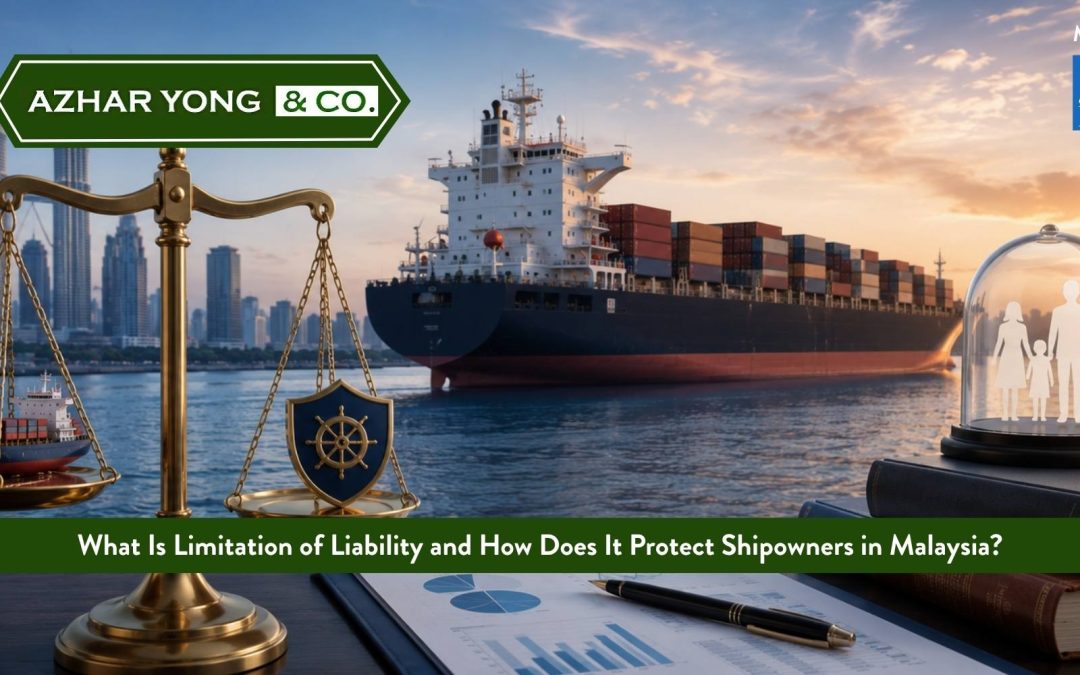
When a vessel is involved in a collision, grounding, or other serious incident, the financial claims that follow can be staggering — cargo loss, hull damage, personal injury, wreck removal, and environmental liability can all arise from the same event. Without a cap on total liability, a shipowner’s entire business could be at risk from a single incident.
Limitation of liability is the international legal framework that prevents this outcome. Under Malaysia’s limitation regime — the LLMC 1996 in Peninsular Malaysia and Labuan, and the 1957 Convention in Sabah and Sarawak — a shipowner can limit their total financial exposure for all claims arising from one incident to a figure calculated by reference to the tonnage of the vessel. Once a limitation fund is constituted with the Admiralty Court, claimants share from that fund, and cannot pursue the shipowner’s other assets beyond it.
The limits in Peninsular Malaysia under the LLMC 1996 are expressed in Special Drawing Rights (SDR). For property claims, the fund starts at 1.51 million SDR for vessels up to 5,000 gross tons. For personal claims (death and injury), the fund starts at 3.02 million SDR. These figures increase incrementally with vessel tonnage. Under the LLMC 1996, limitation can only be broken if a claimant proves the loss resulted from the shipowner’s personal act or omission, committed with the intent to cause such loss, or recklessly and with knowledge that such loss would probably result — a standard that has never been successfully met in Peninsular Malaysian courts.
Limitation is not automatic. A shipowner must apply to the court to constitute a limitation fund. Acting quickly — before claimants obtain judgments or arrest vessels — is essential.
Claims That Can Be Limited in Malaysia
-
Cargo damage and loss arising from the vessel’s operation
-
Collision damage to other vessels, port infrastructure, and aids to navigation
-
Personal injury and death claims connected with the vessel’s operation
-
Wreck removal costs ordered by the Marine Department or port authority
-
Delay claims by cargo owners or charterers
Frequently Asked Questions: Limitation of Liability in Malaysia
Q: Is the limitation of liability automatic in Malaysia?
A: No — limitation does not apply automatically. A shipowner must actively invoke the regime by applying to the Malaysian Admiralty Court (for incidents in Peninsular Malaysia) or the relevant High Court in Sabah or Sarawak to constitute a limitation fund. The fund is constituted by depositing security equal to the applicable limitation amount. Once constituted, claimants must pursue their claims from the fund and cannot enforce judgments against the shipowner’s other assets. Failing to constitute a fund — or doing so too late — can significantly weaken the shipowner’s position.
Q: Does the limitation regime protect charterers and ship managers, not just vessel owners?
A: Yes — under the LLMC 1996, as applied in Peninsular Malaysia and Labuan, the right to limit liability extends far beyond the registered owner. The definition of ‘shipowner’ includes the charterer (whether time, voyage, or bareboat), the manager, and the operator of the vessel. Salvors and liability insurers are also entitled to limit. This means that if a cargo claim is brought against a charterer, the charterer can constitute its own limitation fund to the same amount as the registered owner. The broad scope of the regime is one of its most commercially valuable features.
Q: Can a claimant arrest a vessel after a limitation fund has been constituted?
A: Not in respect of claims subject to limitation. Under the LLMC 1996, where a shipowner has constituted a limitation fund in the court of a state party, any arrest of the vessel obtained by a claimant whose claim is subject to limitation must be lifted, and any security provided to obtain a vessel’s release must be returned. This is a significant practical benefit of constituting a fund early: it can release the vessel from arrest while capping total liability. A maritime lawyer can advise on the timing and strategy for constituting a fund in relation to any ongoing arrest proceedings.
Q: What is the difference between the LLMC 1996 and the 1957 Convention in East Malaysia?
A: The 1957 Convention, which applies in Sabah and Sarawak, is an older and less favourable regime for shipowners in two key respects. First, the financial limits under the 1957 Convention are lower than those under the LLMC 1996. Second, the standard for breaking limitation is less demanding for claimants — proof of actual fault or privity of the shipowner is sufficient, compared to the stricter personal intent or recklessness standard under the LLMC 1996. As a result, limitations have been successfully broken in Malaysian courts in cases governed by the 1957 Convention, whereas it has not been broken in LLMC 1996 cases. The applicable regime depends on where the incident occurs and where proceedings are brought — making the geographic split a critical factor in post-incident legal strategy.
Q: Does the limitation of liability apply to oil pollution claims in Malaysia?
A: Oil pollution claims are excluded from the general LLMC limitation regime and are instead governed by the separate CLC 1992 framework, implemented in Malaysia through the Merchant Shipping (Liability and Compensation for Oil and Bunker Oil Pollution) Act 1994 (Act 515). The CLC 1992 has its own limitation structure based on vessel tonnage, with shipowner liability capped at between 4.51 million SDR (for vessels up to 5,000 GT) and 89.77 million SDR (maximum). Where an incident gives rise to both oil pollution claims and other claims — for example, a collision that also causes a bunker spill — different limitation regimes may apply to different heads of claim simultaneously, requiring careful legal analysis.
Maritime Carbon Regulation in Malaysia: What Shipowners Need to Know Before 2026
Malaysia's maritime sector is entering a period of significant regulatory change. The Malaysian government has announced that a carbon tax will be introduced beginning in 2026, targeting energy-intensive sectors — including shipping and port operations....
Port State Control in Malaysia: What Happens When Your Vessel Is Detained?
Port State Control (PSC) is the system by which a coastal state — in Malaysia's case, the Marine Department of Malaysia (Jabatan Laut Malaysia) — inspects foreign-flagged vessels visiting its ports to verify compliance with international maritime conventions. Malaysia...
A Strategic Guide to Maritime Risk: Understanding General Average in Malaysia
General Average is one of the oldest principles in maritime law — and one of the least understood by modern importers and exporters. It applies when, during a voyage, the shipowner or Master makes a deliberate sacrifice or incurs an extraordinary expenditure to save...
Salvage Claims in Malaysia: What Shipowners and Cargo Interests Need to Know
Salvage is the service rendered by one party to rescue another party's vessel or cargo from peril at sea. In Malaysia, salvage is governed by common law principles and — for vessels party to Lloyd's Open Form (LOF) — by the International Salvage Convention 1989, which...
Limitation of Liability in Malaysian Maritime Law: A Complete Guide for Shipowners
Few legal concepts carry as much financial weight for a shipowner as limitation of liability. In the aftermath of a serious maritime incident — a collision in the Strait of Malacca, a grounding off the Sabah coast, an oil spill in Port Klang — claims from cargo...
Buying or Selling a Ship in Malaysia: The Legal Process Explained
The sale and purchase of a vessel in Malaysia is a multi-step legal transaction governed primarily by the Merchant Shipping Ordinance 1952 (MSO 1952), and the Contracts Act 1950, together with the specific terms of the Memorandum of Agreement (MOA) entered into...