
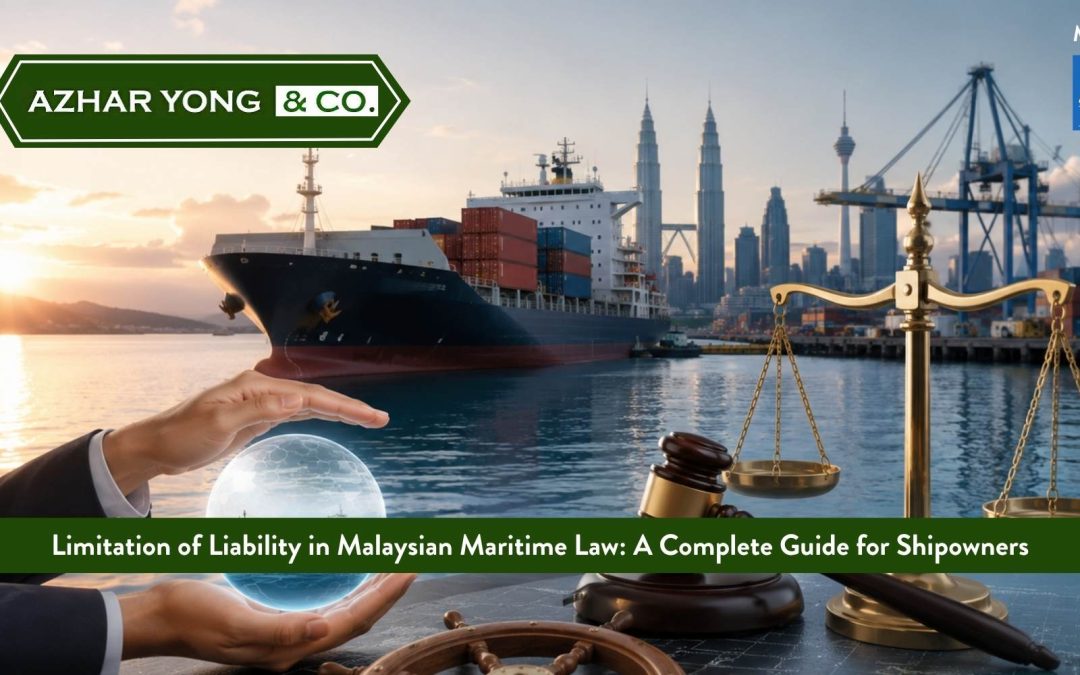
Few legal concepts carry as much financial weight for a shipowner as limitation of liability. In the aftermath of a serious maritime incident — a collision in the Strait of Malacca, a grounding off the Sabah coast, an oil spill in Port Klang — claims from cargo owners, third parties, salvors, wreck removal authorities, and environmental agencies can accumulate rapidly into figures that far exceed the market value of the vessel involved. Without limitation, a single incident could financially destroy even a substantial shipping business.
Limitation of liability is the international legal regime that allows shipowners — and certain other parties — to cap their total financial exposure arising from any one incident to a figure calculated by reference to the tonnage of the vessel. It is not a shield against all liability: the claimant still has a valid cause of action and can still recover. But the total amount recoverable from the shipowner across all claims arising from one incident is capped, regardless of how many claimants there are or how large their individual losses.
Malaysia’s limitation of liability framework is one of the most distinctive in the Asia-Pacific region — not because the rules are unusual, but because two different international conventions apply simultaneously in different parts of the country. For any shipowner operating in Malaysian waters, understanding which regime applies, what the limits are, and how the system works in practice is essential planning knowledge.
Malaysia’s Unique Position: Two Limitation Regimes in One Country
Unlike most maritime jurisdictions, Malaysia does not apply a single limitation convention across its entire territory. Two different regimes operate simultaneously — determined by geography:
Peninsular Malaysia and Labuan — LLMC 1996
The Convention on Limitation of Liability for Maritime Claims 1976, as amended by the 1996 Protocol (LLMC 1996), applies in Peninsular Malaysia and the Federal Territory of Labuan. It is incorporated into Malaysian domestic law through Section 360 and the 16th Schedule of the Merchant Shipping Ordinance 1952 (MSO 1952), as amended by the Merchant Shipping (Amendment and Extension) Act 2011, which came into force on 1 March 2014.
The LLMC 1996 is widely regarded as providing one of the strongest and most commercially favourable limitation regimes for shipowners — often described as providing a ‘virtually unbreakable’ system of limitation. Under the LLMC 1996, a shipowner can only be denied the right to limit liability if it is proved that the loss resulted from their personal act or omission, committed with the intent to cause such loss, or recklessly and with knowledge that such loss would probably result. This is an extremely high bar — and to date, the LLMC 1976/1996 has not been successfully broken in Malaysian courts.
East Malaysia (Sabah and Sarawak) — 1957 Convention
The International Convention Relating to the Limitation of the Liability of Owners of Sea-Going Ships 1957 (the 1957 Convention) applies in the states of Sabah and Sarawak. The 1957 Convention predates the LLMC 1976 and provides meaningfully lower financial limits. Crucially, the standard for breaking limitation under the 1957 Convention is less demanding for claimants — it requires proof of actual fault or privity of the shipowner, rather than the stricter personal intent or recklessness standard of the LLMC 1996. As a result, limitation has been broken in Malaysian courts in cases governed by the 1957 Convention, whereas it has not been broken in LLMC 1996 cases.
Who Is Entitled to Limit Liability Under Malaysian Law?
Under the LLMC 1996 as incorporated into Malaysian law, the right to limit liability is available to a wide range of parties — not just the registered owner of the vessel. The following are entitled to limit their liability:
-
Shipowners — including the registered owner, bareboat charterer, manager, and operator of the vessel. The definition is deliberately broad, meaning that time charterers, voyage charterers, and ship managers can all potentially invoke the limitation regime.
-
Salvors — persons engaged in salvage operations, whether operating from a vessel or independently. The LLMC 1996 extended limitation rights to salvors in all circumstances, closing a gap that existed under earlier conventions.
-
Liability insurers — the P&I Club or other insurer providing liability coverage to the shipowner is entitled to limit liability in proceedings brought directly against it, to the same extent as the shipowner.
-
Any person for whose act, neglect, or default the shipowner or salvor is responsible — including employees, agents, and independent contractors, provided the claim arises out of matters connected with the operation of the vessel.
This broad scope means that a cargo claim brought against a charterer — rather than the registered owner — is still subject to the limitation regime. A charterer that pays a cargo claim and seeks to recover from the shipowner will find that the shipowner can limit against it in exactly the same way as against the original cargo claimant.
Which Claims Can Be Limited — and Which Cannot?
Claims Subject to Limitation
Under Article 2 of the LLMC 1976, the following categories of claim are subject to limitation:
-
Claims for loss of life or personal injury, or loss or damage to property (including damage to harbour works, basins, waterways, and aids to navigation), occurring on board or in direct connection with the operation of the ship.
-
Claims for loss resulting from delay in the carriage by sea of cargo, passengers, or their luggage.
-
Claims for other loss resulting from the infringement of rights other than contractual rights, occurring in direct connection with the operation of the ship.
-
Claims for wreck removal — the raising, removal, destruction, or rendering harmless of a sunken, stranded, or abandoned ship, its cargo, or anything on board.
-
Claims for the removal, destruction, or rendering harmless of the cargo of a ship.
Claims Excluded from Limitation
Not all maritime claims can be limited. The LLMC 1996 expressly excludes the following from the limitation regime:
-
Salvage claims — a salvor cannot limit against the shipowner whose vessel it has salved.
-
Oil pollution claims — these are governed by the separate CLC 1992 regime, which has its own limitation structure under Act 515 (as covered in our earlier blog on oil pollution liability).
-
Claims by the shipowner’s own employees or their dependants arising out of personal injury or death, where the governing law of the employment contract does not permit limitation.
-
Nuclear damage claims.
-
Claims under specific nuclear liability conventions.
What Are the Actual Liability Limits in Peninsular Malaysia?
Under the LLMC 1996 as applied in Peninsular Malaysia and Labuan through the 16th Schedule of the MSO 1952, the limits are calculated by reference to the vessel’s gross tonnage and expressed in Special Drawing Rights (SDR) — an international monetary unit set by the IMF:
LLMC 1996 Liability Limits — Peninsular Malaysia & Labuan
|
Claim Type |
Up to 5,000 GT |
Over 5,000 GT (per additional ton) |
Maximum Cap |
|
Personal claims (death/injury) |
3.02 million SDR |
+ 1,208 SDR |
No stated maximum |
|
Property claims (cargo, collision, etc.) |
1.51 million SDR |
+ 604 SDR |
No stated maximum |
|
Oil pollution (bunkers) — LLMC route |
4.51 million SDR |
+ 631 SDR |
89.77 million SDR |
Note: Limits are stated in SDR. Use the IMF SDR Valuation tool to convert to MYR or USD. The 2012 IMO revision increasing limits under the tacit amendment procedure has NOT been adopted by Malaysia — the limits above reflect current Malaysian domestic law.
When Can Limitation Be Broken?
The LLMC 1996’s standard for breaking limitation is extremely demanding — and by design. Under Article 4 of the Convention, a person is not entitled to limit their liability if it is proved that the loss resulted from their personal act or omission, committed with the intent to cause such a loss, or recklessly and with knowledge that such loss would probably result.
Several features of this test make it very difficult to satisfy in practice. First, the burden of proof lies on the claimant — it is not for the shipowner to prove entitlement to limit, but for the claimant to prove that the test is met. Second, the act or omission must be personal — conduct by the ship’s crew or officers is not sufficient, even where the shipowner is vicariously liable for it. It must be the actual personal conduct of the individual shipowner (or, in the case of a company, of the directing mind and will of the company). Third, the intent or recklessness must be proved to a high standard — negligence, even gross negligence, is not enough.
In practice, this means that the LLMC 1996 limitation fund is almost never successfully challenged. It is precisely this near-absolute quality that makes the convention so commercially valuable to shipowners — and so important to understand and invoke correctly following a serious incident.
How to Invoke Limitation of Liability in Malaysia
A shipowner wishing to invoke the limitation regime under the LLMC 1996 must take active legal steps — limitation does not apply automatically. The process involves the following key steps:
-
Step 1 — Assess the incident and the claims: As soon as a serious incident occurs, the shipowner should engage a maritime lawyer to assess the likely claims, identify the applicable limitation regime, and calculate the available limitation fund.
-
Step 2 — Constitute a limitation fund: The shipowner applies to the Malaysian Admiralty Court (for incidents in Peninsular Malaysia) or the relevant High Court in Sabah or Sarawak to constitute a limitation fund — depositing or providing security equal to the applicable limitation amount. Once constituted, any claimant who receives payment from the fund cannot pursue assets of the shipowner beyond the fund.
-
Step 3 — Obtain a limitation decree: The court issues a limitation decree confirming the shipowner’s right to limit and the total amount of the fund. Claimants then have a defined period to file their claims against the fund.
-
Step 4 — Distribution of the fund: The court supervises the distribution of the limitation fund among all claimants in proportion to their established claims. Personal claims (death and injury) are paid first, ahead of property claims.
-
Step 5 — Arrest protection: Where a limitation fund has been constituted, any vessel arrest obtained by a claimant in respect of a claim subject to limitation must be lifted — the claimant cannot maintain an arrest and claim from the fund simultaneously.
Why Limitation of Liability Matters for Every Shipowner in Malaysia
Limitation of liability is not a remedy that only large shipowners or tanker operators need to think about. Any vessel — however small — operating in Malaysian waters is potentially exposed to claims that could exceed its value many times over. A small tug that causes a collision with a loaded container vessel, for example, could face cargo claims alone running into tens of millions of dollars. Without invoking limitation, the tug owner faces personal financial ruin.
The key practical lessons for Malaysian shipowners are straightforward: understand which regime applies to your operating area; know the applicable liability limits for your vessel tonnage; engage a maritime lawyer immediately after any serious incident before making any admission or payment; and act quickly to constitute a limitation fund if the potential claims are significant.
Limitation of liability is one of the few areas of maritime law where the law is genuinely on the shipowner’s side — but only if the shipowner knows it exists, knows how to invoke it, and acts in time.
How Azhar Yong & Co. Can Help?
At Azhar Yong & Co., we advise shipowners, charterers, P&I Clubs, and insurers on limitation of liability across Malaysian jurisdictions — from the initial post-incident assessment through to constituting limitation funds, managing multi-party claim distribution, and defending attempts to break limitation in court.
Our specific capabilities include:
-
Advising on the applicable limitation regime (LLMC 1996 vs 1957 Convention) based on the location of the incident and the forum of proceedings.
-
Calculating the available limitation fund and advising on the strategic decision to constitute a fund.
-
Filing applications in the Malaysian Admiralty Court and the High Courts of Sabah and Sarawak to constitute limitation funds and obtain limitation decrees.
-
Defending against attempts to break limitations — particularly in East Malaysian proceedings under the 1957 Convention.
-
Coordinating with P&I Clubs and international co-counsel in multi-jurisdiction limitation proceedings.
-
Advising on the interaction between limitation of liability and parallel insurance claims, wreck removal orders, and environmental liability.
The Crucial Role of Maritime Lawyers in Dubai
The Shipowner's Challenge: Why You Need an Expert? Imagine you are a shipowner with a valuable cargo consignment destined for Dubai. Suddenly, a severe storm hits, damaging a portion of the goods. Your client refuses to accept the delivery, and you are now faced with...
The Critical Role of Maritime Lawyers in Abu Dhabi
Why You Need a Maritime Legal Expert in Abu Dhabi Imagine your vessel is docked in Abu Dhabi's Khalifa Port and a dispute arises with the port authority over vessel inspection and safety standards. The situation threatens to delay your entire shipping schedule,...

Navigating UK Maritime Law: Expertise of a Marine Lawyer
The Shipowner's Challenge: A Complex Legal Dispute Imagine a UK-based shipping company faces a dispute with a port authority over a vessel arrest due to alleged environmental breaches. The regulations are complex, and the potential fines are staggering. This scenario...

The Indispensable Role of an International Maritime Lawyer
The Challenge of Multi-Jurisdictional Disputes A complex scenario for any vessel owner is a dispute that spans multiple countries. A ship registered in one country, chartered by a company in another, and carrying cargo that is damaged in international waters must...
China’s Maritime Legal Landscape: The Role of an Admiralty Lawyer
The Shipping Challenge: A Dispute in Chinese Waters Consider a shipping company whose vessel is involved in a collision in a busy Chinese port, resulting in significant damage to another ship and cargo. The legal and financial implications are immense. Dealing with...
Understanding Maritime Law in the UAE
Why Expertise in UAE Maritime Law Is Non-Negotiable Consider a scenario where your vessel is involved in a collision at sea near the United Arab Emirates, resulting in damage and a complex liability claim. The situation is compounded by a web of jurisdictions and...