
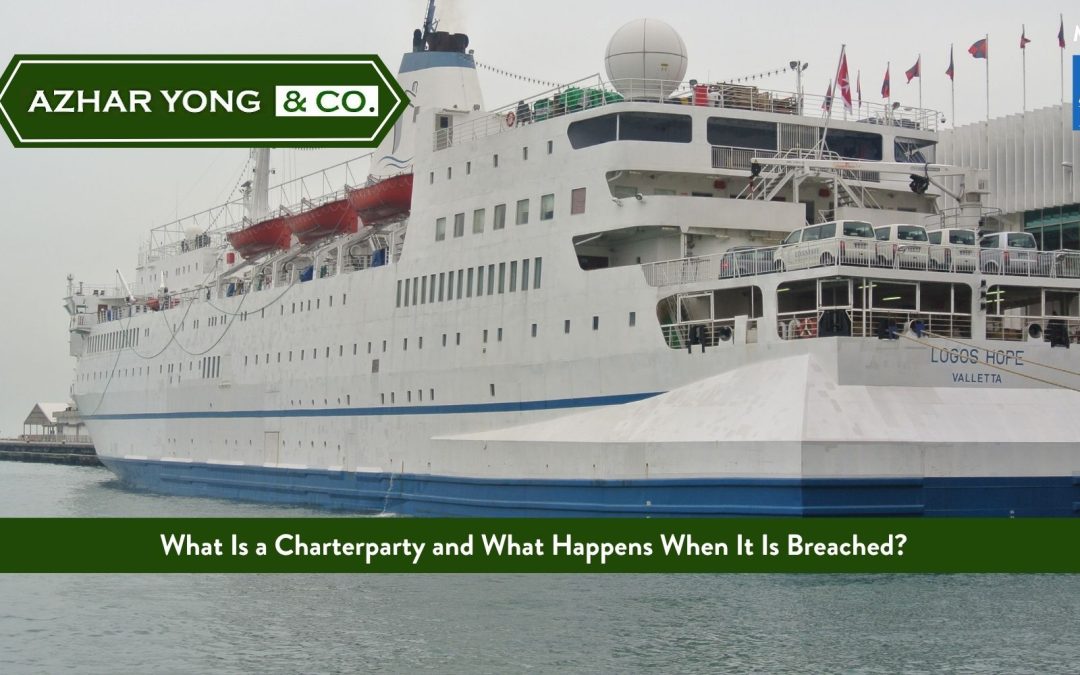
A charterparty is a written contract between a shipowner and a charterer for the use of a vessel. It is the governing document for the commercial relationship: it sets out the hire rate or freight payable, the duration or voyage to be performed, the obligations of each party, and what happens when things go wrong. In Malaysia, charterparties are governed by the Contracts Act 1950, supplemented by English common law and the specific standard form chosen by the parties — whether NYPE, GENCON, BIMCO BARECON, or another.
There are three main types of charterparty. A voyage charterparty hires the vessel for a specific voyage — from one port to another — in exchange for freight. A time charterparty places the vessel at the charterer’s disposal for a fixed period, with hire paid daily or monthly. A bareboat charterparty transfers full possession and operational control of the vessel to the charterer, who takes on crewing, insurance, and management responsibilities as if they were the owner.
Breach of a charterparty occurs when one party fails to perform a material obligation. Common breaches by shipowners include: failing to present the vessel at the agreed time and place; failing to maintain the vessel in a seaworthy and efficient condition; and failing to perform the voyage with reasonable despatch. Common breaches by charterers include: failing to pay hire or freight on time; detaining the vessel beyond the agreed laytime (giving rise to demurrage); and giving unlawful orders that expose the shipowner to liability.
When a breach occurs, the innocent party has a right to claim damages under the Contracts Act 1950. In serious cases — where the breach goes to the root of the contract — the innocent party may also have the right to terminate the charterparty entirely and claim for loss of the benefit of the whole contract.
Common Claims When a Charterparty Is Breached
-
Demurrage: compensation payable to the shipowner when the charterer detains the vessel beyond the agreed laytime at the loading or discharge port.
-
Loss of hire: compensation to the shipowner where the charterer repudiates the charterparty before its natural expiry, leaving the vessel without employment.
-
Deadfreight: payable where the charterer fails to load the agreed quantity of cargo, and the shipowner loses freight on the shortfall.
-
Performance damages: compensation to the charterer where the vessel consistently fails to meet warranted speed or fuel consumption figures.
Indemnity claims: where the charterer’s instructions expose the shipowner to third-party liability, the charterer is typically obliged to indemnify the owner under the charterparty.
Frequently Asked Questions
Q: Does Malaysian law or English law govern my charterparty?
A: Most commercial charterparties used in the regional shipping market — including those involving Malaysian parties and Malaysian ports — incorporate English law as the governing law, and provide for arbitration in London or Singapore. This is a product of historical practice and the dominance of English-origin standard forms. However, parties are free to choose Malaysian law as the governing law, and increasingly do so where both parties are Malaysian or the trade is exclusively regional. Where a charterparty is silent on governing law, Malaysian courts will determine the applicable law based on the closest connection to the contract. A maritime lawyer can advise on which legal system applies to your specific charterparty and what difference that makes to your rights.
Q: What is demurrage and how is it calculated?
A: Demurrage is the agreed daily compensation payable by the charterer to the shipowner when the vessel is detained at the loading or discharge port beyond the agreed free period — known as laytime. The demurrage rate is fixed in the charterparty and expressed as a daily figure (for example, USD 15,000 per day or pro rata). The calculation begins when laytime expires and ends when the vessel is free to sail. Events that interrupt the running of laytime — such as breakdowns caused by the shipowner, or rain stoppages under a ‘weather working days’ clause — must be carefully identified. Demurrage claims are the most frequently litigated charterparty disputes in Malaysia, and the calculations are often heavily contested.
Q: Can a shipowner withdraw the vessel if the charterer has not paid hire?
A: Yes — but only if the right to withdraw is clearly established under the charterparty, and only if the withdrawal is exercised correctly. Under most standard time charter forms, hire must be paid punctually and in full, and any failure entitles the shipowner to withdraw. However, courts and arbitrators have set strict standards: the withdrawal notice must be served through the correct contractual channel, on the correct party, without prior waiver of the default, and at a point where the charterer’s non-payment is unambiguous. A wrongly exercised withdrawal can expose the shipowner to a claim for wrongful repudiation — potentially far more costly than the unpaid hire. Always take legal advice before withdrawing a vessel.
Q: What is a cancelling date and what happens if the vessel misses it?
A: Most voyage charterparties specify a laycan — a window of dates within which the vessel must arrive ready to load. The later date in that window is the cancelling date. If the vessel arrives after the cancelling date, the charterer has the right to cancel the charterparty — regardless of whether the delay was the shipowner’s fault. The charterer is not obliged to wait and is not required to show that the late arrival caused them loss. However, there is no right to cancel in anticipation of a late arrival before the cancelling date actually passes. Shipowners who anticipate missing a cancelling date should communicate with charterers promptly, as early agreement on an extended laycan can avoid the dispute altogether.
Q: How long do I have to bring a charterparty claim in Malaysia?
A: The general limitation period for contract claims in Malaysia is six years under the Limitation Act 1953. However, most commercial charterparties contain shorter contractual time bars — particularly for demurrage claims, which many charterparties require to be submitted with supporting documents within 90 days of completion of discharge, failing which the claim is waived. Arbitration clauses may also impose deadlines for appointing arbitrators or commencing proceedings. These contractual time bars are strictly enforced and can extinguish valid claims entirely. As soon as a potential charterparty dispute arises, you should check your charterparty for any applicable time bars and take legal advice immediately.
Facing a charterparty dispute in Malaysia? Azhar Yong & Co. advises shipowners and charterers on all aspects of charterparty disputes — from demurrage claims to vessel withdrawal and arbitration. Contact us before your time bar expires.
Cruising with Confidence: The Indispensable Cruise Ship Lawyer
Cruising with Confidence: The Indispensable Cruise Ship LawyerThe global cruise industry offers unique adventures. It also presents complex legal challenges. A specialized cruise ship lawyer is vital for navigating these waters. They represent passengers, crew, and...

Admiralty Lawyers: The Pillars of Global Maritime Justice
Admiralty Lawyers: The Pillars of Global Maritime JusticeThe world’s oceans are the arteries of global trade, with over 90% of international goods transported by sea. In this high-stakes industry, admiralty lawyers play a crucial role. From resolving complex disputes...

Marine Lawyers: Global to Future Outlook
The Evolving Role of a Marine Lawyer: A Global, Asian, and Future OutlookIn the global maritime industry, a marine lawyer is often seen as a niche legal expert, responsible for resolving complex disputes at sea. From ship collisions to cargo damages, international...
Azhar Yong & Co.: One of the Best Maritime Law Firms in Kuala Lumpur
Azhar Yong & Co.: One of the Best Maritime Law Firms in Kuala LumpurIn a thriving port city like Klang Valley, the demand for specialised maritime legal services is on the rise. Among the legal firms making waves in this sector, Azhar Yong & Co. is widely...

Your Admiralty Legal Partner in Kuala Lumpur.
Navigating the Legal Seas: One of the Admiralty Law Firms in Kuala Lumpur You Can TrustBeing recognized as one of the admiralty law firms in Kuala Lumpur is no small achievement. In a city known for its maritime significance and bustling trade routes, law firms...

One of the trusted Maritime Attorneys in Kuala Lumpur
One of the Best Maritime Attorneys in Kuala Lumpur: What It Truly MeansBeing recognised as one of the best maritime attorneys in Kuala Lumpur is more than just an accolade—it reflects a mastery of maritime legal frameworks, a deep understanding of international...