
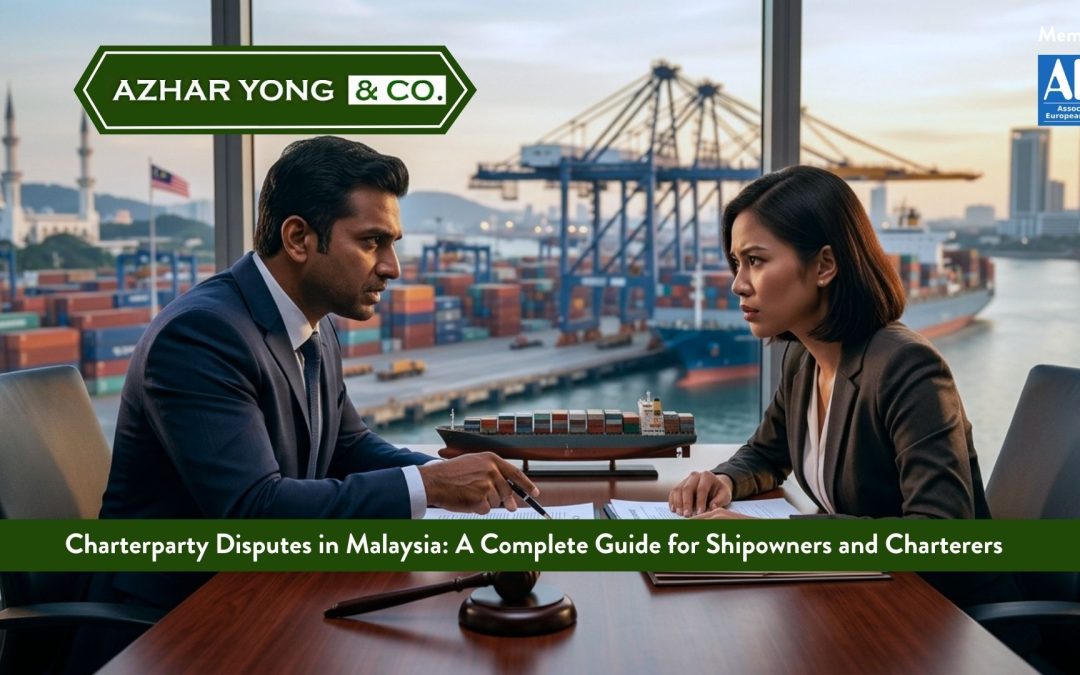
A charterparty is one of the most commercially significant contracts in the shipping industry. When disputes arise under it — over unpaid freight, demurrage, off-hire, or vessel performance — the financial consequences can be enormous. This guide explains how charterparty disputes work in Malaysia, and how to protect your position.
For anyone involved in the commercial shipping of goods by sea, the charterparty is the engine of the transaction. Whether you are a shipowner deploying your vessel under a time charter, a commodity trader using a voyage charter to move bulk cargo across the Strait of Malacca, or a multinational hiring a vessel on bareboat terms, the charterparty defines your rights, your obligations, and your exposure to financial risk.
Malaysia sits at the heart of one of the world’s most active shipping corridors. Thousands of commercial vessels transit Malaysian waters every year, and a significant portion of those voyages are governed by charterparties. When those contracts go wrong — and in commercial shipping, they frequently do — the disputes that follow can be costly, complex, and time-sensitive.
This guide is written for shipowners and charterers who are either in a dispute or trying to understand their legal position under a charterparty governed by Malaysian law or being litigated or arbitrated in Malaysia. It explains the different types of charterparty, the most common categories of dispute, the legal framework that applies, the remedies available, and the key strategic decisions you will face in resolving the dispute efficiently.
Understanding the Different Types of Charterparty
Not all charterparties are the same. The type of charterparty you have entered into will significantly affect both the nature of any dispute that arises and the legal remedies available to you.
Voyage Charterparty
A voyage charterparty (or voyage charter) is a contract under which a shipowner agrees to carry a specified cargo from a named loading port to a named discharge port — or sometimes across multiple ports — in exchange for a freight payment. The shipowner retains operational and navigational control of the vessel throughout. Voyage charters are common in bulk commodity trades such as coal, grain, iron ore, and palm oil — all significant cargo flows through Malaysian ports.
The most frequently litigated issues under voyage charters are laytime and demurrage. Laytime is the agreed period within which the charterer must complete loading and discharging. Once that period expires, demurrage becomes payable — a daily rate of compensation to the shipowner for the vessel’s detention beyond the agreed free period. Demurrage disputes are the single most common category of charterparty litigation in Malaysian admiralty practice.
Time Charterparty
Under a time charterparty, the shipowner places the vessel at the charterer’s disposal for a specified period — weeks, months, or years. The charterer directs the vessel’s employment and pays hire at an agreed daily or monthly rate, while the shipowner remains responsible for the vessel’s technical management, crewing, and maintenance. Common standard forms include the NYPE (New York Produce Exchange) and Baltime forms.
Time charter disputes typically arise over: the payment and deduction of hire; off-hire claims (where the charterer asserts it is not obliged to pay hire because the vessel is not performing as contracted); speed and consumption claims (where the vessel fails to achieve the warranted performance); and disputes about redelivery — the condition of the vessel when the charterer hands it back at the end of the charter period.
Bareboat (Demise) Charterparty
A bareboat charterparty — also known as a demise charter — transfers both possession and control of the vessel to the charterer for the duration of the charter, along with responsibility for crewing, maintenance, and insurance. The charterer effectively becomes the vessel’s operator. Bareboat charters are widely used in ship financing and leasing arrangements, particularly involving Malaysian financial institutions and the Malaysian International Ship Register (MISR) in Labuan.
Bareboat charter disputes often involve the mortgagee bank’s rights in the event of the charterer’s default, the redelivery condition of the vessel, and liability for damage sustained during the charter period.
The Most Common Charterparty Disputes in Malaysia
1. Laytime and Demurrage
As noted above, laytime and demurrage disputes are by far the most frequent category of charterparty litigation. The calculation of laytime — when it begins, what events interrupt it, and whether weather, port congestion, or the fault of third parties stops it from running — is a technically complex exercise governed by a dense body of case law and the specific wording of the charterparty.
In Malaysia, demurrage disputes are regularly heard in the Admiralty Court in Kuala Lumpur, and — where the charterparty contains an arbitration clause — in arbitral tribunals seated in Kuala Lumpur, London, or Singapore. The stakes are significant: demurrage rates on bulk carriers can exceed USD 20,000 per day, and disputes frequently run to hundreds of thousands of dollars.
2. Hire Disputes and Withdrawal Under Time Charters
Under a time charter, the charterer’s obligation to pay hire is typically expressed as a strict condition. If hire is not paid on time, the shipowner may be entitled to withdraw the vessel — terminating the charter and reclaiming control of the ship. However, the right to withdraw is one of the most litigated issues in time charter law, and exercising it incorrectly can expose the shipowner to a counterclaim for wrongful termination.
Malaysian courts and arbitral tribunals have addressed the question of whether an owner may arrest a charterer’s vessel to recover unpaid hire. The answer, following leading case law, is yes: a shipowner with a claim for hire arrears may arrest a vessel beneficially owned by the charterer — even if it is not the chartered vessel itself — to secure the claim, provided the jurisdictional requirements are met.
3. Off-Hire Claims
An off-hire clause in a time charter suspends the charterer’s obligation to pay hire during periods when the vessel is not in a full and efficient state to perform the service immediately required. Common off-hire events include vessel breakdown, damage requiring repair, drydocking, and — more controversially — vessel arrest by third parties.
The precise scope of an off-hire clause is a matter of construction of the specific contract wording. Courts and arbitrators have drawn careful distinctions between events that trigger off-hire and those that do not. The outcome of an off-hire dispute frequently turns on a single sentence — or even a single word — in the charterparty, making specialist legal advice essential from the outset.
4. Speed and Performance Claims
Shipowners frequently warrant in a time charterparty that the vessel will achieve a specified speed and fuel consumption under defined weather and sea conditions. If the vessel consistently underperforms — steaming slower or burning more fuel than warranted — the charterer has a claim for damages, typically quantified as the difference in hire value and the cost of excess fuel consumption.
Performance claims require careful evidence gathering, including passage analysis, weather data, and expert naval architect evidence. They are often defended by shipowners on the basis that poor performance was caused by adverse weather, hull fouling, or the charterer’s own instructions — all of which require detailed factual and technical investigation.
5. Cargo Claims Passed Down the Charter Chain
In a multi-party charter chain — where the owner charters to a time charterer who sub-charters to a voyage charterer who contracts with the cargo interests — cargo damage claims can cascade down through multiple contracts, with each party seeking to pass liability to the next link in the chain. Untangling these chains requires a thorough understanding of the relationships between charterparties and bills of lading, the incorporation of terms, and the identity of the contracting carrier.
The Legal Framework Governing Charterparty Disputes in Malaysia
Charterparties are commercial contracts, and their interpretation in Malaysia is governed by contract law principles — including the Contracts Act 1950 — as supplemented by English common law and maritime law, which Malaysian courts draw upon extensively through the Civil Law Act 1956.
Most commercial charterparties used in the Malaysian market incorporate English law as the governing law and provide for dispute resolution either through English law-governed arbitration (commonly under the London Maritime Arbitrators Association (LMAA) rules) or through litigation in the English courts. However, parties also choose Singapore and Malaysian law and arbitral seats for charters involving regional trades.
Where a charterparty specifies Malaysian law as the governing law, the Contracts Act 1950 provides the foundational framework for issues such as breach, termination, and damages. The courts will also apply established principles from English maritime case law — which forms a significant part of the received law in Malaysia — when interpreting charterparty terms.
Important: Even where a charterparty is governed by English law and subject to London arbitration, a vessel in Malaysian waters can be arrested by the Malaysian Admiralty Court as an interim measure to secure the claim. The arrest is available as a protective remedy regardless of where the substantive dispute is to be resolved.
Resolving Charterparty Disputes in Malaysia: Your Options
When a charterparty dispute arises, the first question is: what does the contract say about how the dispute is to be resolved? The answer to that question determines the procedural path you must follow.
Arbitration
The majority of commercial charterparties contain arbitration clauses — often requiring disputes to be referred to arbitration in London (under LMAA rules), Singapore (under SIAC or SCMA rules), or increasingly Kuala Lumpur (under AIAC, formerly KLRCA, rules). Arbitration offers confidentiality, the ability to choose technical arbitrators with shipping expertise, and — through the New York Convention, to which Malaysia is a signatory — broad international enforceability of awards.
Malaysia’s Arbitration Act 2005 provides the legislative framework for both domestic and international arbitration seated in Malaysia. Even where arbitration is seated abroad, Malaysian courts have jurisdiction to grant interim relief — including ship arrests — in support of those proceedings under Section 11 of the Arbitration Act 2005.
Litigation in the Malaysian Admiralty Court
Where a charterparty does not contain an arbitration clause, or where the parties have agreed to Malaysian court jurisdiction, disputes can be litigated before the Admiralty Court in Kuala Lumpur. The court has specialist expertise in maritime and commercial disputes and is experienced in handling complex multi-party charterparty litigation. For some parties — particularly those seeking the immediate remedy of a ship arrest — commencing proceedings in the Admiralty Court may be strategically preferable even where arbitration will ultimately determine the substantive merits.
Negotiation and Settlement
The majority of charterparty disputes settle before reaching a final hearing, whether through direct negotiation between the parties, without prejudice correspondence between their lawyers, or structured mediation. Early settlement is almost always in both parties’ commercial interests, given the cost, time, and disruption of formal proceedings. A maritime lawyer with strong commercial judgment can identify a credible settlement range early, manage negotiations effectively, and ensure any settlement is properly documented.
At a Glance: Dispute Resolution Comparison
Route |
Best For |
Key Advantage |
Limitation |
|
Arbitration (LMAA/SIAC/AIAC) |
Most commercial charterparties |
Confidentiality + expert tribunal |
Costs; London seat adds expense |
|
Malaysian Admiralty Court |
No arbitration clause; ship arrest needed |
Ship arrest + specialist judges |
Public proceedings |
|
Negotiation / Mediation |
All disputes; early resolution |
Speed + cost saving |
No binding outcome without agreement |
How to Protect Your Position in a Charterparty Dispute
Whether you are a shipowner facing a non-paying charterer or a charterer facing a vessel that is not performing, there are concrete steps you should take from the moment a dispute crystallises — and in many cases, before it does.
Act on Time Limits
Charterparties frequently contain strict time bars — short contractual deadlines beyond which a claim cannot be brought. Under the LMAA Small Claims Procedure, for example, parties must appoint their arbitrator promptly. Under many charterparties, demurrage claims must be submitted with supporting documents within a fixed period — commonly 90 days of completion of discharge — failing which the claim is extinguished. Missing a time bar is one of the most avoidable and most expensive mistakes in charterparty practice.
Preserve Your Evidence
The outcome of a charterparty dispute will depend heavily on documentary evidence: the charterparty itself, fixture recap messages, statements of facts, notice of readiness, laytime calculations, hire statements, vessel logs, performance data, and all correspondence between the parties and their brokers. Preserving this evidence from the outset — and organising it carefully — is essential. In the digital age, this includes electronic messages, platform communications, and voyage data recorder information.
Issue Notices Correctly
Many charterparty rights are conditional on giving correct, timely notices. A notice of readiness that is tendered prematurely can reset the laytime clock. A withdrawal notice served on a non-business day or through the wrong channel can be challenged. A performance claim that is not reserved in the correct form in the redelivery documentation may be waived. Getting notices right requires specialist knowledge of the relevant charterparty form and its case law history.
Warning: Do not issue a withdrawal notice or terminate a charterparty without taking legal advice first. Wrongful withdrawal or termination can expose the shipowner to a counterclaim for loss of the charter, which may far exceed the value of the unpaid hire that prompted the action.
Consider Arresting a Vessel
Where a charterer owes significant hire arrears, demurrage, or damages, and where the charterer has a vessel present in Malaysian waters, a ship arrest may be available to secure the claim and create leverage for settlement. As discussed above, Malaysian admiralty law permits the arrest of a charterer’s vessel — not just the chartered vessel — to secure claims arising from the charterparty, provided the necessary jurisdictional conditions are satisfied.
Why Choose Azhar Yong & Co. for Your Charterparty Dispute?
Charterparty disputes sit at the intersection of complex contract law, shipping industry practice, and international dispute resolution procedure. They require lawyers who not only understand the law, but who have detailed knowledge of how the shipping industry actually works — the mechanics of voyage planning, laytime calculation, vessel performance measurement, and charter chain dynamics.
At Azhar Yong & Co., we act for shipowners, charterers, commodity traders, and freight operators in a wide range of charterparty disputes across Malaysian and international forums. We bring a commercially focused, results-oriented approach to every case — pursuing the fastest and most cost-effective resolution available, while being fully prepared to litigate or arbitrate when that is what the situation requires.
Our specific capabilities in charterparty disputes include:
-
Advising on laytime and demurrage calculations and pursuing or defending demurrage claims.
-
Advising shipowners on withdrawal rights and the correct procedure for exercising them.
-
Advising charterers on off-hire entitlements and managing performance claims against owners.
-
Representing parties in LMAA, SIAC, AIAC, and ad hoc arbitrations involving charterparty disputes.
-
Applying to the Malaysian Admiralty Court for ship arrests to secure charterparty claims.
-
Advising on the interaction between charterparties and bills of lading in multi-party cargo claim chains.
-
Negotiating and drafting charterparty settlement agreements.
Final Thoughts: Early Legal Advice Pays
In charterparty disputes, the party that takes early, specialist legal advice almost always has the stronger position. The reason is straightforward: charterparty rights are frequently conditional on timely action — correct notices, prompt arbitration appointments, preservation of evidence, and avoidance of conduct that might amount to waiver or election. Once those opportunities are missed, they cannot be recovered.
If you are facing a charterparty dispute in Malaysia — whether as a shipowner, charterer, or cargo interest — do not delay. The dispute will not resolve itself, and the legal landscape will not become simpler the longer it is left unaddressed. Contact Azhar Yong & Co. for a confidential initial consultation.
Facing a charterparty dispute in Malaysia? Azhar Yong & Co. advises shipowners, charterers, and cargo interests across the full range of charterparty disputes — from demurrage claims to vessel withdrawal and arbitration representation.
Buying or Selling a Ship in Malaysia: The Legal Process Explained
The sale and purchase of a vessel in Malaysia is a multi-step legal transaction governed primarily by the Merchant Shipping Ordinance 1952 (MSO 1952), and the Contracts Act 1950, together with the specific terms of the Memorandum of Agreement (MOA) entered into...

Oil Pollution Liability at Sea in Malaysia: What Shipowners and Operators Need to Know
Malaysia's strategic position along the Strait of Malacca — through which an estimated 40% of global seaborne trade passes — makes it one of the most environmentally sensitive maritime jurisdictions in the world. A vessel grounding, collision, or structural failure in...
Maritime Arbitration vs Court Litigation in Malaysia: Which Route Is Right for Your Dispute?
Most maritime disputes in Malaysia are resolved through one of two routes: arbitration or litigation before the Admiralty Court. The route that applies to your dispute is largely determined by what your contract says — and understanding the difference before a dispute...
Bunker Disputes in Malaysia: What to Do When Fuel Quality or Quantity Is Disputed
Malaysia is a significant bunkering market, with licensed suppliers operating across 19 ports, including Port Klang, Port of Tanjung Pelepas, Pasir Gudang, Penang, and Labuan. Vessels transiting the Strait of Malacca regularly bunker in Malaysian waters, and where...
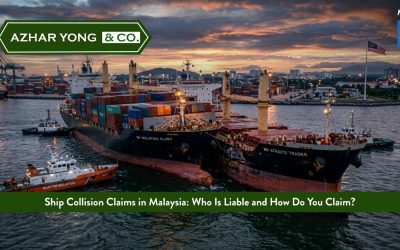
Ship Collision Claims in Malaysia: Who Is Liable and How Do You Claim?
Malaysia's position along the Strait of Malacca — one of the world's busiest and most congested shipping lanes — means that ship collisions are a real and recurring risk. When two vessels collide, the legal consequences are immediate and potentially enormous: hull...
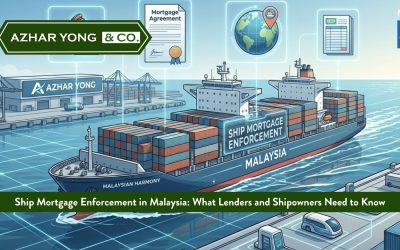
Ship Mortgage Enforcement in Malaysia: What Lenders and Shipowners Need to Know
A ship mortgage is a security interest granted by a shipowner over a vessel in favour of a lender as collateral for a loan or financing facility. It functions similarly to a property mortgage — the shipowner retains possession and continues operating the vessel....